The Anglo-Saxon or Old-English Period is the earliest and one of the most important eras in the history of English literature. Spanning approximately 450 to 1066, it began with the settlement of the Angles, Saxons, and Jutes in Britain and ended with the Norman Conquest of England in 1066.
During this period, literature was primarily oral before being written down by Christian monks. The surviving works reflect a society that valued heroism, loyalty, courage, honour, and religious faith. The most famous literary masterpiece of the age is Beowulf, widely regarded as the first great epic in English literature.
The Anglo-Saxon Period laid the linguistic and literary foundations for the English language and the rich literary traditions that followed.
What Is the Anglo-Saxon or Old English Period?
The Anglo-Saxon Period refers to the earliest stage of English literature, from approximately 450 to 1066. It is called the Old English Period because the literature was written in Old English, a Germanic language that differs significantly from Modern English.
This era ended with the Norman Conquest, which introduced French language and culture into England and marked the beginning of the Middle English Period.
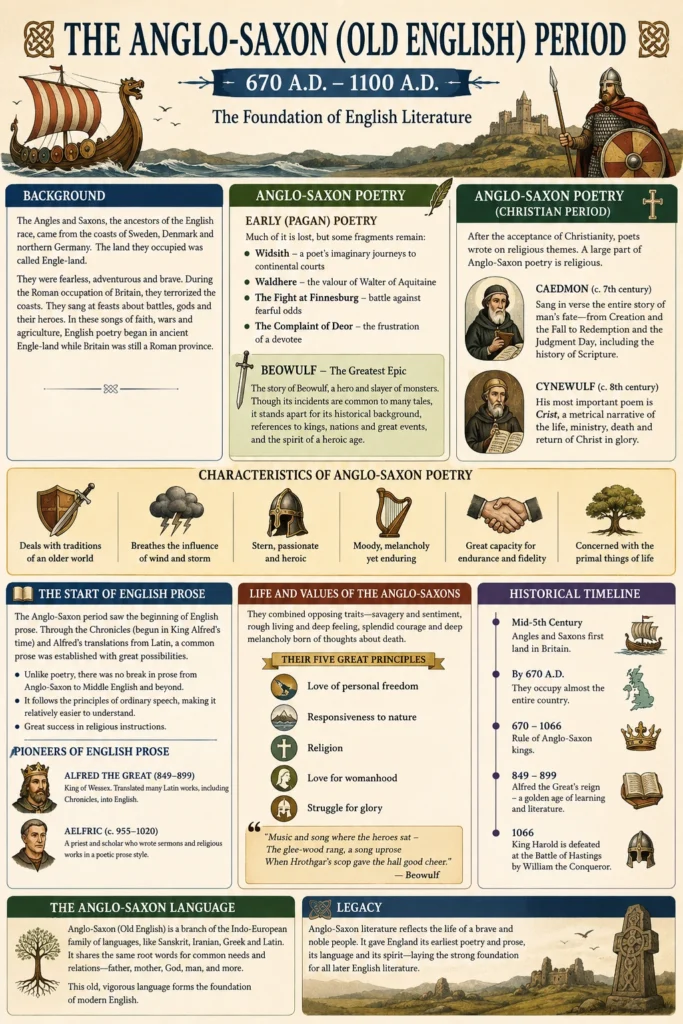
Historical Background of the Anglo-Saxon Period
Understanding the historical background helps explain the themes and style of Anglo-Saxon literature.
Arrival of the Anglo-Saxons
After the Roman army withdrew from Britain around 410 AD, several Germanic tribes migrated to the island.
These tribes included:
- Angles
- Saxons
- Jutes
They gradually established kingdoms throughout England, and their language evolved into Old English.
Pagan Society
Early Anglo-Saxon society followed Germanic pagan beliefs.
People admired qualities such as:
- Bravery
- Honour
- Loyalty
- Strength
- Generosity
These ideals became central themes in early heroic poetry.
Christianization of England
In 597 AD, St. Augustine of Canterbury arrived in England to spread Christianity.
The introduction of Christianity influenced literature by:
- Encouraging literacy
- Preserving oral traditions in written form
- Introducing biblical themes
- Promoting religious poetry and prose
Many surviving Old English manuscripts were copied by Christian monks.
Viking Invasions
Beginning in the late eighth century, Viking invasions created political instability.
These conflicts reinforced themes of:
- Heroism
- Courage
- Loyalty
- Sacrifice
They also influenced historical writings and chronicles.
The Norman Conquest (1066)
The period ended when William the Conqueror defeated King Harold II at the Battle of Hastings.
The Norman Conquest introduced:
- Norman French culture
- French vocabulary
- New political institutions
It also marked the transition to the Middle English (Anglo-Norman) Period.
Characteristics of Anglo-Saxon Literature
1. Heroism
Heroism is the defining characteristic of Old English literature.
Heroes were expected to display:
- Courage
- Loyalty
- Honour
- Physical strength
- Self-sacrifice
They often fought monsters, enemies, or overwhelming odds to protect their people.
2. Oral Tradition
Most Anglo-Saxon literature was originally passed down orally by scops (professional poets).
These storytellers performed poems accompanied by music before the works were eventually written down.
3. Alliteration
Instead of rhyme, Old English poetry relied heavily on alliteration, the repetition of initial consonant sounds.
Example:
“Bright blades broke boldly.”
This technique helped poets remember and recite long poems.
4. Pagan and Christian Elements
Many works combine Germanic heroic values with Christian beliefs.
For example:
- Heroes trust in fate while also acknowledging God’s will.
- Pagan traditions coexist with biblical morality.
This blend reflects England’s religious transition during the period.
5. Fate (Wyrd)
The Anglo-Saxons believed in Wyrd, or fate, as a powerful force governing human life.
Heroes accepted destiny with courage while striving to achieve lasting fame.
6. Elegiac Tone
Several poems express sorrow over:
- Death
- Exile
- Loss of loved ones
- The passing of kingdoms
- The uncertainty of life
These themes create a reflective and melancholic mood.
Major Literary Forms of the Anglo-Saxon Period
Epic Poetry
Epic poems celebrated heroic deeds and national identity.
The greatest example is Beowulf, which combines adventure, heroism, and moral reflection.
Elegies
Elegies are poems expressing grief, loss, and loneliness.
Well-known examples include:
- The Wanderer
- The Seafarer
- The Wife’s Lament
- The Ruin
Religious Poetry
Christian writers composed poems based on biblical stories and spiritual themes.
These works often retold scripture in a heroic style.
Chronicles
Historical records became increasingly important during the later Anglo-Saxon period.
The most famous example is the Anglo-Saxon Chronicle, which documents significant historical events over several centuries.
Major Writers of the Anglo-Saxon Period
Much of Old English literature is anonymous, but several writers are known by name.
Caedmon (c. 657–680)
Caedmon is regarded as the earliest known English poet.
Famous Work
- Caedmon’s Hymn
This short religious poem praises God’s creation and is the oldest surviving English poem attributed to a known author.
Cynewulf (c. 8th–9th century)
Cynewulf is one of the few Old English poets whose name appears within his poems.
Famous Works
- Elene
- Juliana
- Christ II
- The Fates of the Apostles
His poetry focuses on Christian faith and salvation.
The Anonymous Poet of Beowulf
Although the author of Beowulf is unknown, the poem is the greatest literary achievement of the Anglo-Saxon age.
Famous Work
- Beowulf
The epic tells the story of the hero Beowulf, who defeats the monster Grendel, Grendel’s mother, and later a dragon, illustrating the values of courage, honour, and self-sacrifice.
King Alfred the Great (849–899)
King Alfred promoted education and literacy by translating important Latin works into Old English.
His efforts preserved knowledge and encouraged the use of English in scholarship.
Major Literary Works
Some of the most significant works of the period include:
- Beowulf
- Caedmon’s Hymn
- The Wanderer
- The Seafarer
- The Wife’s Lament
- The Battle of Maldon
- The Dream of the Rood
- The Anglo-Saxon Chronicle
These works remain essential texts in the study of English literature.
Themes of Anglo-Saxon Literature
Common themes include:
- Heroism
- Loyalty
- Honour
- Fate (Wyrd)
- Good versus evil
- Death
- Exile
- Religious faith
- Mortality
- Legacy and fame
Language and Style
Old English literature is characterized by:
- Alliteration
- Strong rhythmic patterns
- Kennings (compound metaphors such as “whale-road” for the sea)
- Formulaic expressions
- Vivid imagery
- Elevated, formal language
These stylistic features made oral recitation more memorable and dramatic.
Influence of Christianity on Old English Literature
The spread of Christianity transformed Anglo-Saxon literature by:
- Preserving oral poems in manuscripts
- Introducing biblical themes
- Encouraging religious poetry
- Promoting literacy through monasteries
Many pagan stories were adapted to reflect Christian moral values.
Timeline of the Anglo-Saxon Period
| Year | Event |
|---|---|
| c. 410 | Roman withdrawal from Britain |
| c. 450 | Arrival of the Angles, Saxons, and Jutes |
| 597 | St. Augustine begins the Christian mission in England |
| c. 700 | Beowulf composed (approximate date) |
| 793 | Viking raid on Lindisfarne |
| 871 | Alfred the Great becomes King of Wessex |
| c. 890 | Compilation of the Anglo-Saxon Chronicle begins |
| 1016 | Cnut becomes King of England |
| 1066 | Norman Conquest and end of the Old English Period |
Importance of the Anglo-Saxon Period
The Anglo-Saxon Period is significant because it:
- Produced the earliest surviving English literature
- Established the foundations of the English language
- Developed the heroic tradition
- Introduced literary techniques such as alliteration and kennings
- Preserved England’s early history through chronicles
- Inspired later writers, including J.R.R. Tolkien and Seamus Heaney
Anglo-Saxon Period vs. Middle English Period
| Feature | Anglo-Saxon (Old English) Period | Middle English (Anglo-Norman) Period |
|---|---|---|
| Time | c. 450–1066 | 1066–1500 |
| Language | Old English | Middle English |
| Cultural Influence | Germanic | Norman French |
| Main Themes | Heroism, fate, religion | Chivalry, romance, social realism |
| Literary Forms | Epic poetry, elegies, religious poetry | Romances, allegories, dramas, chronicles |
| Greatest Work | Beowulf | The Canterbury Tales |
| Greatest Writer | Anonymous (Beowulf) | Geoffrey Chaucer |
Frequently Asked Questions (FAQs)
What is the Anglo-Saxon or Old English Period?
The Anglo-Saxon or Old English Period is the earliest era of English literature, lasting from approximately 450 to 1066, before the Norman Conquest.
Why is it called the Old English Period?
It is called the Old English Period because the literature was written in Old English, the earliest recorded form of the English language.
What are the main characteristics of Anglo-Saxon literature?
Its key characteristics include:
- Heroism
- Oral tradition
- Alliteration
- Pagan and Christian influences
- Fate (Wyrd)
- Elegiac themes
- Kennings and vivid imagery
What is the greatest work of the Anglo-Saxon Period?
Beowulf is considered the greatest work of the Anglo-Saxon Period and the earliest surviving epic poem in English.
Who was the first known English poet?
Caedmon is traditionally regarded as the first known English poet because Caedmon’s Hymn is the earliest surviving English poem attributed to a named author.
Conclusion
The Anglo-Saxon or Old English Period marks the beginning of English literary history. Its heroic epics, religious poetry, elegies, and chronicles reveal the values, beliefs, and struggles of early English society. Works such as Beowulf, The Wanderer, and The Dream of the Rood continue to be studied for their literary artistry and historical importance. By laying the foundations of the English language and its earliest literary traditions, the Anglo-Saxon Period prepared the way for the Middle English, Renaissance, and later literary movements.
Next is Middle-English or Anglo-Norman Period (1100-1500).
You would also like to read 5 Best Books on the History of English Literature: A Comprehensive Guide.