What Are Phrasal Verbs?
Phrasal verbs are combinations of a verb and one or two particles (a preposition or an adverb) that create a meaning different from the original verb.
For example:
- Look = use your eyes.
- Look after = take care of someone or something.
Phrasal verbs are common in everyday English and are widely used in conversations, emails, books, movies, and business communication.
Structure
A phrasal verb usually follows one of these patterns:
- Verb + Adverb
- Wake up
- Sit down
- Verb + Preposition
- Look after
- Believe in
- Verb + Adverb + Preposition
- Put up with
- Look forward to
Importantance
Learning phrasal verbs helps you:
- Speak more naturally.
- Understand native speakers.
- Improve IELTS and TOEFL scores.
- Write better English.
- Increase vocabulary.
Types
1. Intransitive Phrasal Verbs
These do not take an object.
Examples:
- The plane took off.
- Please sit down.
- I usually wake up at 6 a.m.
2. Transitive Phrasal Verbs
These require an object.
Examples:
- She turned off the lights.
- He picked up the phone.
- We called off the meeting.
3. Separable Phrasal Verbs
The object can come between the verb and the particle.
Examples:
- Turn off the TV.
- Turn the TV off.
- Pick up the book.
- Pick the book up.
With pronouns:
✅ Turn it off.
❌ Turn off it.
4. Inseparable Phrasal Verbs
The object must come after the complete phrasal verb.
Examples:
- Look after the baby.
- Believe in yourself.
- Run into an old friend.
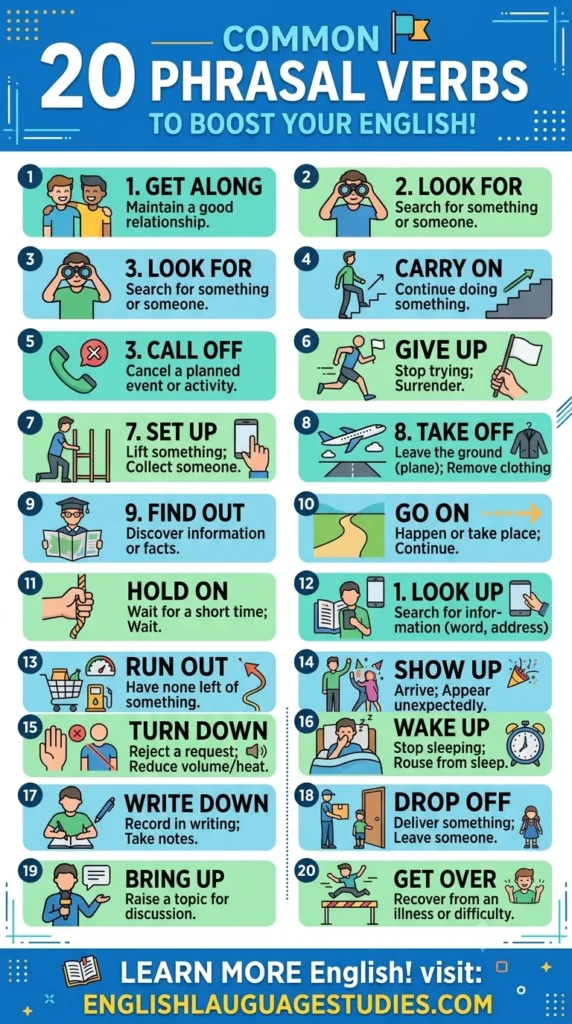
Common Phrasal Verbs with Meanings
| Phrasal Verb | Meaning | Example |
|---|---|---|
| Wake up | Stop sleeping | I wake up at six. |
| Get up | Leave bed | She got up early. |
| Turn on | Switch on | Turn on the fan. |
| Turn off | Switch off | Turn off the TV. |
| Pick up | Collect | I’ll pick you up. |
| Give up | Quit | Never give up. |
| Look after | Take care of | She looks after her grandmother. |
| Find out | Discover | We found out the truth. |
| Bring up | Mention | Don’t bring up that topic. |
| Put off | Postpone | They put off the exam. |
| Carry on | Continue | Carry on your work. |
| Come across | Find by chance | I came across an old letter. |
| Run into | Meet unexpectedly | I ran into my teacher. |
| Take off | Remove or leave the ground | The plane took off. |
| Put on | Wear | Put on your coat. |
| Take away | Remove | Take away the dishes. |
| Fill in | Complete a form | Fill in this application. |
| Check in | Register | We checked in at the hotel. |
| Check out | Leave a hotel | We checked out early. |
| Break down | Stop working | My car broke down. |
Phrasal Verbs Used in Daily Conversation
- Come in
- Go out
- Sit down
- Stand up
- Hurry up
- Slow down
- Put away
- Take out
- Hold on
- Hang up
- Turn around
- Come back
- Go away
- Bring back
- Call back
Examples
- Please come in.
- Hold on for a minute.
- She hung up the phone.
- We came back yesterday.
Business English Phrasal Verbs
- Set up
- Take over
- Carry out
- Deal with
- Follow up
- Look into
- Work out
- Back up
- Bring in
- Phase out
Examples:
- The company set up a new office.
- We will look into the complaint.
- Please follow up the email.
Phrasal Verbs for Students
- Hand in
- Go over
- Write down
- Look up
- Read over
- Figure out
- Catch up
- Keep up
- Point out
- Find out
Examples:
- Hand in your homework.
- Look up the word in the dictionary.
- I need to catch up on my studies.
Common Mistakes
Incorrect
Turn off it.
Correct
Turn it off.
Incorrect
Look the baby after.
Correct
Look after the baby.
Incorrect
He gave the game up.
Correct
He gave up the game.
Tips to Learn Phrasal Verbs
- Learn them in context.
- Read English newspapers and books.
- Watch English movies with subtitles.
- Practice using five new phrasal verbs every day.
- Create your own example sentences.
- Review them regularly.
Practice Exercise
Choose the correct phrasal verb.
- Please ______ the lights before leaving.
- a) turn on
- b) turn off
- She ______ her little sister every afternoon.
- a) looks after
- b) looks up
- Don’t ______. Keep trying.
- a) give up
- b) wake up
- The meeting was ______ until Monday.
- a) put off
- b) put on
- I ______ an old friend at the market yesterday.
- a) ran into
- b) turned on
Answers: 1-b, 2-a, 3-a, 4-a, 5-a
Frequently Asked Questions (FAQs)
What is a phrasal verb?
A phrasal verb is a verb combined with one or more particles that creates a new meaning.
Why are phrasal verbs difficult?
Their meanings are often idiomatic and cannot always be understood from the individual words.
Are phrasal verbs used in formal English?
Yes, but formal writing sometimes prefers single-word alternatives. For example, investigate instead of look into.
How can I improve my phrasal verbs?
Practice reading, listening, speaking, and writing with phrasal verbs in real-life contexts.
Conclusion
Phrasal verbs are an essential part of English communication. By learning their meanings, understanding whether they are separable or inseparable, and practicing them in everyday situations, you can sound more fluent and confident. Start with the most common phrasal verbs, use them regularly, and review them often to build lasting vocabulary.
This Phrasal Verb Game can be very helpful for practice.