Preparing for the IELTS exam can feel like standing at the foot of a massive mountain. Whether you are aiming for academic admission in the UK or immigration to Canada, the sheer volume of information can be overwhelming. However, success in the International English Language Testing System is not about luck; it is about a systematic, step-by-step approach to mastery.
This complete guide to 10 Steps to Prepare for the IELTS Test will take you from absolute beginner to test-day pro, ensuring you have the strategies and confidence to hit your target band score in 2026.
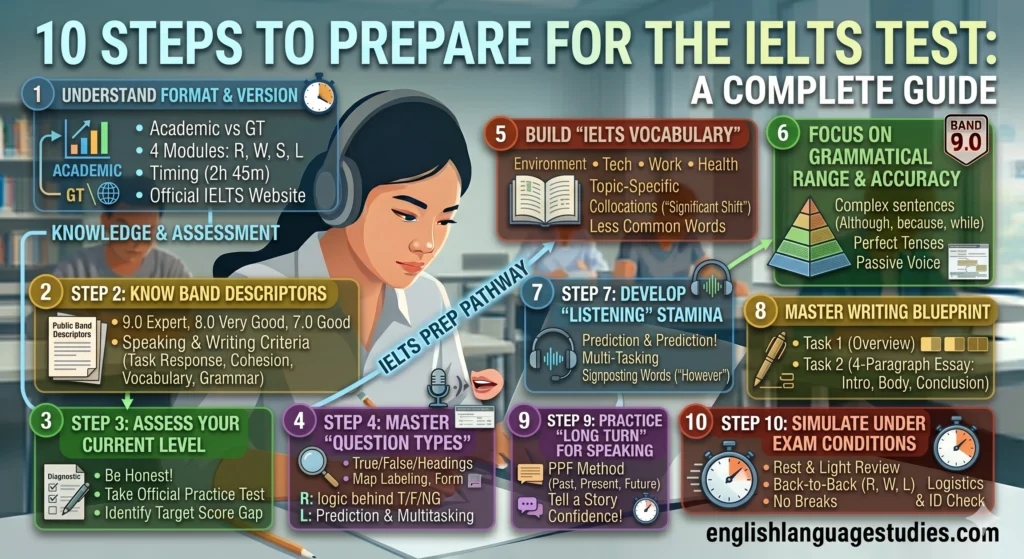
Step 1: Understand the Test Format and Version
Before you buy a single textbook, you must know which version of the test you need.
- IELTS Academic: For those applying for higher education or professional registration.
- IELTS General Training: For those migrating to Australia, Canada, or the UK, or applying for secondary education.
Both versions test all four skills—Listening, Reading, Writing, and Speaking—but the Reading and Writing tasks differ significantly. Familiarize yourself with the timing: the total test time is 2 hours and 45 minutes.
Check out: Top 10 Books for IELTS Preparation: Your Ultimate Guide
Step 2: Know the Band Descriptors
The IELTS isn’t “pass or fail.” You are graded on a scale from 1.0 to 9.0. To score high, you must understand the Public Band Descriptors. These are the checklists examiners use to grade your Speaking and Writing.
- Band 7.0: “Good User” (Occasional inaccuracies but generally handles complex language well).
- Band 8.0: “Very Good User” (Handles complex detailed argumentation well).
- Band 9.0: “Expert User” (Complete command of the language).
Study these descriptors so you know exactly what is expected for your target score.
Step 3: Assess Your Current Level
Be honest with yourself. Take a full, timed practice test from an official source (like the Cambridge IELTS series). This “diagnostic” test will show you your baseline. If you need a Band 7.5 but you are currently at a 5.5, you need to realize that strategy alone won’t save you—you also need to improve your general English proficiency.
Step 4: Master the “Question Types”
The IELTS is famous for its variety. Each module has specific question types that require different “micro-skills.”
- Reading: You will face True/False/Not Given, Matching Headings, and Sentence Completion.
- Listening: You must master Map Labeling, Multiple Choice, and Form Completion.
Don’t just practice; study the logic behind each question type. For example, in “True/False/Not Given,” the most common mistake is confusing “False” (the text says the opposite) with “Not Given” (the text doesn’t mention it).
Try out: Best IELTS Preparation Apps (Updated): Top Free & Paid Apps for High Band Scores
Step 5: Build an “IELTS Vocabulary”
You don’t need to know every word in the dictionary, but you do need Topic-Specific Vocabulary. The IELTS frequently rotates through themes like:
- The Environment and Sustainability
- Technology and AI
- Education and Work
- Health and Diet
Practice using collocations (words that naturally go together) instead of isolated words. Instead of saying “big change,” use “radical transformation” or “significant shift.”
Step 6: Focus on Grammatical Range and Accuracy
IELTS examiners love variety. To reach Band 7.0+, you cannot just use simple sentences. You must demonstrate a mastery of:
- Complex Sentences: Using subordinating conjunctions (although, because, while).
- Perfect Tenses: (e.g., Past Perfect Continuous for background context).
- Passive Voice: Especially for Academic Writing Task 1 processes.
Step 7: Develop “IELTS Listening” Stamina
Listening is about more than just hearing; it’s about prediction and multi-tasking. You must read the questions, listen to the audio, and write your answers simultaneously.
- Pro Tip: Pay attention to “Signposting Words.” When a speaker says “However” or “On the other hand,” the answer is likely about to change.
- British vs. American: Be prepared for various accents, though British English is the most common.
Step 8: Master the Writing Blueprint
Writing is where most candidates lose marks. You must follow a strict structural blueprint:
- Task 1: Provide a clear Overview (for Academic) or a clear Purpose (for General Training letters).
- Task 2: Use a 4-paragraph essay structure. Ensure your introduction has a clear thesis statement and your conclusion summarizes your position perfectly.
Step 9: Practice the “Long Turn” for Speaking
Part 2 of the Speaking test (the Cue Card) requires you to speak for 2 minutes straight. Most people stop after 40 seconds.
- The Strategy: Use the PPF Method (Past, Present, Future). Talk about how the topic was in the past, how it is now, and your thoughts for the future. This ensures you cover the full 2 minutes and use a range of tenses.
Step 10: Simulate Under Exam Conditions
In the final two weeks of your preparation, stop doing “casual” practice. Sit in a quiet room, set a timer, and do the Listening, Reading, and Writing modules back-to-back without a break. This builds the physical and mental stamina required for the actual test day.
Conclusion
Preparing for the IELTS is a marathon, not a sprint. By following these 10 Steps to Prepare for the IELTS Test, you move from a place of confusion to a place of strategy. Focus on the marking criteria, build your vocabulary, and never stop practicing. Your target band score is within reach—you just need the right building blocks.
Also see this: IELTS Reading Practice Online: Improve Your Band Score with Free & Paid Tests
FAQs
How long does it take to prepare for the IELTS?
This depends on your starting level. On average, a student with intermediate English needs 8 to 12 weeks of consistent study (10–15 hours per week) to fully understand the strategies and improve their score by 1.0 band.
Can I use American spelling in the IELTS test?
Yes. IELTS accepts both British and American spelling (e.g., color vs. colour or organize vs. organise). The most important thing is to be consistent. Don’t switch back and forth between the two in the same essay.
What is the most difficult part of the IELTS?
Statistically, the Writing module is the most difficult, as it requires the highest level of grammatical accuracy and logical organization. Many students struggle to finish Task 2 within the 40-minute time limit.
Is the computer-based IELTS easier than the paper-based one?
The content and marking are identical. The choice depends on you. If you have fast typing skills and prefer wearing headphones for the Listening section, the computer-delivered test is better. If you prefer underlining text with a pencil, go for the paper-based version.
Is it okay to make mistakes in the Speaking test?
Yes! Even native speakers make small “slips.” The examiner is looking for your ability to self-correct and keep the conversation flowing. Don’t let a small mistake stop you; just keep talking with confidence.
Is it true that the Speaking test is marked more leniently than the Writing test?
This is a common myth. Both modules are marked using strict, standardized criteria. The Speaking test might feel easier because it is conversational, whereas the Writing test requires formal academic structure. However, the examiner is still checking for the same “Four Pillars” (Fluency, Vocabulary, Grammar, Pronunciation). High scores in Speaking require just as much precision as high scores in Writing.
How should I spend the last 24 hours before the exam?
The last 24 hours should be for rest and light review, not heavy “cramming.” Your brain needs to be fresh to handle the intense focus required for the 2.5-hour exam.
Do: Review your “cheat sheets” for Task 1 and Task 2 structures. Listen to an English podcast to keep your ears tuned.
Don’t: Take a full practice test. If you get a low score, it will destroy your confidence right before the real thing. Ensure you know the exact location of your test center and have your identification (Passport/CNIC) ready.
What should I do if I finish a section early?
If you finish the Reading or Writing sections early, do not sit idle.
In Reading: Go back to the “True/False/Not Given” questions. These are the most common places where students make silly mistakes due to rushing.
In Writing: Check your Subject-Verb agreement and singular/plural nouns. These small errors are the difference between a Band 6.5 and a Band 7.0. In the Listening section, you are given 10 minutes (paper-based) or 2 minutes (computer-based) to transfer or check answers—use every second of it.
Preparation Checklist: The Final Countdown
| Timeframe | Focus Area |
| 8 Weeks Out | Diagnostic test & learning question logic. |
| 4 Weeks Out | Intensive vocabulary building & complex grammar. |
| 2 Weeks Out | Full-length timed simulations. |
| 1 Day Out | Logistics, ID check, and early sleep. |
Check out: 10 Critical Things to Ace the IELTS Test in 2026: The Definitive Guide to Band 8.0+