The Middle English or Anglo-Norman Period is one of the most transformative eras in the history of English literature. Spanning approximately 1066 to 1500, this period began with the Norman Conquest of England and witnessed profound changes in language, culture, society, and literary traditions.
During these centuries, English evolved from Old English into Middle English, enriched by thousands of French and Latin words. Literature expanded beyond religious themes to include romances, allegories, chronicles, dream visions, and realistic portrayals of medieval life. The period also produced Geoffrey Chaucer, often called the Father of English Literature, whose works helped establish English as a respected literary language.
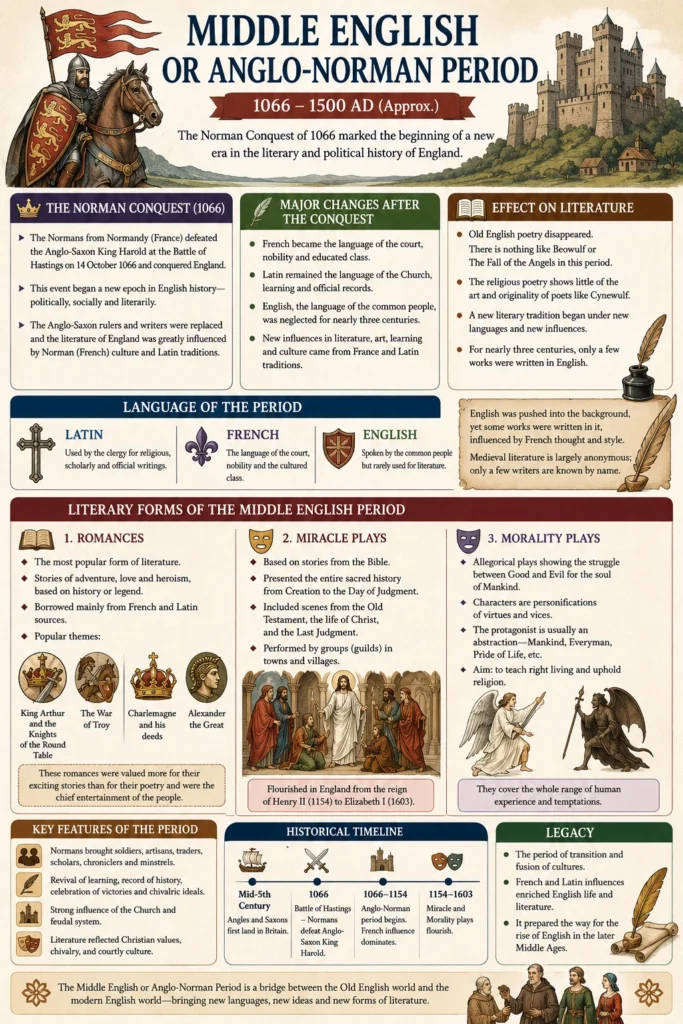
What Is the Middle English or Anglo-Norman Period?
The Middle English Period refers to the literary era from 1066 to around 1500, beginning with the Norman Conquest led by William the Conqueror and ending shortly before the English Renaissance.
The period is also called the Anglo-Norman Period because the Norman rulers introduced the French language and culture into England. For nearly three centuries, French became the language of the royal court, government, and aristocracy, while Latin remained the language of the Church and education. English gradually absorbed many French and Latin influences, eventually emerging as the dominant literary language.
Historical Background of the Middle English Period
Understanding the historical context helps explain the development of Middle English literature.
The Norman Conquest (1066)
The decisive event marking the beginning of the period was the Battle of Hastings in 1066, where William, Duke of Normandy, defeated King Harold II and became William I of England.
The conquest introduced:
- Norman French culture
- Feudalism
- New legal and administrative systems
- Strong French influence on English vocabulary
The Three Languages of England
For several centuries, three languages coexisted:
- Latin – used by the Church, scholars, and universities
- French – spoken by the nobility and government
- English – spoken by ordinary people
Over time, English absorbed thousands of French words, creating the foundation of modern English.
The Hundred Years’ War (1337–1453)
The conflict between England and France strengthened English national identity.
As a result:
- English regained prestige.
- Writers increasingly used English instead of French.
- English became the language of administration and literature.
The Black Death (1348–1350)
The plague dramatically reduced England’s population.
Its social effects included:
- Labour shortages
- Greater social mobility
- Decline of feudalism
- Increased criticism of social inequality
These changes influenced the themes of later Middle English literature.
The Rise of Universities
Institutions such as Oxford and Cambridge encouraged scholarship, translation, and literary production, helping preserve classical and religious learning while promoting intellectual growth.
Characteristics of Middle English Literature
1. Religious Influence
Religion remained central to medieval society.
Many works focused on:
- Christian teachings
- Saints’ lives
- Biblical stories
- Morality
- Salvation
Religious drama also became popular.
2. Chivalry and Romance
The ideals of knighthood greatly influenced literature.
Popular themes included:
- Heroism
- Honour
- Loyalty
- Courtly love
- Courage
- Adventure
Knightly romances became one of the most popular literary genres.
3. Courtly Love
Many poems and romances celebrated idealized love.
Typical features included:
- Noble lovers
- Devotion
- Sacrifice
- Honour
- Emotional restraint
4. Allegory
Writers often used allegory to represent moral and spiritual ideas through symbolic characters and events.
These works encouraged readers to reflect on ethical and religious questions.
5. Realistic Social Observation
By the late Middle English period, writers increasingly portrayed ordinary people and everyday life.
Literature began exploring:
- Social classes
- Corruption
- Human behaviour
- Humour
- Individual personalities
This realism reached its height in Chaucer’s works.
6. Expansion of the English Language
The Middle English period transformed English vocabulary through extensive borrowing from French and Latin.
Thousands of modern English words related to:
- Government
- Law
- Religion
- Fashion
- Literature
- Education
originated during this period.
Major Literary Forms
Romance
Medieval romances featured brave knights, magical adventures, dragons, castles, and quests.
Examples include Arthurian legends and stories of King Arthur’s knights.
Religious Drama
Religious plays educated audiences about biblical history.
Major types included:
- Mystery plays
- Miracle plays
- Morality plays
These performances were often staged during religious festivals.
Allegorical Poetry
Poets used symbolic narratives to teach moral and spiritual lessons.
Chronicles
Historical chronicles recorded important political, military, and religious events, serving as valuable historical sources.
Dream Vision Poetry
In dream vision poems, the narrator experiences symbolic dreams that reveal philosophical or moral truths.
Major Writers of the Middle English Period
Geoffrey Chaucer (c. 1343–1400)
Geoffrey Chaucer is regarded as the Father of English Literature.
He demonstrated that English could rival French and Latin as a literary language.
Famous Works
- The Canterbury Tales
- Troilus and Criseyde
- The Book of the Duchess
- The Parliament of Fowls
His vivid characters, humour, and social realism transformed English literature.
William Langland (c. 1330–1386)
Langland wrote one of the most significant allegorical poems of the Middle Ages.
Famous Work
- Piers Plowman
The poem criticizes corruption in society and emphasizes Christian virtue.
John Gower (c. 1330–1408)
Gower wrote in English, French, and Latin.
Famous Work
- Confessio Amantis
His writings explore morality, politics, and human behaviour.
Sir Thomas Malory (c. 1415–1471)
Malory compiled and adapted the Arthurian legends.
Famous Work
- Le Morte d’Arthur
His work remains one of the greatest collections of medieval legends.
Julian of Norwich (c. 1343–after 1416)
One of the earliest known women writing in English.
Famous Work
- Revelations of Divine Love
This devotional text reflects on divine love, hope, and faith.
Themes of Middle English Literature
Common themes include:
- Religion
- Chivalry
- Courtly love
- Honour
- Loyalty
- Pilgrimage
- Morality
- Social criticism
- Human nature
- Death
- Salvation
Language and Style
Middle English literature is characterized by:
- Simpler grammar than Old English
- French and Latin vocabulary
- Rhyming verse
- Symbolism
- Allegory
- Narrative storytelling
- Regional dialects
The language gradually became closer to Modern English, making later works such as The Canterbury Tales more accessible than Old English texts.
Influence of the Norman Conquest on English Literature
The Norman Conquest reshaped English literature by:
- Introducing French literary traditions
- Expanding English vocabulary
- Encouraging multilingual writing
- Influencing law, politics, and culture
- Inspiring new literary genres
Without the Norman influence, Modern English would be very different.
Timeline of the Middle English Period
| Year | Event |
|---|---|
| 1066 | Norman Conquest and Battle of Hastings |
| 1086 | Domesday Book completed |
| 1154 | Beginning of the Plantagenet dynasty |
| 1215 | Magna Carta signed |
| 1348 | Black Death reaches England |
| 1362 | English becomes the language of Parliament |
| c. 1387–1400 | Chaucer writes The Canterbury Tales |
| 1476 | William Caxton introduces the printing press to England |
| 1485 | Beginning of the Tudor dynasty |
| c. 1500 | Transition to the Renaissance period |
Importance of the Middle English Period
The Middle English Period was essential because it:
- Transformed Old English into Middle English
- Established English as a literary language
- Produced Geoffrey Chaucer’s masterpieces
- Developed new literary genres such as romances and morality plays
- Expanded English vocabulary through French and Latin influences
- Prepared the way for the English Renaissance
Middle English vs. Old English Literature
| Feature | Old English Period | Middle English Period |
|---|---|---|
| Time | c. 450–1066 | 1066–1500 |
| Main Language | Old English | Middle English |
| Cultural Influence | Anglo-Saxon | Norman French |
| Main Themes | Heroism, fate, religion | Chivalry, romance, religion, social life |
| Literary Forms | Epic poetry, elegies | Romances, allegories, dramas, chronicles |
| Greatest Writer | Anonymous (Beowulf) | Geoffrey Chaucer |
Frequently Asked Questions (FAQs)
What is the Middle English or Anglo-Norman Period?
The Middle English or Anglo-Norman Period is the literary era from 1066 to around 1500, beginning with the Norman Conquest and ending before the English Renaissance.
Why is it called the Anglo-Norman Period?
It is called the Anglo-Norman Period because the Norman rulers introduced French language and culture into England after conquering the country in 1066.
What are the main characteristics of Middle English literature?
Its key characteristics include:
- Religious influence
- Chivalric romance
- Courtly love
- Allegory
- Social realism
- French and Latin influence on English
- Narrative storytelling
Who is the Father of English Literature?
Geoffrey Chaucer is known as the Father of English Literature because he demonstrated that English could serve as a major literary language.
Why is the Norman Conquest important in English literature?
The Norman Conquest transformed the English language by introducing French vocabulary, reshaped English society, and laid the foundations for Middle English literature.
Conclusion
The Middle English or Anglo-Norman Period represents a crucial stage in the evolution of English literature. It witnessed the transformation of the English language, the rise of new literary genres, and the emergence of writers whose works remain influential today. From the chivalric romances of medieval knights to Chaucer’s vivid portraits of English society, this era bridged the gap between the heroic traditions of the Anglo-Saxons and the humanistic spirit of the Renaissance. Understanding the Middle English Period is essential for appreciating the development of English language, literature, and culture.
Next is The Renaissance Period (1500-1600).
You would also like to know The Anglo-Saxon or Old-English Period (670-1100).