ELSA Speak Review
If you are studying English, you’ve probably hit “the wall.”
You know the grammar rules. Your vocabulary is solid. But the moment you open your mouth to speak, people look confused, or they ask you to repeat yourself. It’s incredibly frustrating.
Traditional language apps like Duolingo or Babbel are great for vocabulary, but they are notoriously bad at correcting your actual accent. That is where ELSA Speak (English Language Speech Assistant) steps in. It claims to use world-class Artificial Intelligence to act as a personal, 24/7 pronunciation coach.
But does it actually work, or is it just another overhyped AI tool?
In this comprehensive ELSA Speak review, we’ll break down its core features, look at the pricing, and weigh the pros and cons so you can decide if it’s worth your hard-earned cash.
What Exactly is ELSA Speak?
ELSA Speak is a mobile application dedicated entirely to helping English language learners improve their pronunciation, fluency, and intonation. Unlike massive, all-in-one language apps, ELSA doesn’t care if you know how to conjugate past-tense verbs on paper. Its sole mission is to make sure you sound clear and confident when you speak.
The app uses proprietary Automatic Speech Recognition (ASR) technology, which was trained on thousands of hours of audio from both native and non-native English speakers. This allows the AI to catch the exact phonetic mistakes you are making.
Core Features: How It Works
When you first open ELSA, it doesn’t just throw you into generic lessons. It builds a map of your voice.
1. The Initial AI Assessment
Your journey starts with a 16-sentence reading test. You read the text aloud, and ELSA’s AI analyzes your voice against a native speaker model. Within seconds, it generates a detailed score report breaking down your:
- Pronunciation accuracy (percentage match to native speakers)
- Intonation (the rhythm and rise-and-fall of your sentences)
- Fluency (your pacing and pauses)
It even gives you a predicted IELTS speaking score equivalency, which is incredibly useful for students prepping for exams.
2. Sound-by-Sound Drills
Once the app identifies your problem areas—for example, if you struggle with the tricky “th” sound or the “schwa” sound ($\partial$)—it builds a custom curriculum. Lessons drill down into specific minimal pairs (words that sound almost identical, like ship vs. sheep) so you can master individual mouth movements.
3. Real-Time Visual Feedback
This is where ELSA shines. When you record a sentence, the app highlights your text in three colors:
- Green: Perfect, native-level pronunciation.
- Yellow: Close, but needs improvement.
- Red: Incorrect.
If you get a red mark, you can tap the word, and the app will show you exactly how to adjust your tongue and lips to correct the sound.
You would also like our 30 Days English Speaking Fluency Plan.
ELSA Speak Pricing: Free vs. Pro vs. Premium
ELSA uses a freemium model. While anyone can download it, the free version is heavily restricted.
| Plan | Features | Ideal For |
| Free Plan | Limited daily exercises, basic dictionary access, and the initial assessment test. | Casual learners testing the waters. |
| ELSA Pro (~$19.99/mo or ~$129.99/yr) | Access to 1,200+ lessons, 60+ topics, full progress tracking, and advanced sound drills. | Intermediate learners aiming to polish specific accents. |
| ELSA Premium (Slightly higher tier) | Includes everything in Pro plus ELSA AI, which allows for unscripted, open-ended conversation practice. | Advanced learners preparing for interviews or English exams. |
The Pros: Where ELSA Beats the Competition
- Incredible Accuracy: The AI is sensitive. It doesn’t just check if you said the word; it checks if you hit the consonants and vowels correctly.
- Hyper-Focused: It skips the fluff. If your only goal is to sound clearer at work or school, this app saves you time by focusing strictly on speech.
- Native Language Tailoring: When you sign up, you select your mother tongue. The app leverages this data to predict the specific accent habits you are likely struggling with.
The Cons: What the App Misses
- Lacks Suprasegmental Balance: While it’s brilliant at fixing individual sounds (segmentals), it historically spends less time teaching natural sentence flow and emotional melody (suprasegmentals).
- No Human Element: AI feedback is excellent for drilling, but it cannot fully replicate the nuances, encouragement, and organic flow of talking to a real human accent coach.
- Strictly American/British Focus: The app heavily prioritizes standard American English, though it has introduced British modules. If you want to learn regional accents, you won’t find them here.
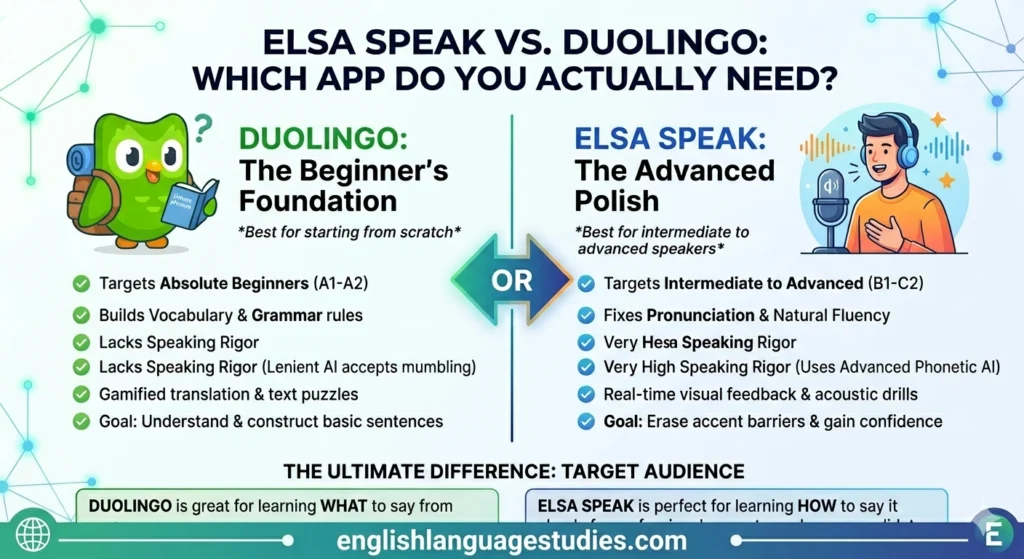
ELSA Speak vs. Duolingo: Which App Do You Actually Need?
It’s impossible to talk about language learning apps without mentioning the green owl. However, comparing ELSA Speak to Duolingo is a bit like comparing a specialized running shoe to a Swiss Army knife—both are great tools, but they serve entirely different purposes.
If you are trying to choose between the two, the decision comes down to one major factor: your current proficiency level.
ELSA Speak vs. Duolingo: Quick Comparison Matrix
| Core Feature | 🦉 Duolingo | ⚡ ELSA Speak |
| Target Audience | Absolute Beginners (A1–A2) | Intermediate to Advanced (B1–C2) |
| Primary Goal | Building vocabulary & grammar rules | Perfecting pronunciation & fluency |
| Speaking Rigor | Lenient (Accepts basic audio matches) | Strict (Deep phonetic-level analysis) |
| Core Lesson Style | Gamified translation & text puzzles | AI voice analysis & acoustic drills |
| Best Used For… | Learning what to say from scratch | Learning how to say it with confidence |
| Ideal User | Casual learners building a daily habit | Professionals, expats, & exam candidates |
Duolingo: The Beginner’s Foundation
Duolingo is built for the absolute beginner. It uses gamified lessons to introduce you to basic vocabulary, fundamental grammar rules, and sentence structures. It excels at teaching you how to read, write, and translate simple phrases.
However, Duolingo’s speaking exercises are incredibly forgiving. You can often mumble a sentence, skip words entirely, or speak with a heavy, uncorrected accent, and the app will still give you a green checkmark. It is designed to keep you motivated, not to make you sound native.
ELSA Speak: The Advanced Polish
ELSA Speak assumes you already know the basics. If you don’t know how to structure a past-tense sentence, ELSA won’t teach you. Instead, it is built for intermediate to advanced learners who can already read and understand English but struggle to speak it clearly.
ELSA doesn’t let you get away with mumbling. Its AI is ruthless (in a helpful way), pinpointing the exact syllable or phonetic sound you missed. While Duolingo builds your internal language map, ELSA trains the physical muscles in your mouth to execute that language perfectly.
The Ultimate Difference: Target Audience
- Choose Duolingo if: You are starting from scratch, want to learn basic English vocabulary, or need a fun, low-pressure way to build a daily learning habit.
- Choose ELSA Speak if: You can already understand English conversations, but native speakers struggle to understand you. It is the choice for professionals, expats, and exam candidates who need to eliminate language-barrier anxiety at work or school.
The Verdict: Is ELSA Speak Worth It?
If you are a complete beginner who needs to learn grammar and basic vocabulary, ELSA Speak is not the tool for you. You’ll find it too specialized and frustrating.
However, if you are an intermediate to advanced English learner, an expat working in an English-speaking country, or a student prepping for the IELTS/TOEFL, ELSA Pro is absolutely worth the investment. It bridges the massive gap that traditional language apps leave behind, giving you a safe, judgment-free space to speak, make mistakes, and systematically erase your accent barriers.