English is one of the most widely spoken languages in the world, but not all English is exactly the same. The two major varieties are American English and British English. While both forms come from the same language, they differ in vocabulary, spelling, pronunciation, grammar, and even punctuation.
For English learners, these differences can sometimes feel confusing. You may see one book using the word color while another writes colour. One speaker talks about an elevator, while another says lift. Both are correct — they simply belong to different varieties of English.
Understanding the differences between American vs British English is important for students, teachers, IELTS candidates, TOEFL learners, writers, bloggers, and professionals communicating internationally.
In this detailed guide, you will learn:
- Vocabulary differences
- Spelling variations
- Grammar rules
- Pronunciation changes
- Which English to learn
- Tips for avoiding mistakes
Let’s explore the fascinating world of American and British English.
What Is American English?
American English refers to the variety of English used mainly in the United States. Over time, it developed unique vocabulary, spelling conventions, pronunciation patterns, and grammar structures.
American English is widely used in:
- The United States
- International business
- Hollywood movies and TV
- Technology and software
- TOEFL examinations
- Social media and online communication
Because of the influence of American media, many learners become familiar with American English first.
What Is British English?
British English is the variety of English traditionally used in the United Kingdom. It is considered the original form from which many other English varieties developed.
British English is commonly used in:
- The United Kingdom
- IELTS examinations
- Cambridge English exams
- International schools
- Academic publishing
- Many Commonwealth countries
British English often sounds more formal to some learners because of its traditional spelling and pronunciation patterns.
Knowing these 5 English Language Teaching Trends in USA & Europe can upgrade your English teacher career!
Why Are American and British English Different?
The differences began after British settlers moved to America in the 17th century. Over hundreds of years, the language evolved differently in both regions.
Several factors influenced these changes:
- Geography and separation
- Immigration from different countries
- Cultural development
- Dictionary reforms
- Media and education systems
American English became simpler in some spellings, while British English kept many traditional forms.
For example:
- American English: color
- British English: colour
Both are correct depending on the style you choose.
American vs British English Vocabulary
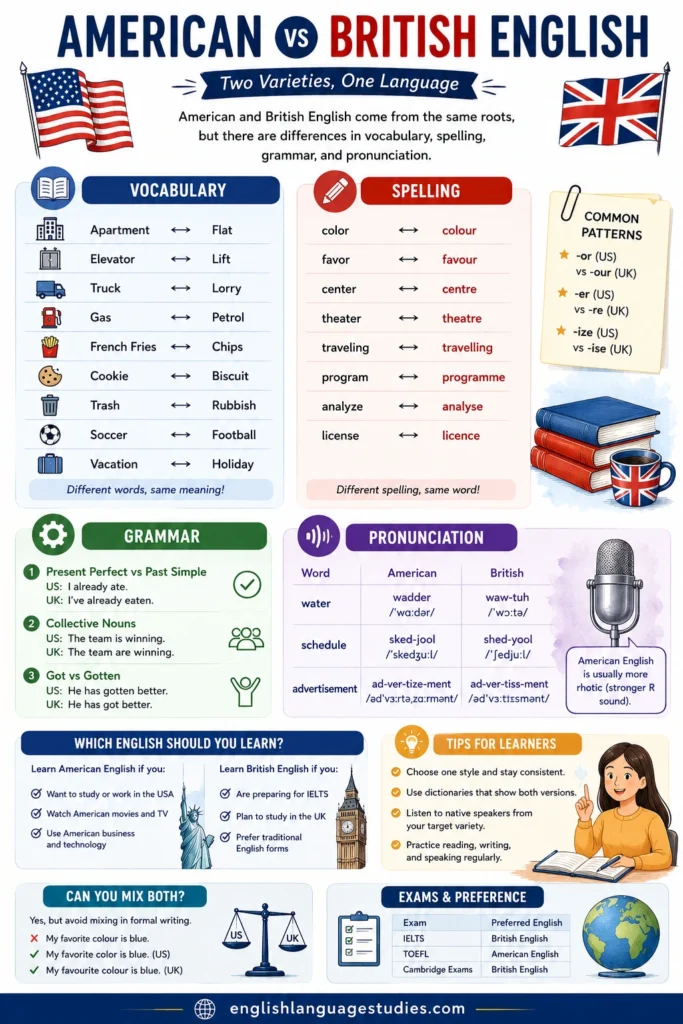
Vocabulary is one of the easiest differences to notice. Many common objects have different names in American and British English.
| American English | British English |
|---|---|
| Apartment | Flat |
| Elevator | Lift |
| Truck | Lorry |
| Gas | Petrol |
| Sidewalk | Pavement |
| Cookie | Biscuit |
| French Fries | Chips |
| Trash | Rubbish |
| Vacation | Holiday |
| Soccer | Football |
More Vocabulary Differences
| American | British |
|---|---|
| Sweater | Jumper |
| Post | |
| Candy | Sweets |
| Movie Theater | Cinema |
| Drugstore | Chemist |
| Cell Phone | Mobile Phone |
Example Sentences
- American: I parked my truck outside the apartment.
- British: I parked my lorry outside the flat.
- American: I bought cookies from the store.
- British: I bought biscuits from the shop.
Even though the words differ, native speakers usually understand both versions.
American vs British English Spelling
Spelling differences are extremely common and important for writing consistency.
| American Spelling | British Spelling |
|---|---|
| Color | Colour |
| Favor | Favour |
| Center | Centre |
| Theater | Theatre |
| Traveling | Travelling |
| Program | Programme |
| Analyze | Analyse |
| License | Licence |
Common Spelling Patterns
1. -or vs -our
American English often removes the letter “u.”
American
- color
- honor
- labor
British
- colour
- honour
- labour
2. -er vs -re
British English frequently uses “-re.”
American
- center
- meter
- theater
British
- centre
- metre
- theatre
3. -ize vs -ise
American
- organize
- realize
- recognize
British
- organise
- realise
- recognise
4. Double “L” Differences
British English often doubles the letter “l.”
American
- traveling
- canceled
British
- travelling
- cancelled
Grammar Differences Between American and British English
Grammar differences are smaller than vocabulary and spelling differences, but they still matter.
1. Present Perfect vs Past Simple
British English uses the present perfect more frequently.
American English
- I already ate.
- Did you finish yet?
British English
- I’ve already eaten.
- Have you finished yet?
Both are grammatically correct, but British English prefers the present perfect in these situations.
2. Collective Nouns
British English sometimes treats collective nouns as plural.
American
- The team is winning.
British
- The team are winning.
3. Got vs Gotten
American
- He has gotten better.
British
- He has got better.
The word “gotten” is common in American English but rare in British English.
Pronunciation Differences
Pronunciation is one of the most noticeable differences between American and British English.
Examples
| Word | American Pronunciation | British Pronunciation |
|---|---|---|
| Water | wadder | waw-tuh |
| Schedule | sked-jool | shed-yool |
| Advertisement | ad-ver-tize-ment | ad-ver-tiss-ment |
American English is generally more rhotic, meaning speakers pronounce the “r” sound strongly.
For example:
- American: car → pronounced with strong “r”
- British: car → softer ending sound
Differences in Punctuation
There are also small punctuation differences.
Quotation Marks
American English
Uses double quotation marks:
- “Hello”
British English
Often uses single quotation marks:
- ‘Hello’
Date Format Differences
The date format can also differ.
American Format
- Month / Day / Year
- 05/10/2026 = May 10, 2026
British Format
- Day / Month / Year
- 05/10/2026 = 5 October 2026
This can sometimes create confusion internationally.
Which English Should You Learn?
The best choice depends on your goals.
Learn American English If You:
- Want to study in the USA
- Watch American movies and TV
- Use American business English
- Prepare for TOEFL
Learn British English If You:
- Plan to study in the UK
- Are preparing for IELTS
- Prefer traditional spelling
- Use British educational materials
Fortunately, both forms are accepted internationally.
Can You Mix American and British English?
Yes, but consistency is important.
Avoid mixing styles in formal writing.
❌ Incorrect:
- My favorite colour is blue.
✅ American:
- My favorite color is blue.
✅ British:
- My favourite colour is blue.
Choose one style and stay consistent throughout your writing.
Tips for English Learners
1. Choose One Main Style
Select either American or British English for consistency.
2. Watch Native Content
Movies, podcasts, YouTube videos, and TV shows improve listening skills.
3. Use Dictionaries
Many online dictionaries show both American and British versions.
4. Practice Speaking
Regular speaking improves pronunciation naturally.
5. Read Books and Articles
Reading helps you become familiar with spelling and grammar patterns.
American vs British English in Exams
Different English exams may prefer different varieties.
| Exam | Preferred Variety |
|---|---|
| IELTS | British English |
| TOEFL | American English |
| Cambridge Exams | British English |
However, most international exams accept both styles if used consistently.
Which English Is More Popular Worldwide?
American English has become highly influential because of:
- Hollywood
- Social media
- Technology
- Global business
However, British English remains extremely important in:
- Education
- International testing
- Academic writing
- Commonwealth countries
Both forms are valuable and widely understood.
Final Thoughts
American and British English are two versions of the same language. Although they differ in vocabulary, spelling, grammar, and pronunciation, both are correct and internationally recognized.
The most important thing for learners is consistency. Choose the style that matches your goals and practice it regularly.
Whether you prefer American vocabulary or British spelling, mastering English will improve your communication skills, confidence, and global opportunities.
Frequently Asked Questions
Is American English easier than British English?
Many learners find American English easier because of exposure through movies and social media.
Which English is better for IELTS?
British English is more common in IELTS, but American English is also accepted.
Can I use both American and British English?
Yes, but avoid mixing them in formal writing.
Which spelling should I use?
Use the spelling style that matches your audience or exam requirements.
Is British English more formal?
Some learners think so because of traditional spelling and pronunciation, but both are equally correct.
If you are teacher, you would also like to know How to Use Flashcards to Teach English Vocabulary Effectively
Conclusion
Learning the differences between American vs British English helps you become a more confident English user. From vocabulary and spelling to grammar and pronunciation, understanding these differences improves reading, writing, listening, and speaking skills.
Whether you choose American English or British English, the key to success is regular practice, consistency, and exposure to authentic English content.
Keep learning, keep practicing, and enjoy your English journey!
Continue Improving Your English Pronunciation
Mastering the English IPA chart is only one part of developing clear and confident pronunciation. To deepen your understanding, explore our related guides on phonetics and phonology, English vowel sounds, English consonant sounds, minimal pairs, word stress, sentence stress, connected speech, intonation, schwa sound (/ə/), silent letters, and common pronunciation mistakes. These resources explain how English sounds work together and provide practical examples, exercises, and teaching tips to help students, teachers, and English learners improve their speaking, listening, and pronunciation skills.