Beyond the Red Pen: 5 English Language Teaching Trends Dominating 2026
For a long time, English Language Teaching (ELT) followed a predictable, deficit-based model: a student arrives with limited English skills, and the educator’s job is to fill those gaps with grammar drills, vocabulary lists, and a heavy dose of red ink.
But something fundamental is shifting in classrooms and lecture halls across the United States and Europe.
Driven by rapid AI integration, stricter immigration and visa landscapes, and an explosive demand for corporate upskilling, the focus of language acquisition has fundamentally changed. Today, English is no longer treated just as a subject to pass—it is treated as a strategic vehicle for global collaboration.
Whether you are designing university curricula, running a digital educational platform, or teaching private clients across international borders, these five trends are redefining the discipline.
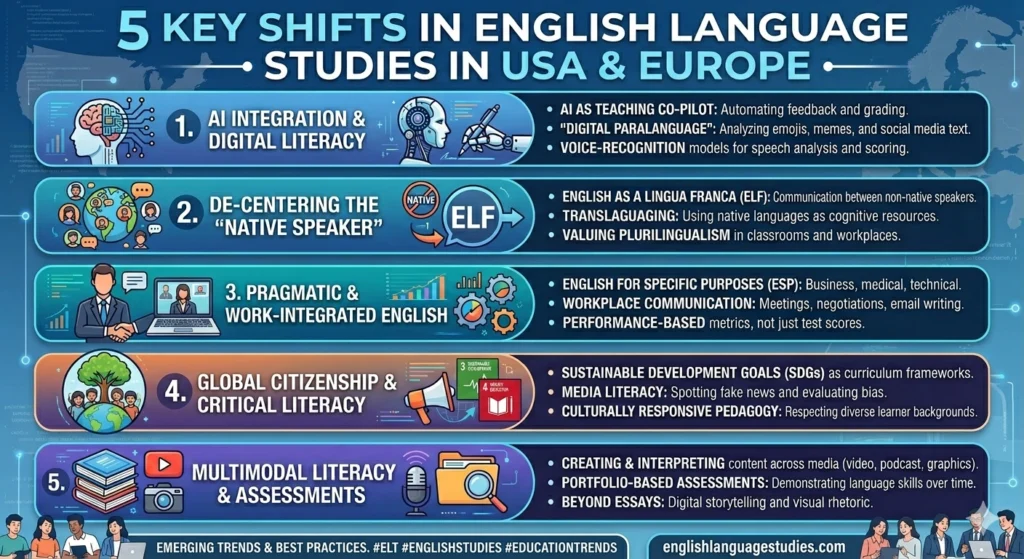
1. AI as a “Co-Pilot,” Not a Classroom Replacement
When generative AI models first went mainstream, the initial panic in language departments was palpable. Educators worried about widespread cheating, while investors questioned if human language teachers would become obsolete.
The verdict is officially in: AI cannot replace human connection.
Instead, a striking data-to-human workflow has emerged. Teachers and institutions are deploying AI to handle routine, time-consuming tasks like generating personalized reading templates, drafting initial writing feedback, and analyzing grammar patterns.
By automating these basic correction loops, educators are freeing up classroom time to focus on higher-order, irreplaceable human skills:
- Navigating delicate conversational nuances
- Cross-cultural empathy and storytelling
- Real-time negotiation and collaborative problem-solving
[ AI Analytics & Automated Draft Feedback ] ➔ Saves Educator Time ➔ [ More Live Classroom Focus on Human Soft Skills ]
2. The Move Toward Translaguaging (Multilingualism as an Asset)
The strict “English-only” classroom rule is rapidly losing ground in both American intensive language programs and European language centers. In its place is translaguaging—the practice of allowing students to utilize their entire native linguistic toolkit to help them master a target language.
Instead of penalizing a student for code-switching or referencing their primary language, strategic flexibility is encouraged. For example, a group of European professionals might brainstorm a complex project in their native language to ensure conceptual accuracy, scaffold their notes bilingually, and then deliver their final presentation entirely in professional English.
By treating a student’s native language as a cognitive resource rather than an obstacle, research shows a massive boost in learner confidence, identity retention, and overall fluency retention.
3. Work-Integrated Learning and “Pragmatic” English
Generic English courses are facing a steep decline in enrollment. In the workforce-first economy, learners in both the US and the EU are demanding English for Specific Purposes (ESP) that directly integrates into their daily hybrid workflows.
The modern learner doesn’t want to memorize abstract idioms; they want to know how to manage a remote meeting, handle international client objections, write concise email pitches, or coordinate across distributed, multicultural teams.
Educational providers are pivoting toward modular training, micro-credentials, and performance-driven metrics. Success is no longer measured solely by a static test score, but by actionable milestones—such as a professional’s ability to run a cross-border corporate meeting without a translator.
4. Multimodal Literacy and Portfolio-Based Assessment
The traditional essay isn’t dead, but it no longer holds a monopoly on language assessment. In a media-rich digital ecosystem, students must be able to interpret and create meaning across text, video, audio, and interactive media simultaneously.
Modern English programs are replacing high-stakes, discrete-item testing with holistic, portfolio-based assessments. A typical module might require a student to listen to an English podcast, adapt the core argument into a visual infographic, script a brief audio reflection, and document their linguistic choices.
This multi-layered approach ensures that writing mechanics are evaluated alongside actual communicative impact and visual rhetoric.
5. Trauma-Informed Pedagogy & Social-Emotional Learning (SEL)
The demographics of the global English classroom are shifting rapidly. Due to evolving geopolitical realities, classrooms in Western Europe and major US urban hubs have seen a significant influx of displaced and refugee student populations.
Consequently, language instruction is becoming deeply intertwined with social-emotional learning and trauma-awareness. Language learning requires immense vulnerability; a student must be willing to make mistakes and look imperfect in front of peers.
Top-tier institutions are investing heavily in training educators to build psychologically safe spaces, focusing on Foreign Language Enjoyment (FLE) to mitigate anxiety and foster long-term student persistence.
From Theory to Classroom: How to Adapt Your Curriculum for the New Era
Recognizing these macro shifts in English Language Studies is only the first step. The real challenge lies in execution. Whether you are managing an online educational repository, designing an intensive university program in the US, or training corporate clients across Europe, updating traditional lesson structures is essential to staying relevant.
Here is a practical framework for transitioning away from outdated, grammar-heavy models toward a modern, high-impact English curriculum.
1. Audit and Redefine Your Assessment Rubrics
If your grading criteria still allocate 40% of the total score to mechanical accuracy (such as perfect spelling or flawless preposition usage), it is time for an update. Modern rubrics should distribute weight across a more balanced ecosystem of skills:
- Communicative Competence (35%): Did the learner successfully deliver the intended message, resolve the hypothetical conflict, or pitch the concept clearly?
- Strategic Adaptability & Pragmatics (25%): Did the student select the appropriate tone for the medium (e.g., distinguishing between a Slack message, a formal proposal, or a live presentation)?
- Critical Synthesis (20%): How effectively did the learner evaluate external sources, recognize bias, or utilize diverse data points to construct their argument?
- Linguistic Mechanics & Precision (20%): Standard grammar and syntax rules remain important, but they serve as a supportive framework for communication rather than the sole benchmark of success.
2. Implement the “AI-Scaffolded” Lesson Structure
Instead of banning AI tools or ignoring them, build them directly into the learning sequence to foster critical digital literacy. A highly effective, modern three-step lesson workflow looks like this:
[ Step 1: Ideation & AI Draft ] ➔ [ Step 2: Critical Human Edit ] ➔ [ Step 3: Interactive Peer Debate ]
- The AI Draft: Students prompt a generative AI tool to write a basic 300-word response or email pitch regarding a complex global issue, like a UN Sustainable Development Goal.
- The Human Critique: Students critically analyze the AI-generated output. They identify generic phrasing, correct structural weaknesses, adapt the tone for a specific target audience, and add personal anecdotes to inject authenticity.
- The Live Defense: Students bring their refined, human-edited copies to class to debate their points live with peers, ensuring that the final, high-stakes assessment relies entirely on real-time, unscripted human interaction.
3. Embrace Modular, Micro-Learning Formats
Long-form, multi-month generic English courses are increasingly difficult to sell to busy modern learners. The current educational market in both the USA and Europe favors modular design. Break down your comprehensive courses into hyper-focused, micro-credentialed tracks.
Instead of offering a generic “Advanced Business English” course, consider publishing distinct, targeted modules such as: “Mastering the Agile Standup Meeting,” “Writing High-Conversion Email Pitches for US Clients,” or “Navigating Cross-Cultural European Negotiations.”
These bite-sized, objective-driven packages provide immediate, actionable value that professionals can apply to their careers the very same day.
The Takeaway for Content Publishers & Educators: The most successful digital learning platforms and educational websites are no longer competing with AI on basic grammar delivery. They are winning by publishing highly contextualized, real-world case studies, project-based worksheets, and frameworks that teach students how to negotiate, create, and connect using English as a global tool.
If you are confused about American and British English differences, this post can be very helpful for you: American vs British English: Key Differences in Vocabulary, Spelling, Grammar & Pronunciation