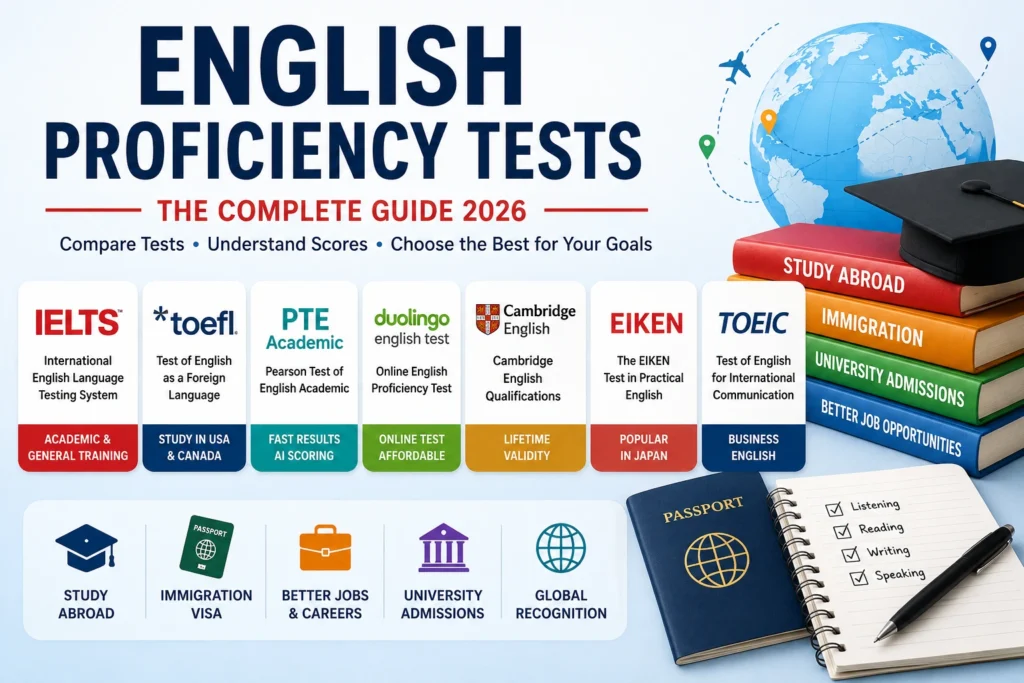
If you’re studying, working, or immigrating in Japan, at some point you’ll likely need to prove your English ability with an official score. Japanese universities use English scores for admissions and credit transfer. Employers — especially trading companies, manufacturers, and multinationals — use them for hiring and promotion. Immigration authorities and overseas universities use them for visas and study-abroad applications. Even some professional licensing bodies ask for a minimum score.
The trouble is that “English tests in Japan” isn’t just one exam. It’s a whole ecosystem: TOEIC dominates the corporate world, EIKEN dominates junior and senior high schools, and IELTS, TOEFL, PTE, and Cambridge English serve people heading overseas. Each test measures something slightly different, and picking the wrong one can waste months of preparation.
This guide walks through every major English test available in Japan, what each one is actually for, how registration and fees work, and how to decide which exam fits your goal — whether that’s a university seat, a job offer, a visa, or a scholarship.
What Are English Tests in Japan?
English proficiency tests are standardized exams that measure a candidate’s ability to read, listen, speak, and (usually) write in English, scored against a consistent international benchmark. In Japan, these tests serve several distinct communities:
- Japanese students preparing for university entrance exams, credit requirements, or study-abroad programs
- University applicants — both domestic and international — who need a benchmark score for admission
- Working professionals whose employers require a TOEIC score for hiring, promotion, or overseas assignment
- Immigration and visa applicants, including those applying for work visas or permanent residency in English-speaking countries
- Teachers and licensed professionals, such as English instructors, nurses, and engineers seeking overseas certification
Because the purposes differ so much, different institutions accept different tests. A trading company might ask only for TOEIC. A UK university might insist on IELTS or Cambridge. A US graduate program might require TOEFL iBT. A Japanese high school might use EIKEN as its internal benchmark. Understanding which organizations recognize which test is the first step to avoiding wasted study time and test fees.
Major English Tests Available in Japan
Here’s a side-by-side comparison of the seven tests most commonly taken in Japan. Fees and formats change periodically, so always confirm current details on the official test websites before registering.
| Test | Purpose | Skills Tested | Difficulty | Score Range | Validity | Accepted By | Typical Test Fee (Japan) | Best For |
|---|---|---|---|---|---|---|---|---|
| TOEIC L&R | Workplace English | Listening, Reading | Moderate | 10–990 | Officially no expiry (2 years commonly requested) | Japanese employers, some universities | ¥7,810 (Secure Program) | Job hunting, promotion in Japan |
| TOEIC S&W | Workplace speaking/writing | Speaking, Writing | Moderate | 0–200 each | 2 years (commonly requested) | Some employers, global roles | Separate fee from L&R | Roles requiring spoken/written English |
| TOEFL iBT | Academic English | Reading, Listening, Speaking, Writing | High | 0–120 | 2 years | US/global universities | Approx. USD 200+ | Studying in the US, grad school |
| IELTS Academic | Academic English | Reading, Listening, Speaking, Writing | High | 0–9 (band) | 2 years | UK/Australia/Canada universities | Approx. ¥25,000–27,500 | University study abroad |
| IELTS General Training | General/immigration English | Reading, Listening, Speaking, Writing | Moderate–High | 0–9 (band) | 2 years | Immigration authorities, some employers | Approx. ¥25,000–27,500 | Visas, migration, work abroad |
| PTE Academic | Academic English, AI-scored | Reading, Listening, Speaking, Writing | High | 10–90 | 2 years | Many universities, Australian/UK/NZ visas | Approx. USD 200–225 | Fast results, tech-savvy test-takers |
| Cambridge English (B2 First, C1 Advanced, C2 Proficiency) | Academic/general, lifelong certificate | Reading, Listening, Speaking, Writing, Use of English | Moderate–Very High | CEFR-aligned | No expiry | UK universities, employers globally | Varies by level and center | Permanent proof of a CEFR level |
| EIKEN | School and general English | Varies by grade | Varies (5 to 1) | Grade + CSE Score | No expiry | Japanese schools, universities, MEXT | Varies by grade (see EIKEN section) | Japanese students, school-based certification |
TOEIC in Japan
Summary: TOEIC (Test of English for International Communication) is the most widely taken English test among working adults in Japan. It has two separate components — Listening & Reading, and Speaking & Writing — and is used heavily by Japanese employers for hiring, promotion, and assessing readiness for overseas assignments.
TOEIC is administered in Japan by IIBC (Institute for International Business Communication), the official licensee of ETS’s TOEIC program in the country.
Listening & Reading vs. Speaking & Writing
The TOEIC L&R test is a 2-hour, 200-question, computer-scored (mark-sheet) exam covering listening comprehension and reading comprehension, scored from 10 to 990. The TOEIC S&W test is a separate exam assessing spoken and written English, scored 0–200 on each section, and is taken far less often than L&R in Japan.
Registration Process
Candidates register through IIBC’s official site (iibc-global.org) during set application windows for each monthly test date. Applicants choose a test date and region; specific test center assignments are given closer to the exam, and candidates generally cannot choose their exact venue.
Fees
Based on IIBC’s published fee structure, the Secure Program (public) TOEIC L&R test costs ¥7,810 (tax included) per sitting. Many universities and companies also offer the Institutional Program (IP), a cheaper in-house version of the same test — commonly in the ¥4,000–5,000 range — that is valid for internal purposes like graduation requirements, though not all institutions treat it as equivalent to an official Secure Program score. Always check with the requesting institution whether they require the Secure Program version specifically.
Test Frequency
The TOEIC L&R Secure Program is offered roughly once a month at various locations around Japan, while TOEIC S&W is offered less frequently (also roughly monthly, usually on a Sunday).
Employers and Universities Using TOEIC
Major Japanese employers — including many trading companies, manufacturers, and financial institutions — commonly ask for TOEIC scores as part of hiring or promotion criteria, with typical internal benchmarks varying by company and role. Some Japanese universities also accept TOEIC scores for credit recognition or as part of admissions criteria, though this is less standardized than TOEIC’s use in the corporate world. Always verify a specific employer’s or university’s required score directly, since requirements vary widely.
TOEFL in Japan
Summary: TOEFL iBT (Test of English as a Foreign Language, internet-based test) is an academic English test administered by ETS, primarily used for admission to universities in the United States and other English-medium institutions worldwide. It tests all four skills in an academic context and is taken on a computer at authorized test centers.
Test Format
TOEFL iBT measures Reading, Listening, Speaking, and Writing in an academic setting — for example, listening to a simulated lecture or reading an academic passage and responding to related questions. It is scored on a scale of 0–120. ETS has periodically updated the test’s length and structure, so candidates should confirm the current format on the official ETS website before preparing.
Registration
Registration is done directly through the ETS TOEFL website, where candidates create an account, select a test center or the at-home TOEFL iBT Home Edition (where available), and choose from testing dates offered throughout the year.
Fees
TOEFL iBT fees vary by country; figures reported for the region are in the range of roughly USD 200 or more, but candidates in Japan should confirm the exact current fee on the official ETS registration portal, since ETS sets pricing per market and fees are subject to change.
Score Validity
TOEFL iBT scores are valid for two years from the test date.
Universities Requiring TOEFL
TOEFL iBT is accepted by thousands of universities and colleges worldwide, particularly in the United States, and is also recognized by many institutions in Canada and elsewhere. If you’re applying to a specific university, check that institution’s admissions page directly, since minimum score requirements differ by program and degree level.
Best Preparation Methods
- Practice with official ETS TOEFL sample questions and practice tests
- Focus on academic vocabulary and note-taking, since much of TOEFL centers on lecture-style listening
- Practice integrated tasks (reading + listening + speaking/writing together), which are unique to TOEFL’s format
- Time yourself strictly, since pacing is one of the biggest challenges for first-time TOEFL takers
IELTS in Japan
Summary: IELTS (International English Language Testing System) is jointly owned by the British Council, IDP Education, and Cambridge University Press & Assessment, and is one of the most widely accepted English tests globally for university admission, immigration, and work purposes. In Japan it’s available through both the British Council and the Eiken Foundation of Japan, in both computer-delivered and paper-based formats.
Academic vs. General Training
IELTS Academic is intended for candidates applying to universities or professional bodies that require academic-level English. IELTS General Training is intended for candidates migrating to English-speaking countries, or applying for secondary education or work experience programs. Both versions share the same Listening and Speaking sections but differ in Reading and Writing content.
Registration and Test Centres
In Japan, IELTS can be booked through the British Council or through IDP Education’s Japan partner sites, with computer-delivered testing available at centres including the Eiken Foundation of Japan locations in Tokyo, Yokohama, Osaka, and Fukuoka, plus Berkeley House centres in Tokyo and Nagoya. Paper-based testing is also offered through the Japan Study Abroad Foundation and other partner centres.
Computer vs. Paper Test
IELTS on Computer offers faster results (typically within a few days) and is available at more frequent intervals, while the paper-based test is held on set monthly dates. Both versions test the same content and use the same band-scoring system, so the choice mainly comes down to convenience and personal preference for typing versus handwriting.
Fees
Based on official pricing pages, IELTS test fees in Japan are approximately ¥25,000–27,500 depending on the test centre and delivery format (computer vs. paper). Always confirm current pricing directly with the test centre you plan to book with, since fees can differ slightly between British Council, IDP, and Eiken Foundation venues.
Band Scores
IELTS uses a 9-band scoring system, from Band 1 (non-user) to Band 9 (expert user), with most universities and immigration programs requiring an overall band of 6.0–7.5 depending on the institution and course.
Who Should Take IELTS
IELTS is a strong choice if you’re applying to universities in the UK, Australia, Canada, New Zealand, or Ireland, or if you need a score for immigration or visa purposes in those countries. It’s also widely recognized by employers and professional registration bodies internationally.
PTE Academic in Japan
Summary: PTE Academic (Pearson Test of English Academic) is a fully computer-based, AI-scored English test accepted by thousands of universities worldwide and by immigration authorities in Australia, New Zealand, and the UK. Its main draws are fast turnaround and fully automated scoring, which removes examiner variability.
Availability
PTE Academic is delivered at Pearson-authorized test centres in Japan, including locations in Tokyo and Osaka, with bookings made through a Pearson VUE account.
AI Scoring and Fast Results
Unlike IELTS, TOEFL, and Cambridge exams — which involve human examiners for speaking and writing — PTE Academic is scored entirely by automated systems, and Pearson typically reports results within about 48 hours of the test.
Universities Accepting PTE
PTE Academic is accepted by a large number of universities and colleges globally, including many in Australia, the UK, New Zealand, and the United States, and is recognized for several skilled migration visa categories in Australia. As with any test, confirm PTE’s acceptance directly with your target institution or visa authority before booking.
Registration
Candidates register online through pearsonpte.com, selecting a test date, centre, and paying the fee via credit card. According to reporting on regional pricing, PTE Academic in Japan runs in the range of roughly USD 200–225, though candidates should verify the exact current fee on Pearson’s official pricing page since it can change and may be shown in local currency.
Cambridge English Qualifications
Summary: Cambridge English Qualifications, offered by Cambridge University Press & Assessment, are exams tied to specific CEFR levels rather than a single sliding scale. Unlike TOEFL, IELTS, or TOEIC, a Cambridge qualification doesn’t expire — once you pass, that certificate is valid for life as proof of that CEFR level.
B2 First
B2 First (formerly known as FCE) certifies upper-intermediate English, corresponding to CEFR level B2. It’s commonly used to show readiness for study, work, or living in an English-speaking environment at an independent user level.
C1 Advanced
C1 Advanced (formerly CAE) certifies advanced English at CEFR level C1, and is accepted by many universities — particularly in the UK — as evidence of English proficiency for admission.
C2 Proficiency
C2 Proficiency (formerly CPE) is the highest-level Cambridge qualification, certifying near-native mastery at CEFR level C2. It’s less commonly required but can be valuable for high-level academic or professional roles.
Who Should Take Cambridge Exams
Cambridge qualifications suit candidates who want a permanent, non-expiring certificate rather than a score that needs renewing every two years, and who are targeting UK universities or employers that recognize CEFR-based qualifications specifically. In Japan, Cambridge exams are available through authorized exam centres — check the Cambridge English official site for current test locations and dates.
EIKEN
Summary: EIKEN (STEP Eiken, or the “Test in Practical English Proficiency”) is Japan’s own English proficiency test, administered by the Eiken Foundation of Japan. It’s the most widely taken English test in the country by sheer volume, largely because it’s deeply embedded in the junior high and high school curriculum, and it uses a graded system rather than a single numeric scale.
What EIKEN Is
EIKEN measures English ability across seven distinct grades, each pass/fail, rather than producing a single continuous score. Overall performance across grades can also be compared using the EIKEN CSE Score, a common scale introduced to make results comparable across grade levels and to CEFR.
EIKEN Grades
- Grade 5 and 4 — beginner levels, aimed at students starting out in English
- Grade 3 — junior high school graduate level
- Grade Pre-2 — aimed at second-year high school students, useful for post-secondary applications and academic credit
- Grade 2 — high school graduate level, required or recommended for many Japanese university applications
- Grade Pre-1 — university/professional level, recognized by Japan’s Ministry of Education as a benchmark for English instructors
- Grade 1 — near-native level, the highest EIKEN grade, relevant for English teachers, translators, and highly English-dependent professional roles
Most grades from Pre-2 upward are split into two stages: Stage 1 (reading, listening, and writing) and Stage 2 (a face-to-face speaking interview), with candidates needing to pass Stage 1 before advancing to Stage 2.
Popularity in Japanese Schools
EIKEN test dates run several times a year, and the exam is offered both at large public test sites and at roughly 18,000 approved school-based “group” sites across Japan, making it by far the most accessible English test for students still in the Japanese school system.
Universities Accepting EIKEN
Many Japanese universities use EIKEN grades — commonly Grade 2 or higher — as part of admissions or credit-recognition criteria, and it’s also referenced by MEXT (Japan’s Ministry of Education) in relation to teacher benchmarks. Some universities and colleges outside Japan, including in the US, Canada, and Australia, also recognize EIKEN scores at certain grade levels, though this is far less universal than TOEFL or IELTS recognition, so confirm with any overseas institution directly.
Benefits
EIKEN certificates don’t expire, it’s available at accessible price points compared to international tests, and it’s tightly aligned with the Japanese school English curriculum — making it a natural stepping stone before students move on to TOEFL, IELTS, or TOEIC later in life.
Which English Test Should You Choose?
There’s no single “best” English test — the right one depends entirely on your goal.
- Japanese students still in school: EIKEN, since it aligns with the school curriculum and is recognized for university admissions and credit within Japan
- International students applying abroad: IELTS Academic or TOEFL iBT, depending on the destination country — IELTS is generally favored in the UK, Australia, and Canada, while TOEFL is more common for US applications
- Working professionals in Japanese companies: TOEIC L&R, since it’s the standard benchmark used by most Japanese employers for hiring and promotion
- Engineers and technical professionals seeking overseas roles: TOEFL iBT or IELTS Academic, depending on the destination and whether the employer or licensing body specifies one
- Nurses and healthcare professionals: Check the specific licensing body’s requirements first — some overseas nursing councils specify IELTS or PTE Academic specifically, so confirm before choosing
- English teachers: EIKEN Grade Pre-1 or higher (recognized by MEXT), or a Cambridge qualification such as C1 Advanced, depending on the employer
- Immigration applicants: IELTS General Training or PTE Academic, since both are recognized by immigration authorities in countries like Australia, the UK, and New Zealand — but always confirm accepted tests with the specific immigration authority
- Study abroad or exchange applicants: Whatever test your target university specifies — this varies widely, so check the admissions page directly
- Scholarship applicants: Many scholarships (such as MEXT scholarships) specify accepted tests and minimum scores in their own guidelines, so always check the scholarship’s official requirements rather than assuming
Registration Process
While each test has its own platform, the general registration steps are similar across TOEIC, TOEFL, IELTS, PTE, Cambridge, and EIKEN:
- Create an account on the test’s official registration platform (IIBC for TOEIC, ETS for TOEFL, British Council or IDP for IELTS, Pearson VUE for PTE, Cambridge English for Cambridge qualifications, or the Eiken Foundation for EIKEN).
- Choose your test date and location. Availability varies by test and city, and popular dates can fill up weeks in advance.
- Confirm your identification documents. Most tests require a valid passport or, for some Japan-administered tests, an accepted form of Japanese ID — check the specific test’s requirements before test day.
- Pay the test fee online, typically by credit card.
- Prepare using official materials where possible, since third-party practice materials can vary in quality and accuracy.
- Receive your admission ticket or confirmation, and double-check the test center location and required documents in advance.
- Take the test and await your results, which are released on a timeline that varies by test (from about 48 hours for PTE to several weeks for some paper-based IELTS or TOEIC options).
Because dates, fees, formats, and required documents can and do change, always verify the latest information directly through the official website of the test you’re planning to take before registering.
Preparation Tips
Regardless of which test you choose, a few preparation habits apply across the board:
Reading
- Practice reading academic and general-interest English daily — newspapers, journal articles, and official practice materials all help build reading speed and stamina.
- Learn to skim for gist and scan for specific details, since most tests include both types of questions.
Listening
- Expose yourself to a range of English accents (British, American, Australian), since tests like IELTS and TOEFL don’t limit themselves to one accent.
- Practice note-taking while listening, especially for TOEFL’s lecture-based sections.
Speaking
- Record yourself answering practice questions and listen back for clarity, pacing, and pronunciation.
- Practice speaking under time pressure, since most tests give you a strict, short window to respond.
Writing
- Learn the specific task types for your chosen test (e.g., IELTS Task 1 data description vs. Task 2 essay, or EIKEN’s email and summary writing tasks).
- Practice organizing ideas quickly, since most writing tasks are timed and reward clear structure over elaborate vocabulary.
Vocabulary and Grammar
- Build vocabulary in context rather than through isolated word lists — this helps more with reading and listening comprehension.
- Review core grammar structures regularly, since small grammar errors add up across writing and speaking sections.
Mock Tests and Time Management
- Take full-length mock tests under realistic timed conditions before test day, so the actual exam format feels familiar.
- Practice pacing yourself section by section, since running out of time is one of the most common reasons candidates underperform relative to their actual ability.
Common Mistakes
- Choosing the wrong test for the goal. Preparing for TOEIC when a university requires IELTS (or vice versa) wastes valuable study time.
- Not checking score validity. Many tests expire after two years; submitting an outdated score can derail an application.
- Underestimating the speaking section. Many candidates who read and write well in English still struggle with timed, spoken responses simply because they haven’t practiced that format.
- Relying only on unofficial practice materials. Official practice tests from ETS, IELTS, Pearson, Cambridge, or the Eiken Foundation most closely match the real exam’s style and difficulty.
- Registering too late. Popular test dates and centers, especially in Tokyo and Osaka, can fill up quickly.
- Not confirming acceptance in advance. Always verify that your target university, employer, or immigration authority actually accepts the specific test and score you’re planning to submit — before you register and pay.
Frequently Asked Questions
Which English test is most popular in Japan? EIKEN is the most widely taken English test in Japan overall, largely due to its integration into the school system, while TOEIC is the most common test among working professionals.
Is TOEIC better than IELTS? Neither is objectively “better” — they measure different things. TOEIC focuses on workplace English and is mainly used within Japan by employers, while IELTS is an academic and immigration-focused test recognized internationally. The right choice depends on your goal.
Is TOEFL accepted in Japan? Yes, TOEFL iBT scores are accepted by many Japanese universities, particularly for international programs, and TOEFL is widely used by Japanese students applying to universities in the US and elsewhere.
Can foreigners take TOEIC in Japan? Yes, TOEIC is open to any registered candidate in Japan regardless of nationality, though registration and instructions are primarily in Japanese and English.
Which English test is easiest? Difficulty is subjective and depends on your strengths. EIKEN’s lower grades (5, 4, 3) are designed for beginners and are generally considered accessible, while TOEFL and IELTS Academic tend to be more demanding due to their academic focus.
Which exam is best for studying abroad? IELTS Academic and TOEFL iBT are the two most widely accepted tests for university admissions abroad — IELTS is typically favored in the UK, Australia, and Canada, while TOEFL is more common for US applications. Always confirm your target university’s specific requirement.
How long are scores valid? Most international tests (TOEFL, IELTS, PTE) have scores valid for two years. TOEIC scores don’t officially expire, but many employers request scores from within the last two years. Cambridge English qualifications don’t expire at all. EIKEN certificates also don’t expire.
Is PTE accepted by Japanese universities? Some Japanese universities with international programs accept PTE Academic, but acceptance is less universal than TOEFL or IELTS in Japan specifically. Always check directly with the university’s admissions office.
What is EIKEN? EIKEN (STEP Eiken) is Japan’s domestic English proficiency test, administered by the Eiken Foundation of Japan, with seven grades ranging from beginner (Grade 5) to near-native (Grade 1).
Which English test is best for getting a job in Japan? TOEIC L&R is the standard test requested by most Japanese employers for hiring and internal promotion criteria.
Which test is accepted worldwide? IELTS and TOEFL iBT both have very broad international recognition for academic and, in IELTS’s case, immigration purposes. PTE Academic is also widely recognized, particularly for Australian, UK, and New Zealand visas and university admissions.
Can I take multiple English tests? Yes, there’s no rule against taking more than one test, and some candidates do so if different institutions or employers require different exams. Just be mindful of the added cost and preparation time each additional test requires.
Is EIKEN recognized outside Japan? Some overseas institutions, particularly in the US, Canada, and Australia, recognize EIKEN at certain grade levels, but this is far less consistent than international tests like IELTS or TOEFL, so always confirm with the specific institution.
How much does it cost to take these tests in Japan? Fees vary significantly: TOEIC L&R runs around ¥7,810 for the Secure Program, IELTS is roughly ¥25,000–27,500, PTE Academic runs around USD 200–225, and TOEFL iBT is priced at over USD 200 in most markets. EIKEN fees vary by grade. Always check official sites for current pricing, since fees are adjusted periodically.
Do I need a test at all if I already studied English in school? Many institutions, employers, and immigration authorities require an official, dated score regardless of your educational background, since it standardizes proficiency across all applicants. Check the specific requirement of whoever is asking for the score.
Key Takeaways
- Japan has a wide ecosystem of English tests, each serving a different purpose: TOEIC for employment, EIKEN for school-based certification, and IELTS, TOEFL, PTE, and Cambridge for international study, work, and immigration.
- There’s no universal “best” test — the right choice depends entirely on what a specific university, employer, or immigration authority requires.
- Fees, formats, and score validity periods differ significantly between tests, so always verify current details on official test websites (IIBC, ETS, British Council/IDP, Pearson, Cambridge English, or the Eiken Foundation) before registering.
- Preparing with official practice materials and taking timed mock tests are the most reliable ways to improve your score, regardless of which exam you choose.
Conclusion
Choosing the right English test in Japan comes down to one question: what is the score actually for? A job at a Japanese company points toward TOEIC. A university seat in the UK or Australia points toward IELTS. A graduate program in the US points toward TOEFL. A Japanese high schooler building toward university points toward EIKEN. And candidates who want a fast, automated, or non-expiring result have PTE Academic and Cambridge English as strong alternatives.
Once you know your goal, the path becomes much clearer: confirm the exact test and score your target institution or employer requires, register through the official platform, and build a preparation plan around that specific exam’s format. If you’d like more guidance on building your English skills for any of these exams, explore the other English learning resources on our site to keep building toward your target score.
Continue Preparing for Your English Test
Whichever English test you choose in Japan, consistent preparation is the key to achieving your target score. To strengthen your skills, explore our collection of English learning resources, including comprehensive IELTS practice tests, TOEFL practice tests, PTE Academic practice materials and Cambridge English exam guidance.
Learn More About English Proficiency Tests
While this guide focuses on English tests available in Japan, you may also want to explore our comprehensive guide to English Proficiency Tests. It explains the differences between major international exams such as IELTS, TOEFL, PTE Academic, Duolingo English Test, Cambridge English, TOEIC, and EIKEN, helping you compare formats, scoring systems, accepted countries, and the best exam for study, work, immigration, or university admission worldwide.