If you are choosing between the composition options in Section B of Paper 2 (0500), you might feel torn between narrative and descriptive writing. While a narrative moves through time, a descriptive essay is a static photograph captured in words.
Examiners are not looking for a plot. In fact, if “too much happens” in a descriptive essay, you will be penalized for writing a narrative. Instead, you are being marked on your ability to create a vivid, immersive atmosphere using sensory language, spatial structures, and sophisticated vocabulary.
This guide breaks down the exact framework to score a Grade 9/A* in IGCSE English 0500 Descriptive Essay Writing.
The Golden Rules of IGCSE Descriptive Writing
To maintain complete stylistic control within the required 350 to 450 words, you must establish strict boundaries before writing:
- Freeze the Clock: The entire essay should span no more than a few minutes. Think of it as a camera panning across a scene. If your character goes home, falls asleep, and wakes up the next day, you have accidentally written a story.
- Create a Shift in Perspective: Rather than moving across a massive map, keep your character stationary and shift their focus. You can move from looking at a vast landscape to zooming in on a tiny detail (like a cracked teacup), or shift the atmosphere by changing the weather or lighting.
- Engage All Five Senses: Weak descriptive essays rely entirely on sight. To unlock top-tier marks, you must describe the texture of the air, the scent of damp concrete, the hum of background noise, or the bitter taste of dust on the tongue.
- Vary the Focal Points: Structure your paragraphs like a movie director positioning a camera lens. Move from the wide shot (macro) down to the close-up (micro).
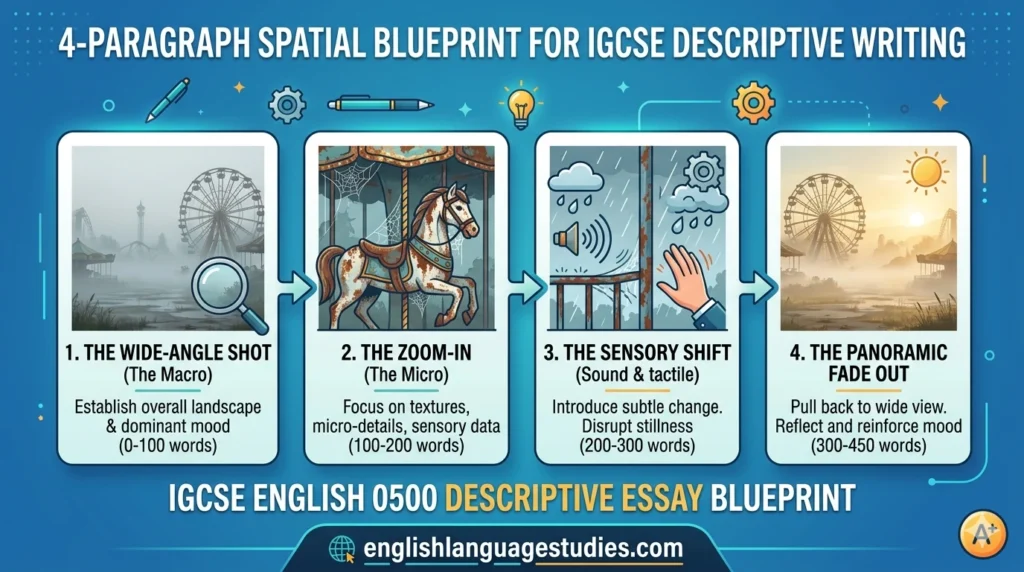
The 4-Paragraph Spatial Blueprint
Since you cannot rely on a plot to organize your paragraphs, you must use spatial progression to guide the reader through the scene.
1.1. The Wide-Angle Shot (The Macro):~25% of essay.
Establish the overall landscape and climate. Establish a dominant mood immediately using pathetic fallacy (weather reflecting the emotion of the scene).
Example: A abandoned amusement park blanketed in heavy, silent fog.
2.2. The Zoom-In (The Micro):~25% of essay.
Move the “camera” closer to a specific object within that landscape. Focus heavily on textures, micro-details, and close-up sensory data.
Example: The rusted, peeling paint on a stationary carousel horse and the smell of decaying wood.
3.3. The Sensory Shift (Sound & Atmosphere):~25% of essay.
Introduce a subtle internal or external change. Change the focus from visual elements to auditory or tactile ones to disrupt the stillness.
Example: The sudden, agonizing groan of iron shifting in the wind, and a cold drop of rain hitting the skin.
4.4. The Panoramic Fade Out:~25% of essay.
Pull the camera back out to the wide view. Reflect on the scene as a whole, ending on a poignant, lingering image that reinforces the opening mood.
Example: The fog completely swallowing the park once more, leaving it frozen in time.
Inside a Grade 9 Essay: “The Market”
Here is an exemplar descriptive essay designed to fit perfectly within the exam constraints while demonstrating high-tier structural control.
Exemplar Essay: The Market
An oppressive wave of heat and noise slammed into the senses upon entering the cavernous marketplace. Above, a patchwork of frayed canvas tarpaulins fractured the harsh midday sun into volatile shards of light and shadow. The air was thick, heavy, and suffocating, saturated with a chaotic symphony of scents: the sharp, metallic tang of raw copper, the sweet perfume of bruised mangoes, and the underlying stench of damp concrete. Thousands of voices meandered and collided in mid-air, creating a low, pulsing roar that vibrated through the very ground.
To the left, an old spice vendor sat cross-legged behind an array of burlap sacks. His face was a map of deep, weathered creases, his eyes half-closed against the rising dust. Inside the sacks lay conical mounds of powdered spices—vibrant turmerics, deep obsidians, and fiery parameters of chili that seemed to radiate heat of their own. He reached down with a skeletal hand, running his dry, leaden fingers through the coarse grains of cumin, letting them trickle back down like a slow, fragrant hourglass.
Suddenly, a sudden downburst of rain lashing against the canvas roof shattered the market’s rhythm. The ambient roar shifted pitch instantly. The dry dust on the ground transformed into a slick, rich clay, and the cool moisture caused the heavy scent of roasted coffee beans to erupt from a nearby stall. Footsteps shuffled frantically as merchants scrambled to pull their delicate silks away from the invading dampness, their damp wool cloaks steaming slightly in the ambient warmth.
As the sudden squall passed, a fragile stillness settled over the rows of stalls. The chaotic energy did not vanish, but it slowed, enveloped by the cool mist rising from the wet linoleum floors. The market took a collective, shallow breath. The sun pierced through the wet canvas once more, illuminating the suspended dust motes dancing in the air like tiny, golden embers over an enduring hive.
📈 Why This Essay Scores Full Marks
- Zero Plot: Absolutely nothing “happens” in terms of a story line. A character enters a market, watches a vendor, it rains, and the market settles. The focus remains 100% on description.
- Sensory Dominance: It builds a complete texture of the market using smell (tang of copper, roasted coffee), touch (oppressive heat, wet clay), and sound (pulsing roar, lashing rain).
- Vivid Imagery: Complex structures and precise word choices like cavernous, fractured, skeletal, and enveloped are woven naturally into the descriptions rather than feeling forced.
Your Pre-Submission Checklist
Before you hand in your descriptive script, run through this mental audit:
Content, Structure & Pacing
- [ ] Frozen Clock: Did you avoid turning the piece into a narrative story?
- [ ] Clear Perspective: Is the scene viewed from a logical, controlled viewpoint?
- [ ] Paragraph Hierarchy: Does each paragraph handle a distinct spatial viewpoint (Macro $\rightarrow$ Micro $\rightarrow$ Atmospheric Shift)?
- [ ] No Cheap Clichés: Did you avoid starting with “I woke up and saw…” or ending with a sudden exit?
Style & Accuracy
- [ ] Five-Senses Check: Did you include at least three different senses beyond just sight?
- [ ] Advanced Verbs: Did you swap out basic verbs for precise movements (shuffled, meandered, pulsed)?
- [ ] Technical Consistency: Are your tenses completely uniform from start to finish?
if you want to improve your Narrative Writing, read IGCSE English 0500 Narrative Essay Guide: Get a Grade 9.