If you are preparing for the Cambridge IGCSE English First Language (0500) exam, you already know that Paper 2 (or Component 3 for coursework) demands a high level of writing control. Specifically, Section B: Composition gives you a choice between descriptive and narrative writing.
Many students choose the narrative essay because they love “telling stories.” However, this is often where they fall into a trap.
Examiners are not looking for a massive, action-packed Hollywood blockbuster crammed into 400 words. They want to see descriptive precision, tight atmospheric control, and structural mastery.
This comprehensive guide breaks down exactly how to plan, structure, and write a Grade 9 IGCSE English 0500 Narrative Essay that ticks every box on the examiner’s mark scheme.
The Golden Rules of IGCSE Narrative Writing
Before you put pen to paper, you must understand the constraints of the exam. You are expected to write between 350 and 450 words. Because this word count is incredibly tight, you must follow these four golden rules to maintain control:
- Keep the Timeline Tight: Do not try to write a story that spans a week, a year, or a lifetime. If you write, “Over the next three years, John travelled the world,” you lose all narrative tension. Instead, focus on a slice of time, a stressful 10-minute wait for exam results, a walk down a dark corridor, or the final minutes of a high-stakes deadline.
- Limit Your Cast: Stick to one or two characters maximum. You do not have the spatial real estate to develop a whole ensemble cast. Give your protagonist one dominant emotion or physical trait, and focus deeply on how they react to their environment.
- Show, Don’t Tell: This is the golden rule of all descriptive prose.
- Weak (Telling): “Mark was incredibly terrified as he waited in the office.”
- Strong (Showing): “Mark’s breath hitched in his throat; his collar suddenly felt like a tightening noose.”
- Vary Your Sentence Structures: To achieve top marks in “Style and Accuracy,” you must use sentence length deliberately to control pacing. Use long, multi-clausal complex sentences to build atmosphere and describe scenery. When the tension peaks, smash the brakes and use short, punchy sentences to mimic a racing heartbeat.
The 5-Stage Narrative Blueprint
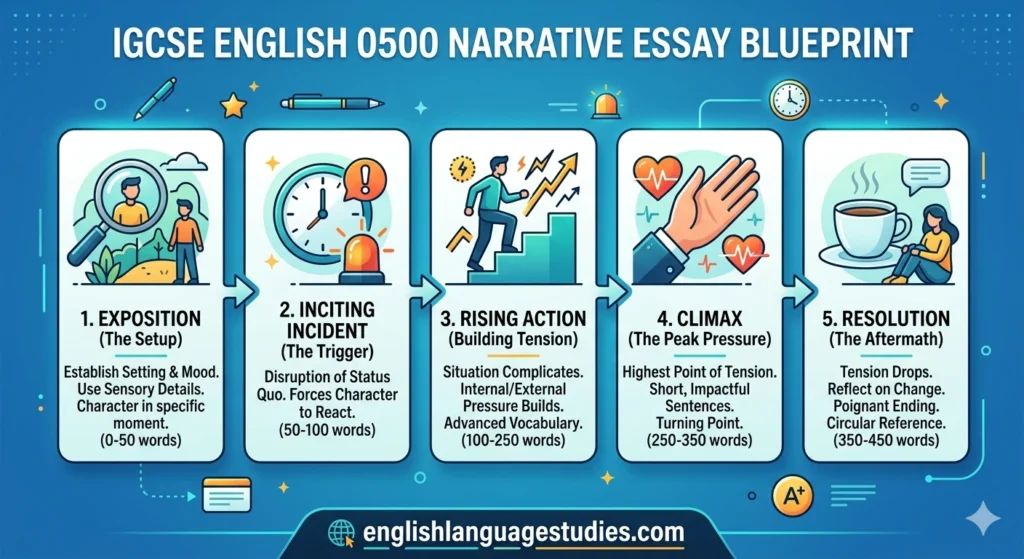
Improvising your plot during the exam is a recipe for a rushed, messy ending. Instead, map your prompt onto this classic five-stage narrative arc.
- 1. Exposition
~10% of essay
Establish the setting and mood immediately using sensory details (sight, sound, smell, temperature). Introduce your character in a specific, static moment. - 2. Inciting Incident
~15% of essay
Introduce a specific catalyst that disrupts the status quo. A phone rings, a door locks, a light flickers, or footsteps echo. This forces the character to react. - 3. Rising Action
~40% of essay
The situation complicates and pressure builds. This is where you deploy your best vocabulary to showcase the character’s internal panic or the external threat. - 4. Climax
~20% of essay
The highest point of physical or emotional tension. Keep the language incredibly sharp, and consider using a single-sentence paragraph for dramatic impact. - 5. Resolution
~15% of essay
The tension drops. Reflect on how the character or situation has fundamentally changed. End on a poignant note, a lingering reflection, or a circular reference to your opening line.
Inside a Grade 9 Essay: “The Deadline”
To see how these rules and structures translate into actual exam performance, look at the exemplar essay below. This piece was planned using a strict 5-minute framework, focusing on an exhausted writer racing against a midnight deadline.
Exemplar Essay: The Deadline
The obsidian screen of the desktop monitor cast a sickly, blue glow across Mark’s face, illuminating the deep hollows beneath his eyes. It was 11:55 PM. Around him, the cavernous, open-plan office lay wrapped in a suffocating silence, broken only by the rhythmic, mechanical countdown of the wall clock. Tick. Tick. Tick. Every second felt like a physical weight pressing down on his chest. His fingers hovered over the keyboard, completely frozen. The flashing cursor mockingly reminded him of the empty white page and the finality of midnight.
Then, the air shifted. The harsh fluorescent lights overhead flickered once, hummed violently, and died. Simultaneously, the blue screen plunged into darkness, taking his half-written draft with it. The clock chimed midnight, its deep rings echoing through the empty space like a funeral knell.
Panic, sharp and cold, flooded his veins. Before he could even process the loss of his work, a heavy creak broke the silence. The editor’s office door, down the long corridor, was swinging open.
Slow, deliberate footsteps began to advance down the hall. Thud. Thud. Thud. Heavy boots clicked against the polished linoleum floors, growing louder with agonizing slowness. Mark’s breath hitched in his throat; his collar suddenly felt like a tightening noose. He shrank back into his swivel chair, wishing he could blend into the skeletal shadows stretched across the room. He wanted to run, but his limbs were leaden. The footsteps drew closer, measuring out the final moments of his career.
The sound stopped directly behind his desk. A massive, towering shadow loomed over him, blocking out the faint moonlight filtering through the blinds. Mark closed his eyes tightly, his heart hammering against his ribs like a trapped bird.
This was it. The failure was complete.
“Rough night, Mark?”
Mark’s eyes snapped open. The terrifying silhouette belonged to the night-shift security guard, who was smiling gently. The man reached past Mark’s shoulder and dropped a steaming paper cup onto the desk.
“The main fuse blew downstairs, but the tech team just bypassed it,” the guard said, pointing to the monitor as it coughed back to life, auto-saving the draft. “Drink some coffee. See you tomorrow.”
As the guard’s footsteps faded back down the corridor, Mark collapsed against his chair. The suffocating weight left his chest, replaced by the warm, earthy aroma of dark roast. The mechanical clock resumed its steady rhythm, but the terror had vanished.
The Essential IGCSE 0500 Vocabulary Bank
To write an essay like the one above, you need to swap out simple, conversational words for precise, academic vocabulary. Focus on these four core areas:
Setting the Scene (Exposition)
- Obsidian (adj.): Jet-black, glossy, and smooth. (“The obsidian night swallowed the landscape.”)
- Cavernous (adj.): Vast, echoing, and empty. (“Her footsteps echoed across the cavernous station hall.”)
- Oppressive (adj.): Overwhelmingly heavy, restrictive, or uncomfortable. (“An oppressive heat hung in the air.”)
- To Envelop (v.): To wrap up, cover, or surround completely. (“A dense fog slowly enveloped the pier.”)
- Skeletal (adj.): Bare, structural, or bony. (“The skeletal shadows of the trees stretched across the lawn.”)
Building Tension (Rising Action)
- To Hitch (v.): To catch or freeze temporarily (used for breath or heartbeat). (“His breath hitched as a floorboard groaned.”)
- Leaden (adj.): Dull, heavy, or slow-moving. (“Fear anchored him, rendering his limbs completely leaden.”)
- To Loom (v.): To appear as a large, vague, or threatening shape. (“The ancient clock tower loomed over the street.”)
- Agonizing (adj.): Painfully slow or uncomfortable. (“The minutes ticked by with agonizing slowness.”)
- To Pulse / Throb (v.): To vibrate or beat with a strong, rhythmic regularity. (“The neon sign pulsed erratically.”)
Dynamic Action Verbs
Never write “walked slowly” or “ran fast” when you can use a single, high-impact verb:
| Basic Phrase | Sophisticated Upgrade | The Exact Nuance |
|---|---|---|
| Walked slowly | Shuffled | Dragging one’s feet due to extreme fatigue or fear. |
| Walked confidently | Strode | Walking with long, decisive, and purposeful steps. |
| Walked aimlessly | Meandered | Moving slowly and twisting or turning frequently. |
| Ran fast | Sprinted / Bolted | Moving at maximum speed, often out of sudden panic. |
| Moved carefully | Crept / Prowled | Moving stealthily and quietly to avoid being caught. |
The Aftermath (Resolution)
- To Dissipate (v.): To scatter or disappear completely. (“The cold knot of panic slowly dissipated.”)
- Poignant (adj.): Evoking a sharp sense of sadness or deep reflection. (“The empty frame was a poignant reminder of what he had lost.”)
- To Collapse (v.): To suddenly fall down due to a total loss of strength. (“He collapsed back into his seat.”)
Your Pre-Submission Checklist
Before you hand in your exam script, spend the final two minutes running through this mental checklist to guarantee you hit the highest bands of the mark scheme:
Content, Structure & Pacing
- [ ] Tight Timeline: Does the entire story take place over minutes or hours rather than days or weeks?
- [ ] Micro Cast: Are there no more than 1 or 2 characters total?
- [ ] The 5-Stage Arc: Is there a clear setup, trigger, build-up, peak, and release?
- [ ] Controlled Climax: Is the peak of your story a specific, focused moment rather than a chaotic rush of action?
- [ ] Earned Ending: Does the resolution feel logical (no “it was all a dream” or sudden unearned deaths)?
Style & Accuracy
- [ ] Show, Don’t Tell: Have you replaced abstract emotions with physical, sensory symptoms?
- [ ] Sensory Variety: Did you include sounds, textures, or temperatures alongside visual descriptions?
- [ ] Deliberate Pacing: Are your sentences long during the setup, and short and sharp during the climax?
- [ ] Consistent Mechanics: Is your narrative voice (1st or 3rd person) and tense (past or present) uniform from start to finish?
- [ ] Word Count: Is the essay roughly between 350 and 450 words?
By pairing a locked-in structural arc with precise, evocative word choices and running it through a strict final checklist, you will easily stand out to the examiner and secure a Grade 9.
if you want to improve your Descriptive Writing, read Master the IGCSE English 0500 Descriptive Essay: The Grade 9 Guide.