The IELTS Writing test is frequently the lowest-scoring module for candidates worldwide. It is a one-hour test of logic, vocabulary, and grammatical control that requires you to produce two distinct pieces of writing. Unlike the Reading or Listening sections, there are no “lucky guesses” here—you are being judged on your ability to construct an argument and describe data from scratch.
To achieve a Band 7.5 or higher in 2026, you must understand that the examiners are not looking for “creative” writing; they are looking for academic precision. This guide to Mastering the IELTS Writing Test provides the structural blueprints and strategic insights needed to excel in both Academic and General Training modules.
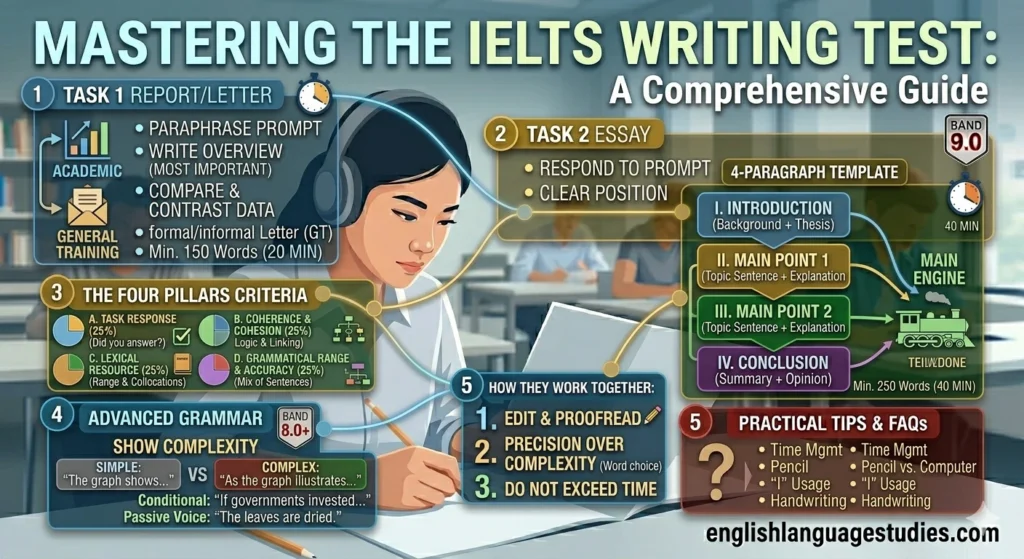
1. Understanding the Two-Task Format
The Writing test is divided into two tasks, and managing your time between them is the first step toward mastery.
Task 1: The Report or Letter (20 Minutes)
- Academic: You are given a visual (graph, chart, table, or diagram) and must describe the main features in at least 150 words.
- General Training: You must write a formal, semi-formal, or personal letter based on a specific situation in at least 150 words.
- Weighting: Task 1 counts for one-third of your total writing score.
Task 2: The Essay (40 Minutes)
- Common to both: You must write a formal essay of at least 250 words in response to a point of view, argument, or problem.
- Weighting: Task 2 counts for two-thirds of your total writing score. Never spend more than 20 minutes on Task 1.
2. The Four Pillars of the Marking Criteria
To master the test, you must write specifically for the examiner’s checklist. Both tasks are graded on four criteria, each worth 25% of the mark:
- Task Response/Achievement: Did you answer every part of the prompt? Is your position clear throughout the essay?
- Coherence and Cohesion: Are your ideas logically organized? Do you use “linking words” (like furthermore, consequently, however) effectively?
- Lexical Resource: Do you use a wide range of vocabulary? Are you using “less common” words and collocations correctly?
- Grammatical Range and Accuracy: Do you use a mix of simple, compound, and complex sentences? Is your punctuation accurate?
Check out: Best IELTS Preparation Apps (Updated): Top Free & Paid Apps for High Band Scores
3. Mastering Academic Task 1: The Overview is King
The biggest mistake students make in the Academic module is listing every single number they see. To score high, you must summarize and compare.
- The Introduction: Paraphrase the prompt. If the prompt says “The graph shows the number of cars sold,” you write, “The line graph illustrates the volume of vehicle sales.”
- The Overview: This is the most important paragraph. It should summarize the main trends without using specific numbers. If you don’t include an overview, you cannot score above a Band 5 in Task Achievement.
- The Details: Group your data into two paragraphs. Look for “highs,” “lows,” and “intersections.” Use comparative language like “In contrast to,” “respectively,” and “roughly doubled.”
4. Mastering Task 2: The Structural Blueprint
A Band 8.0 essay is not a random collection of thoughts; it is a highly structured argument. Use the following four-paragraph template for Mastering the IELTS Writing Test:
Paragraph 1: Introduction
- Sentence 1: Paraphrase the background information of the question.
- Sentence 2: The “Thesis Statement.” Clearly state your opinion or the main points you will discuss.
- Sentence 3: Outline sentence. Tell the examiner what you will cover (e.g., “This essay will discuss the economic and social impacts of…”).
Paragraph 2: First Main Point
- Topic Sentence: State the main idea of the paragraph.
- Explanation: Explain why this is true.
- Example: Provide a specific (or hypothetical) example.
Paragraph 3: Second Main Point
- Follow the same structure as Paragraph 2, but focus on a different aspect or the opposing view.
Paragraph 4: Conclusion
- Summarize your main points.
- Restate your opinion.
- Pro Tip: Never introduce new information in the conclusion.
5. Improving Grammatical Range and Accuracy
To reach the higher bands, you must show the examiner you can use advanced structures.
- Passive Voice: Excellent for Task 1 processes. (e.g., “The tea leaves are then dried” instead of “The workers dry the tea leaves”).
- Conditional Sentences: Perfect for Task 2 arguments. (e.g., “If governments invested more in renewable energy, carbon emissions would decrease”).
- Relative Clauses: Great for adding detail. (e.g., “Digital technology, which has transformed modern communication, also has its drawbacks”).
6. Vocabulary: Precision over Complexity
Many students think they need to use “big words” to impress the examiner. This is a myth. Using a complex word incorrectly is worse than using a simple word correctly.
- Avoid “Over-used” Words: Stop using good, bad, nice, or happy. Instead, use beneficial, detrimental, pleasant, or optimistic.
- Use Collocations: The examiner looks for words that naturally go together. Instead of saying “give an answer,” say “provide a response.” Instead of “do research,” say “conduct research.”
- Topic-Specific Vocabulary: If the prompt is about the environment, use words like biodiversity, sustainable, mitigation, and ecosystem.
7. The Final Polish: Editing and Proofreading
You must leave 2–3 minutes at the end of each task for proofreading. Even native speakers make “slips” under pressure. Look for:
- Subject-Verb Agreement: Does “The data show” or “The data shows”? (Technically, “data” is plural, though “shows” is increasingly common; be consistent).
- Spelling: Check common traps like environment, government, and accommodation.
- Articles: Ensure you haven’t missed “a,” “an,” or “the.”
Conclusion
Mastering the IELTS Writing Test is a journey of discipline. It requires you to be your own harshest critic during practice. By following a clear structure, using a variety of sentence types, and focusing on task response, you can overcome the writing “plateau” and achieve the band score you need for your future endeavours.
Also see this: Top 10 Books for IELTS Preparation: Your Ultimate Guide
FAQs
Is it better to write more than the word limit?
There is no “maximum” word count, but writing too much can be dangerous. If you write 400 words for Task 2, you are more likely to make grammatical errors and run out of time for proofreading. Aim for 170–190 words for Task 1 and 270–290 words for Task 2.
Should I use a pen or a pencil for the Writing test?
In the paper-based test, you can use either, but pencil is highly recommended. It allows you to erase mistakes cleanly, keeping your paper organized. In the computer-delivered test, you simply type your answers.
Can I use “I” in the IELTS essay?
Yes, but only when giving your opinion (e.g., “In my opinion,” or “I believe”). For the rest of the essay, try to maintain a formal, objective tone using structures like “It is often argued that…” or “Evidence suggests…”
How important is handwriting?
The examiner must be able to read your work. If your handwriting is illegible, you will lose marks. If you have messy handwriting, consider taking the computer-delivered IELTS.
Do I need a conclusion for Task 1?
No. For Academic Task 1, you need an overview, not a conclusion. A conclusion summarizes an argument, but Task 1 is just a report of facts. For General Training Task 1 (letters), you should have a closing statement (e.g., “I look forward to hearing from you”).