The IELTS Listening test is often the first hurdle candidates face on exam day. It’s a fast-paced, 30-minute sprint that requires intense concentration, multitasking, and a sharp ear for detail. While many test-takers assume that simply “listening more” is the key, the real secret to how to score high in IELTS Listening involves a blend of linguistic skill and tactical precision.
In 2026, the test remains a foundational part of both the Academic and General Training modules. Whether you are taking the paper-based or computer-delivered version, understanding the mechanics of the exam is the only way to ensure success. The following guide provides an exhaustive breakdown of the strategies required to reach the top bands.
1. Understand the Test Architecture to Maximize Your Marks
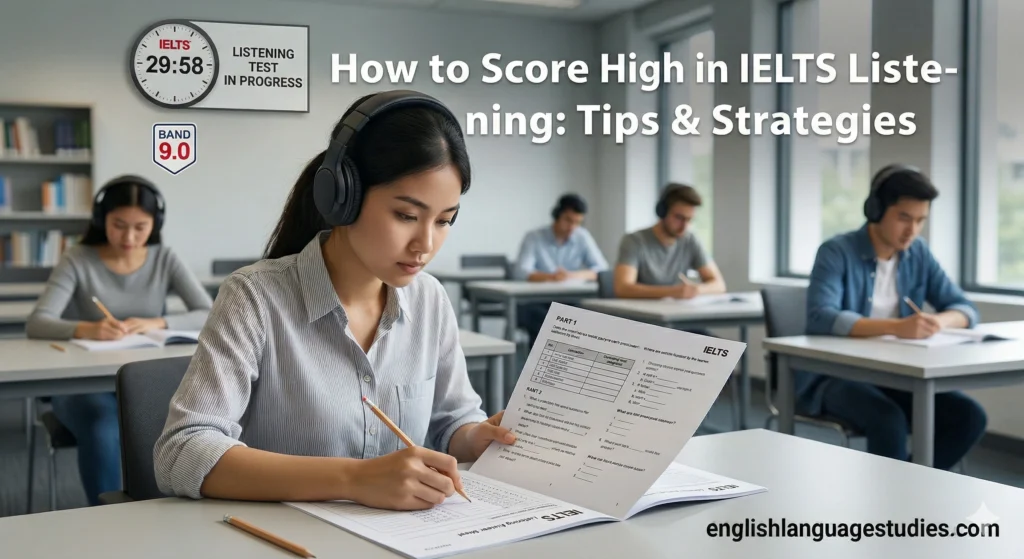
If you want to know how to score high in IELTS Listening, you must first master the test’s anatomy. You cannot achieve a top band if you are surprised by the format. The test consists of 40 questions divided into four parts, each progressively more difficult.
- Part 1: A social conversation between two people (e.g., booking a hotel or inquiring about a library membership). This is your best chance to bank 10 easy points.
- Part 2: A monologue in an everyday social context (e.g., a guided tour of a museum or a speech about local park facilities).
- Part 3: An educational or training discussion involving up to four people (e.g., students discussing a group project with a tutor).
- Part 4: An academic lecture—the most challenging part for those aiming for a Band 9, as it features a continuous flow of high-level vocabulary without a break.
The Scoring Thresholds
Each correct answer is worth one mark. To understand how to score high in IELTS Listening, look at the raw marks required for your target band:
| Target Band | Correct Answers Required |
| Band 7.0 | 30 out of 40 |
| Band 8.0 | 35 out of 40 |
| Band 9.0 | 39–40 out of 40 |
check out Top 10 Books for IELTS Preparation: Your Ultimate Guide
2. Master Prediction: The Ultimate Strategy for High Scores
Before each recording starts, you are given a short window to “look at the questions.” High scorers don’t just read the words; they use this time to predict the answers. This is a non-negotiable step in how to score high in IELTS Listening.
- Identify the Word Type: Is the blank a noun, a verb, an adjective, or a number? If the sentence is “The seminar starts at ________,” you are listening for a specific time. If it says “The ________ was found in the forest,” you are likely hunting for a noun.
- Contextualize the Topic: If the topic is “Marine Biology,” expect technical terms like habitat, ecosystem, predator, or salinity. Having these words in the back of your mind makes them easier to recognize when they are spoken.
- Highlight Anchors: Underline names, dates, and nouns. While the speaker might use synonyms for verbs (e.g., saying “commence” instead of “start”), they rarely change proper nouns like “Oxford Street” or “Dr. Peterson.”
Try out Best IELTS Preparation Apps (Updated): Top Free & Paid Apps for High Band Scores
3. Beware of “Distractors” Designed to Lower Your Score
The IELTS test is famous for using “distractors”—information that sounds like the answer but is immediately corrected. Learning to spot these is essential to how to score high in IELTS Listening.
Example of a Distractor:
Speaker A: “Shall we meet at 6:00 PM?”
Speaker B: “Actually, I have a meeting then. Let’s make it 7:30 instead.”
Speaker A: “Perfect, see you at 7:30.”
If you wrote “6:00 PM” the moment you heard it, you’ve lost a point. To score high in IELTS Listening, you must learn to wait for the final confirmation. Listen for “pivot words” like but, however, actually, or sorry, I meant… These are verbal signals that the information is about to change.
4. Technical Precision: Spelling and Grammar
You can understand 100% of the audio and still fail if your technical execution is sloppy. A major part of how to score high in IELTS Listening is avoiding “silly” mistakes that cost marks.
- Spelling Counts: IELTS is a test of English proficiency, and that includes orthography. “Accommodation” with one ‘m’ is wrong. “Government” without the ‘n’ is wrong. If you are aiming for a Band 9, you cannot afford more than one or two spelling slips.
- Singular vs. Plural: This is one of the most common traps. If the speaker says “graduates” and you write “graduate,” the answer is marked incorrect. Train your ear to listen for that final ‘s’ or ‘z’ sound at the end of nouns.
- Follow Word Limits: Pay close attention to the instructions for each section. If the prompt says “NO MORE THAN TWO WORDS,” and the answer is “a blue car,” you must write “blue car.” Adding the “a” makes it three words, resulting in zero marks.
5. Computer vs. Paper: Choosing the Right Path
Choosing the format that fits your habits is a key decision in how to score high in IELTS Listening. Since 2025/2026, the computer-delivered test has become the standard in many regions, but both have their pros and cons.
- Paper-Based: Best for those who find it easier to focus on physical paper and like to underline keywords with a pencil. A major advantage is the 10-minute transfer time at the end, allowing you to check your spelling and grammar carefully.
- Computer-Delivered: Best for fast typists. You enter answers directly into the screen, and the timer is always visible. However, you only get 2 minutes at the end to check your work, so your initial entry must be accurate.
6. Active Listening Habits for Band 9 Candidates
Practicing with past papers is only half the battle. If you are serious about how to score high in IELTS Listening, you need to immerse yourself in various English accents. IELTS is an international test, so expect to hear British, Australian, American, and Canadian speakers.
- The Shadowing Technique: This involves repeating what a speaker says exactly as they say it, matching their intonation and speed. This helps your brain process English sounds at a native pace, making the Part 4 lectures feel less overwhelming.
- Focus on Signposting: In the academic lecture (Part 4), the speaker will not stop. To score high in IELTS Listening, you must follow “signpost words” that indicate the structure of the talk. Words like “Moving on to…”, “In contrast…”, or “To summarize…” tell you exactly where the speaker is on your question sheet.
7. Common Pitfalls to Avoid
Even the best candidates can struggle if they fall into these traps. Here is what not to do when trying how to score high in IELTS Listening:
- Losing Focus: If you miss an answer, let it go immediately. The most common cause of a low score is “cascading errors”—missing Question 5, panicking, and subsequently missing Questions 6, 7, and 8 because you were still thinking about Question 5.
- Writing Too Soon: Never assume the first number or name you hear is the final answer. Wait for the context to confirm it.
- Ignoring the Preview Time: Each section gives you time to read the questions. Never use this time to check your previous answers. Always look ahead to what is coming next.
8. Final Countdown: The Week Before the Test
In the final seven days, your focus should shift from “learning” to “simulating” the test environment.
- Full Mock Exams: Do one full 40-question test daily using headphones. This builds the mental stamina required to stay focused for the full 30 minutes.
- Analyze Your Errors: After every practice test, don’t just look at your score. Ask why you got an answer wrong. Was it a spelling error? Did you mishear a plural? Identifying your patterns is the fastest way to score high in IELTS Listening.
- Volume Adjustment: During your practice, find the volume level that works for you. In the real exam, ensure your headphones are comfortable and the audio is clear before the test begins.
Conclusion: Your Roadmap to Success
Ultimately, how to score high in IELTS Listening isn’t about being a genius; it’s about being a detective. You are hunting for specific pieces of information in a forest of words. By mastering prediction, staying alert for distractors, and tightening up your technical accuracy, a Band 8.5 or 9.0 is entirely within reach.
Stay calm, keep your pencil (or cursor) moving, and remember: you only hear the audio once. Make it count!
Also try Top 10 Books for IELTS Preparation: Your Ultimate Guide
How to score high in IELTS Listening if I have trouble with accents?
To score high, you must expose yourself to a variety of English accents, including British, Australian, and Canadian. Use podcasts like BBC Global News to train your ear to different pronunciations of common words.
Can I use abbreviations to score high in IELTS Listening?
No. To ensure you score high in IELTS Listening, avoid abbreviations unless they are standard (like “kg” or “AM/PM”). Writing “info” instead of “information” will likely cost you a mark.
Is the computer-delivered test easier if I want to score high in IELTS Listening?
It depends on your skills. If you are a fast typer, the computer-delivered test helps you score high in IELTS Listening because you can edit your answers quickly. If you prefer underlining keywords with a pencil, the paper-based version is better.
What is the most important tip for how to score high in IELTS Listening?
The most important tip is anticipation. Always use the time given before the audio starts to highlight keywords and guess what type of information (name, date, number) is required for each blank.
How to score high in IELTS Listening Part 4?
Part 4 is a continuous lecture. To score high in IELTS Listening here, focus on “signposting language”—words like “furthermore” or “consequently”—which indicate that the speaker is moving to the next question.