English is a notoriously tricky language. We have only 26 letters in our alphabet, yet we use them to produce 44 distinct sounds (phonemes). This discrepancy is exactly why words like tough, through, and though don’t rhyme.
To master pronunciation, spelling, and literacy, you must shift your focus from letters to sounds. This complete guide provides a deep dive into Understanding the 44 Sounds of the English Language, breaking down vowels, consonants, and the mechanics behind them.
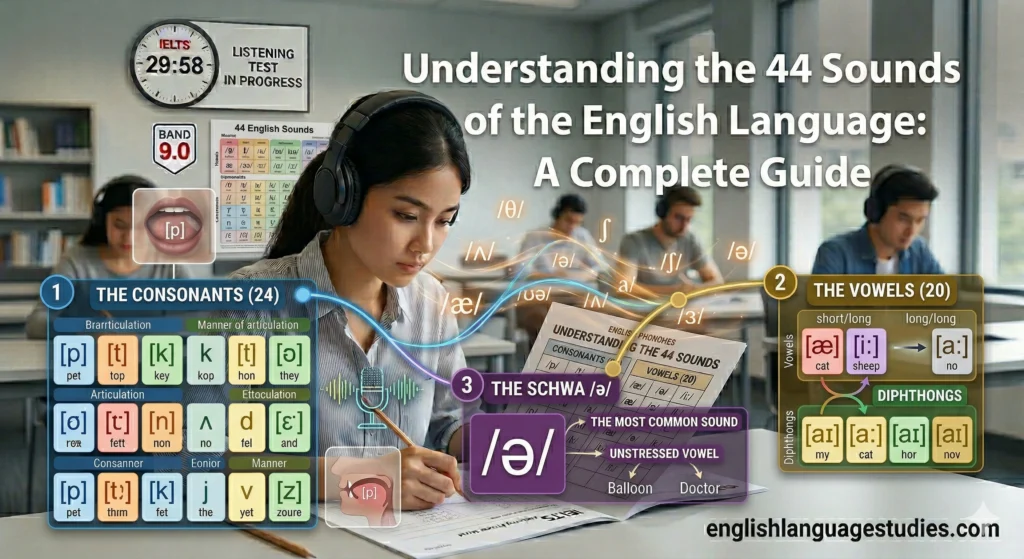
1. Why Understanding the 44 Sounds of the English Language Matters
Before we list the sounds, it is important to understand why this knowledge is foundational. In linguistics, a phoneme is the smallest unit of sound that can change the meaning of a word. For example, changing the /p/ sound in “pat” to a /b/ sound gives us “bat.”
By understanding the 44 sounds of the English language, you gain:
- Improved Spelling: You begin to see patterns in how sounds (phonemes) are represented by letter groupings (graphemes).
- Clearer Pronunciation: Especially for ESL learners, distinguishing between sounds like /i:/ (sheep) and /ɪ/ (ship) is vital for clarity.
- Literacy Development: Phonics-based reading relies entirely on the ability to blend these 44 sounds.
check out 5 Best AI Applications to Practice English Speaking (Updated Guide) | Top Apps for Fluency
2. The Consonant Sounds (24 Sounds)
Consonants are sounds produced by restricting or blocking the airflow using the tongue, lips, or teeth. Of the 44 sounds, 24 are consonants. These are generally divided into “voiced” (vocal cords vibrate) and “unvoiced” (breath only).
Plosive Consonants
These sounds are created by stopping the airflow completely and then releasing it suddenly.
- /p/ – Pin, cap
- /b/ – Bat, rabbit
- /t/ – Ten, fitter
- /d/ – Dog, ladder
- /k/ – Cat, key, luck
- /g/ – Gun, dog
Fricative Consonants
These are “friction” sounds where the air escapes through a narrow passage.
- /f/ – Fish, phone
- /v/ – Van, stephen
- /θ/ – Think, bath (Unvoiced)
- /ð/ – This, mother (Voiced)
- /s/ – Sun, city, Miss
- /z/ – Zebra, has
- /ʃ/ – Shoe, chef, action
- /ʒ/ – Vision, measure
- /h/ – Hat, who
Nasal, Liquid, and Glide Consonants
These involve air flowing through the nose or moving the tongue smoothly.
- /m/ – Moon, lamb
- /n/ – Night, knot
- /ŋ/ – Sing, pink
- /l/ – Light, bell
- /r/ – Rat, write
- /j/ – Yes, use
- /w/ – Wet, wheel
3. The Vowel Sounds (20 Sounds)
Vowels are the “soul” of the English language. Unlike consonants, they are produced with an open vocal tract. Understanding the 44 sounds of the English language requires a firm grasp of the three types of vowels: Short, Long, and Diphthongs.
Short Vowels (7 Sounds)
Short vowels are quick and do not “say their name.”
- /æ/ – Cat, bat
- /e/ – Egg, bed
- /ɪ/ – Sit, pin
- /ɒ/ – Hot, rock
- /ʌ/ – Cup, luck
- /ʊ/ – Put, foot
- /ə/ – The Schwa. This is the most common sound in English. It appears in unstressed syllables like about, teacher, and cinema.
Long Vowels (5 Sounds)
Long vowels are held longer and often correspond to the letter’s name in the alphabet.
- /i:/ – Sheep, beam
- /ɑ:/ – Farm, father
- /ɔ:/ – Fork, wall
- /u:/ – Boot, blue
- /ɜ:/ – Bird, work
Diphthongs (8 Sounds)
A diphthong is a complex sound that “glides” from one vowel to another within the same syllable. Mastering these is a hallmark of understanding the 44 sounds of the English language.
- /eɪ/ – Train, say
- /aɪ/ – Light, my
- /ɔɪ/ – Boy, oil
- /aʊ/ – Out, cow
- /əʊ/ – No, road
- /ɪə/ – Deer, here
- /eə/ – Hair, there
- /ʊə/ – Cure, poor
4. Digraphs and Blends: Where Letters Meet Sounds
A common point of confusion when understanding the 44 sounds of the English language is the difference between letters and phonemes.
- Digraphs: Two letters that make one sound. (e.g., “sh” in ship, “th” in thin, “oa” in boat).
- Blends: Two or more consonants that appear together, but each sound is still heard. (e.g., “st” in stop, “fl” in flow).
In a word like “Chat,” there are four letters but only three sounds: /tʃ/ – /æ/ – /t/. Recognizing these patterns is the key to advanced phonics.
5. The Schwa /ə/: The King of English Sounds
You cannot claim to be understanding the 44 sounds of the English language without knowing the Schwa. It is the lazy, neutral sound made when a vowel is in an unstressed syllable.
- Example: In the word “Balloon,” the ‘a’ is not pronounced /æ/. It is a soft /ə/—”buh-LOON.”
- Example: In “Doctor,” the ‘or’ becomes /ə/—”Doc-tuh.”
The Schwa is what gives English its unique rhythm and is essential for sounding like a native speaker.
6. Practical Tips for Mastering the 44 Sounds
How do you move from theory to practice? Understanding the 44 sounds of the English language takes consistent effort.
- Use a Mirror: Many sounds (like /θ/ and /ð/) require specific tongue placement. Watch your mouth to see if your tongue is between your teeth.
- Record Yourself: Compare your pronunciation of minimal pairs (words that differ by only one sound, like ship and sheep) to native recordings.
- Color-Coded Phonics: If you are teaching or learning, use colors to represent vowel groups. This visual aid reinforces sound recognition.
- Listen to Poetry: Rhyme and meter highlight the phonetic similarities between words that look different (like blue and through).
7. Common Obstacles in Phonetic Learning
Why is understanding the 44 sounds of the English language so difficult?
- Regional Accents: A person from London, New York, and Sydney may pronounce the same phoneme differently. However, the category of the sound remains the same.
- Silent Letters: Words like knife (/naɪf/) or write (/raɪt/) ignore the first letter entirely, which can be frustrating for beginners.
- Borrowed Words: English is a “linguistic magpie,” stealing words from French, German, and Latin, often keeping the original (and inconsistent) pronunciations.
check out 10 AI-Powered Tools That Can Transform English Language Learning in 2025
Conclusion
Understanding the 44 sounds of the English language is like gaining the “source code” to the language. Once you stop looking at the 26 letters as rigid rules and start seeing them as symbols for 44 fluid sounds, your ability to read, write, and speak will transform.
Whether you are a student, a teacher, or a language enthusiast, mastering these phonemes is the most direct path to English fluency.
Frequently Asked Questions
Why are there 44 sounds but only 26 letters?
English uses combinations of letters (digraphs) to create new sounds. For example, ‘s’ and ‘h’ are two letters, but together they create the /ʃ/ sound found in “shop.” This is why understanding the 44 sounds of the English language is more effective than just learning the alphabet.
What is the hardest sound to learn in English?
Many learners find the “th” sounds (/θ/ and /ð/) and the Schwa (/ə/) the most difficult. Understanding the 44 sounds of the English language requires practicing the physical position of the tongue for these specific phonemes.
Does every dialect have the same 44 sounds?
While the core 44 sounds exist in most dialects, some accents may merge sounds or use different vowels for certain words (the “cot-caught” merger is a famous example). However, the IPA (International Phonetic Alphabet) provides a standard for understanding the 44 sounds of the English language globally.
How can I teach children about the 44 sounds?
Start with the most common consonant sounds and short vowels. Use “Elkonin boxes” to help them segment words into individual sounds. For instance, the word “duck” would have three boxes: /d/ – /ʌ/ – /k/.
Are the 44 sounds the same in American and British English?
The number of phonemes is generally the same, but the realization (the way they sound) differs. For example, the /r/ sound is often silent at the end of words in British English (non-rhotic) but pronounced clearly in American English (rhotic).