The IELTS speaking test is one of the most challenging parts of the IELTS examination for many students. Even learners with strong grammar and vocabulary often struggle to speak confidently in front of an examiner. Nervousness, hesitation, poor pronunciation, and lack of fluency can lower the final band score significantly. This is where an IELTS speaking tutor becomes extremely valuable.
An IELTS speaking tutor helps students improve fluency, pronunciation, vocabulary, grammar, and confidence through structured speaking practice and personalized feedback. Whether you are aiming for Band 6, Band 7, or even Band 9, working with an experienced tutor can dramatically improve your performance in the speaking section.
Many students prepare for reading, writing, and listening independently but fail to practice speaking effectively. Unlike other sections, speaking requires live communication and immediate correction. An IELTS speaking tutor identifies your weaknesses, corrects mistakes, and guides you toward natural and confident communication.
In this complete guide, you will learn what an IELTS speaking tutor does, the benefits of hiring one, how tutors help improve band scores, how to choose the right tutor, and the best strategies to maximize your IELTS speaking preparation.
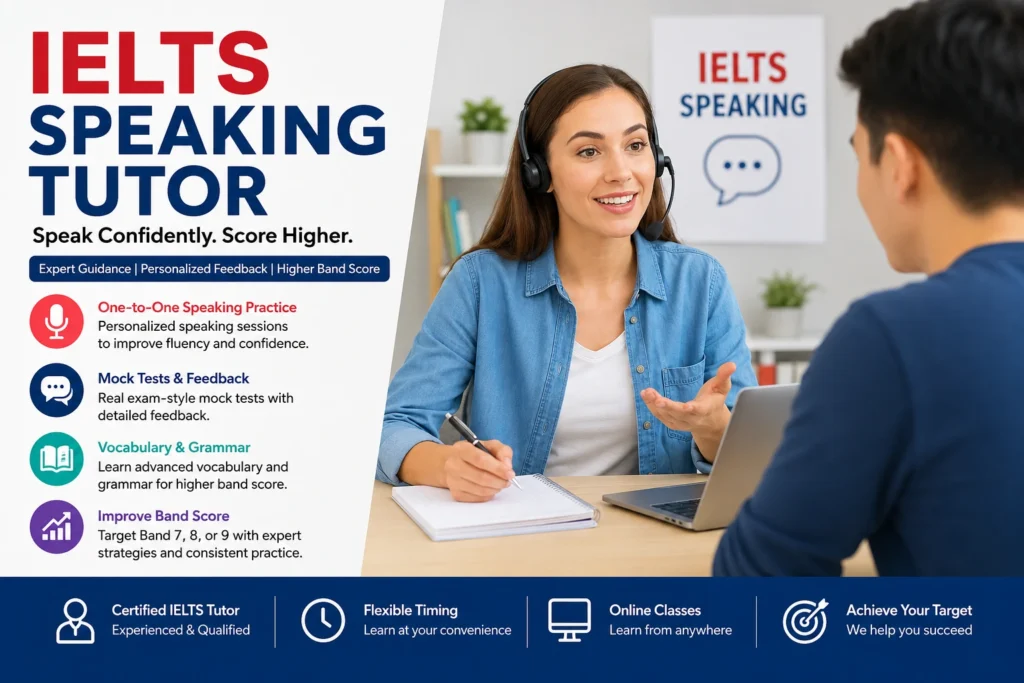
What Does an IELTS Speaking Tutor Do?
An IELTS speaking tutor is a trained instructor who helps students prepare specifically for the speaking module of the IELTS exam. Their primary role is to improve your ability to communicate clearly, confidently, and fluently in English.
Unlike general English teachers, IELTS speaking tutors focus on the exact format and assessment criteria used in the IELTS speaking test. They understand how examiners evaluate responses and help students improve in all four assessment areas:
- Fluency and coherence
- Lexical resource
- Grammatical range and accuracy
- Pronunciation
A tutor provides personalized lessons tailored to your current speaking level and target band score.
Understanding the IELTS Speaking Test Structure
Before preparing for the test, students must understand its format. A good IELTS speaking tutor explains the structure in detail and trains students for each section.
Part 1: Introduction and Interview
In this section, the examiner asks general questions about familiar topics such as:
- Hobbies
- Family
- Education
- Work
- Daily routine
The goal is to assess your ability to communicate naturally in everyday situations.
Part 2: Cue Card
You receive a topic card and have one minute to prepare before speaking for up to two minutes. Many students struggle in this part because they run out of ideas or hesitate during speaking.
An IELTS speaking tutor teaches students how to organize answers quickly and speak continuously with confidence.
Part 3: Discussion
This section contains more advanced discussion questions related to the Part 2 topic. Students must explain opinions, compare ideas, and discuss broader issues.
Tutors help learners develop analytical thinking and advanced vocabulary for this section.
You may like our IELTS Speaking: 50 Sample Answers for Part 1 and 2
Benefits of Hiring an IELTS Speaking Tutor
Working with an IELTS speaking tutor offers many advantages compared to preparing alone.
Personalized Feedback
One of the biggest benefits of having a tutor is receiving immediate correction and feedback. Self-study cannot always identify pronunciation problems, grammar mistakes, or weak vocabulary usage.
A tutor analyzes your speaking performance and helps you improve systematically.
Better Pronunciation and Fluency
Many IELTS candidates understand English well but struggle to speak smoothly. Tutors improve pronunciation by focusing on:
- Stress
- Intonation
- Word clarity
- Natural rhythm
They also help reduce hesitation and unnecessary pauses.
Increased Confidence
Fear and nervousness are common during speaking exams. Regular mock interviews with a tutor build confidence and reduce anxiety.
Students become familiar with the exam environment and learn how to answer questions naturally.
Faster Score Improvement
An IELTS speaking tutor creates a structured preparation plan based on your target band score. Instead of wasting time on random practice, students focus on areas that directly improve performance.
Many learners improve more quickly through guided preparation than independent study.
How an IELTS Speaking Tutor Helps You Achieve Band 7+
Scoring Band 7 or higher in IELTS speaking requires more than basic English communication skills. Students need fluency, advanced vocabulary, grammatical accuracy, and clear pronunciation.
A professional IELTS speaking tutor helps students master all these areas.
Improving Fluency and Coherence
Fluency means speaking smoothly without long pauses. Coherence means organizing ideas logically.
Tutors help students:
- Use linking words naturally
- Expand answers clearly
- Avoid repetitive phrases
- Speak continuously
For example, instead of giving one-line answers, tutors encourage students to explain ideas with examples and details.
Enhancing Lexical Resource
Lexical resource refers to vocabulary usage. Students aiming for Band 7 or above must use a wide range of vocabulary naturally.
Tutors teach:
- Topic-specific vocabulary
- Idioms and collocations
- Synonyms
- Advanced expressions
They also help students avoid repeating the same words repeatedly.
Grammar Accuracy
Grammar mistakes can reduce band scores significantly. IELTS speaking tutors improve grammar by teaching:
- Complex sentence structures
- Tenses
- Conditional sentences
- Comparative structures
Students learn to communicate accurately while maintaining fluency.
Pronunciation Techniques
Pronunciation is not about having a British or American accent. The goal is clarity.
Tutors improve pronunciation through:
- Word stress practice
- Intonation exercises
- Sound correction
- Speaking drills
Better pronunciation helps examiners understand responses more easily.
You may also like: Mastering IELTS Speaking Part 1: Questions, Tips, and Sample Answers
Online IELTS Speaking Tutor vs Offline Coaching
Today, students can choose between online IELTS speaking tutors and traditional offline coaching centers.
Both options have benefits depending on the learner’s needs.
Advantages of Online IELTS Tutors
Online IELTS speaking tutors have become extremely popular due to flexibility and convenience.
Benefits include:
- Learn from home
- Flexible schedules
- Affordable fees
- Access to international tutors
- Recorded lessons for review
Students can practice through Zoom, Skype, or Google Meet from anywhere in the world.
Benefits of Offline IELTS Classes
Offline coaching provides face-to-face interaction and classroom learning environments.
Advantages include:
- Physical classroom discipline
- Group discussions
- Direct interaction
- Peer learning
Some students feel more motivated in traditional classroom settings.
Which Option Is Better?
The best option depends on your learning style, budget, and schedule.
Online tutoring is usually better for working professionals and students with busy routines. Offline coaching may suit learners who prefer classroom interaction.
However, many students now prefer online IELTS speaking tutors because of convenience and personalized learning.
Qualities of the Best IELTS Speaking Tutor
Not all tutors provide the same quality of instruction. Choosing the right IELTS speaking tutor is essential for success.
IELTS Teaching Experience
Experienced tutors understand examiner expectations and common student mistakes. They know how to guide students toward higher band scores effectively.
Strong Communication Skills
A good tutor explains concepts clearly and encourages interactive learning. They should create a comfortable environment where students feel confident speaking.
Knowledge of IELTS Band Descriptors
Professional tutors understand official IELTS scoring criteria and use them during evaluation.
They should explain why you received a certain band score and how to improve.
Ability to Motivate Students
IELTS preparation can feel stressful and tiring. Great tutors motivate students, track progress, and maintain consistency during preparation.
Mock Tests and Feedback
The best IELTS speaking tutors regularly conduct mock interviews and provide detailed feedback after each session.
Students should receive practical advice instead of general comments.
Common Mistakes IELTS Speaking Tutors Help You Avoid
Many students make similar mistakes during the IELTS speaking exam. Tutors help identify and correct these problems early.
Memorized Answers
Some students memorize speaking responses from the internet. Examiners can easily recognize unnatural answers.
Tutors teach students how to respond naturally and spontaneously.
Speaking Too Fast
Nervous students often speak too quickly, making pronunciation unclear.
Tutors train learners to maintain a natural speaking pace.
Using Limited Vocabulary
Repeating simple words lowers vocabulary scores. Tutors help students expand vocabulary and use more precise expressions.
Giving Very Short Answers
Short responses reduce opportunities to demonstrate fluency and vocabulary.
Tutors teach students how to develop answers with explanations and examples.
Poor Pronunciation
Incorrect pronunciation can confuse examiners.
Regular speaking practice with a tutor improves clarity and confidence.
IELTS Speaking Practice Activities Recommended by Tutors
Daily speaking practice is essential for improvement.
Daily Speaking Practice
Students should practice speaking English every day, even for 15–20 minutes.
Speaking regularly improves fluency and confidence.
Recording Your Voice
Tutors often ask students to record themselves while speaking.
This helps learners identify:
- Pronunciation mistakes
- Hesitation
- Grammar errors
Cue Card Practice
Cue cards are one of the most important parts of IELTS speaking preparation.
Tutors provide practice topics and teach answer organization techniques.
Mock Interviews
Regular mock tests simulate real exam conditions.
Students become familiar with time pressure and examiner interaction.
Watching English Videos
Tutors recommend watching:
- English interviews
- Podcasts
- TED Talks
- IELTS speaking videos
This improves listening comprehension, vocabulary, and pronunciation.
For more practice: Most Repeated IELTS Speaking Questions 2025 | Part 1, 2 & 3 Sample Answers
How to Choose the Right IELTS Speaking Tutor
Selecting the right tutor can greatly affect your IELTS results.
Define Your Target Band Score
Choose a tutor experienced in helping students achieve your desired score.
For example:
- Band 6 preparation differs from Band 8 preparation.
Compare Tutor Fees
Expensive tutors are not always better. Compare qualifications, reviews, and lesson quality before making a decision.
Check Student Reviews
Student feedback provides insight into teaching quality and results.
Look for reviews mentioning:
- Score improvement
- Communication skills
- Effective feedback
Ask for a Trial Lesson
Many tutors offer demo sessions. Trial classes help determine if the teaching style suits your needs.
Ensure Regular Feedback
Choose a tutor who provides detailed performance analysis after speaking practice sessions.
Best Platforms to Find an IELTS Speaking Tutor
Students can find IELTS speaking tutors through multiple online platforms.
Online Tutoring Websites
Websites connect students with certified IELTS instructors worldwide.
Many platforms offer:
- Trial classes
- Flexible scheduling
- Recorded lessons
Language Learning Platforms
Apps and language-learning websites also provide IELTS speaking preparation.
YouTube IELTS Tutors
Some experienced tutors share free lessons on YouTube.
Students can learn:
- Speaking strategies
- Vocabulary
- Cue card techniques
Social Media Communities
Facebook groups, WhatsApp communities, and online forums often help students connect with tutors and speaking partners.
Self-Study vs IELTS Speaking Tutor
Many students wonder whether they need a tutor or can prepare independently.
Advantages of Self-Study
- Free resources
- Flexible schedule
- Independent learning
Limitations of Self-Study
- No speaking correction
- Limited feedback
- Difficulty identifying weaknesses
Advantages of an IELTS Speaking Tutor
- Personalized guidance
- Structured preparation
- Faster improvement
- Professional feedback
The best approach is combining self-study with regular tutor sessions.
Tips to Maximize Results with an IELTS Speaking Tutor
Even the best tutor cannot help unless students practice consistently.
Practice Daily
Daily English speaking builds fluency faster than occasional practice.
Speak Only in English During Sessions
Avoid switching to your native language during speaking practice.
Keep a Vocabulary Notebook
Write down:
- New words
- Idioms
- Useful phrases
Review them regularly.
Review Tutor Feedback
Carefully analyze corrections and avoid repeating the same mistakes.
Take Weekly Mock Tests
Weekly speaking tests help measure improvement and build exam confidence.
Frequently Asked Questions About IELTS Speaking Tutors
Is an IELTS speaking tutor necessary?
A tutor is not mandatory, but professional guidance can significantly improve speaking performance and confidence.
Can I improve IELTS speaking at home?
Yes. Students can improve at home through regular speaking practice, online lessons, and mock interviews.
How long does it take to improve IELTS speaking?
Improvement depends on current English level, practice consistency, and target band score.
Are online IELTS speaking tutors effective?
Yes. Many students successfully prepare online and achieve high band scores.
Can a tutor help me get Band 8 or 9?
An experienced IELTS speaking tutor can help students develop advanced speaking skills needed for higher band scores.
Conclusion
The IELTS speaking test requires confidence, fluency, pronunciation, vocabulary, and strong communication skills. Many students struggle because they do not practice speaking effectively or receive proper feedback during preparation.
An IELTS speaking tutor provides structured guidance, personalized correction, mock tests, and targeted speaking practice that help students improve faster and achieve higher band scores.
Whether you choose online tutoring or offline coaching, consistent speaking practice and expert feedback are essential for success. Students aiming for Band 7, 8, or 9 can benefit greatly from working with a professional tutor who understands IELTS scoring criteria and exam strategies.
Start your IELTS speaking preparation today, practice regularly, and focus on improving your fluency and confidence step by step. With the right tutor and dedication, achieving your target IELTS speaking score becomes much more realistic.