I. Introduction: The English Landscape in 2026
In the rapidly evolving digital landscape of 2026, the question is no longer “How do I find information?” but rather “How do I filter it?” With an overwhelming number of tools claiming to offer the “fastest” path to fluency, identifying the right English language learning resources has become the single most important step in a student’s journey.
The traditional methods of rote memorization and static textbooks are being replaced by a sophisticated ecosystem of interactive technology. Today, mastering a new language is about building a “resource stack” that blends high-tech innovation with proven linguistic principles. Whether you are a professional aiming for a promotion, a student preparing for exams like IELTS or PTE, or a hobbyist looking to connect with the world, having a curated list of tools is essential.
In this ultimate guide, we have vetted and categorized the best English language learning resources available today. We will move beyond basic apps to explore AI-driven conversation coaches, immersive video platforms, and high-stakes professional tools. By the end of this post, you won’t just have a list of websites—you will have a personalized roadmap to fluency that fits your lifestyle, your goals, and your budget.
II. The 2026 Tech Revolution: AI Language Coaches
The biggest breakthrough in recent years is the transition from “Static AI” (correcting your spelling) to “Conversational AI” (acting as a 24/7 tutor).
Generative AI for Real-Time Practice
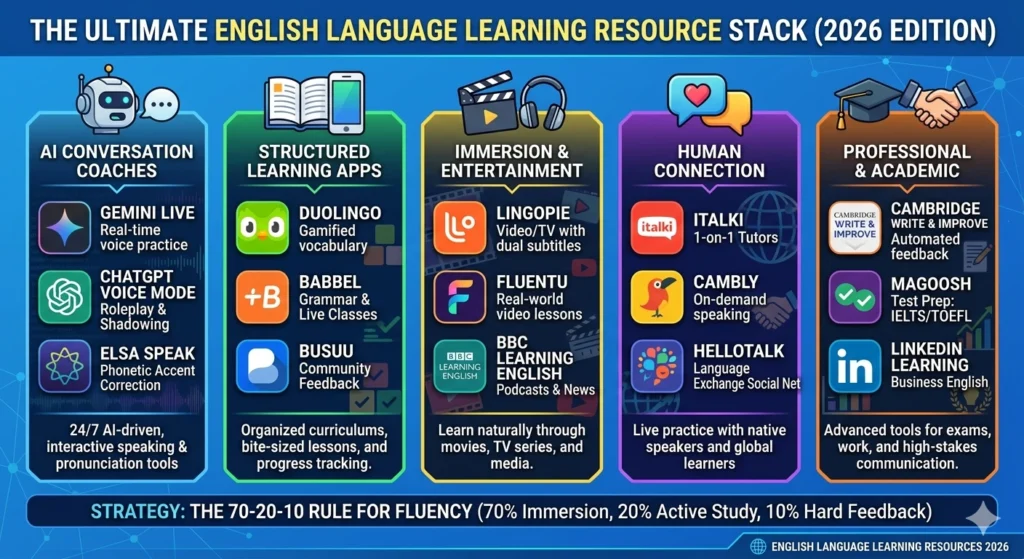
- Gemini Live: Use the mobile app’s voice mode to practice fluid conversation. You can say, “Hey Gemini, let’s practice a coffee shop scenario. You’re the barista, and I’m a grumpy customer.” It provides instant, natural feedback.
- ChatGPT Voice Mode: Excellent for “shadowing.” Ask it to read a paragraph slowly, then repeat it back to see if it understands your pronunciation.
- Elsa Speak: Specifically designed for pronunciation. It uses AI to pinpoint exactly which phonemes (sounds) you are mispronouncing based on your native language.
AI Writing Assistants
- Grammarly: Beyond fixing commas, use the “Goals” feature to adjust your tone (Professional, Casual, or Academic).
- Quillbot: A powerful paraphrasing tool. If you know what you want to say but it sounds “too simple,” Quillbot helps you see advanced ways to restructure the same thought.
III. Comprehensive App Ecosystems
While AI is the coach, these apps provide the structure, the curriculum that ensures you don’t have “holes” in your knowledge.
The “Big Three” Platforms
- Duolingo:
- Best for: Building the habit.
- Strategy: Use it for 10 minutes a day to keep your brain “switched on” to English, but don’t rely on it as your only source.
- Babbel:
- Best for: Real-life utility.
- Strategy: Focus on their “Live” classes (Babbel Live) to supplement the app’s grammar lessons.
- Busuu:
- Best for: Community feedback.
- Strategy: Submit your recorded speaking exercises to the community. Getting a correction from a native speaker in London or New York is invaluable.
Niche Powerhouses
- Pimsleur: Still the gold standard for “Hands-Free” learning. If you commute, this 30 minute audio-only method forces you to recall and speak English out loud.
- Memrise: Uses “Learn with Locals” video clips. It’s the best way to see how English speakers actually move their mouths and use gestures.
IV. Immersion Through Entertainment
Traditional study is “Active.” Entertainment is “Passive” (or Semi-Passive) study, which is how you develop a “natural ear.”
Video-Based Learning
- Lingopie: Think of it as Netflix for language learners. Every word in the subtitles is clickable, providing a definition and adding it to your flashcard deck.
- FluentU: Uses real-world videos, music videos, movie trailers, news, and inspiring talks, and turns them into personalized language learning lessons.
- Top YouTube Channels:
- English with Lucy: Best for British English and modern etiquette.
- Learn English with TV Series: Uses clips from Friends or Harry Potter to explain slang and fast speech.
- Rachel’s English: The ultimate resource for American English pronunciation and rhythm.
Podcasts for Every Level
- BBC Learning English – 6 Minute English: Perfect for intermediate learners who only have a few minutes.
- The English We Speak: Focuses specifically on idioms and phrases you won’t find in textbooks.
- All Ears English: Focuses on “Connection, not Perfection” great for overcoming the fear of speaking.
V. Human Connection: Tutors and Exchanges
Technology is the bridge, but speaking to a human is the destination.
- italki: The “Amazon of Tutors.” You can find professional teachers or “Community Tutors” (cheaper, for conversation practice).
- Cambly: On-demand access. If you have 15 minutes of free time, you can hit a button and be talking to a native speaker instantly.
- HelloTalk: A social network for language exchange. You teach them your language; they teach you English. It’s free but requires patience and safety awareness.
VI. Academic & Professional Excellence
If you are learning English for a promotion or a degree, you need high-stakes resources.
- Cambridge English Write & Improve: A free tool where you write an essay and get a CEFR level (A1–C2) back in seconds.
- Magoosh: Excellent for IELTS and TOEFL prep. Their video explanations for “wrong answers” are the best in the industry.
- LinkedIn Learning – English for Business: Essential for learning how to write emails, lead meetings, and negotiate in English.
VII. The “Silent” Skills: Reading & Writing
While speaking gets all the attention, reading and writing are where you build “deep fluency.” These skills allow you to process complex ideas and express yourself with precision.
Reading for Vocabulary & Context
- Beelinguapp: This is a game changer for beginner and intermediate learners. It shows you stories in two languages side by side (Parallel Text). You can listen to the audio in English while following along in your native language, ensuring you never get lost.
- Project Gutenberg: If you are an advanced learner, this is your treasure chest. It offers over 70,000 free eBooks.
- Tip: Start with “Graded Readers” or classics like Animal Farm by George Orwell, known for its clear, direct prose.
- Google News: Set your region to “United States” or “United Kingdom.” Reading daily news exposes you to “High-Frequency” vocabulary, the words people actually use in 2026.
Writing with Precision
- Cambridge Write & Improve: This is perhaps the best free writing tool for learners. You choose a prompt, write your response, and an AI instantly grades it against the CEFR scale (A1 to C2). It highlights parts that “don’t sound quite right,” forcing you to self-correct.
- Ludwig.guru: A sentence search engine. If you aren’t sure if a phrase like “make a decision” or “take a decision” is more common, Ludwig searches millions of reliable sources (like The New York Times) to show you how native speakers use it.
- Hemingway Editor: This tool doesn’t just check grammar; it checks clarity. It tells you when your sentences are too long or complex, which is a common habit for learners who translate directly from their native tongue.
VIII. Building Your “Resource Stack” (The Strategy)
Having 50 resources is useless if you don’t have a plan. In 2026, the most successful learners use a “Stack” approach.
The 70-20-10 Rule for Fluency
- 70% Immersion (Passive): Podcasts, YouTube, and Netflix. This should be fun. If you aren’t enjoying it, change the content, not the habit.
- 20% Active Study: Using apps like Babbel or attending a 1 on 1 session on italki.
- 10% Hard Feedback: Using tools like Write & Improve or Elsa Speak to fix specific, recurring mistakes.
Example: The “Busy Professional” Stack
- Commute (30 mins): Listen to All Ears English Podcast.
- Lunch Break (15 mins): 1 on 1 conversation on Cambly.
- Evening (10 mins): Read one news article on Beelinguapp.
IX. Conclusion: Your Journey Starts Today
The “perfect” resource doesn’t exist. The “best” resource is simply the one you will actually use every day. Whether you choose to dive into the world of AI coaching or stick to the structured path of traditional apps, the key is consistency over intensity.
English is no longer a subject you study; it is a world you inhabit.
Call to Action: Pick two resources from this guide, one for fun (Immersion) and one for work (Active Study), and commit to them for just 14 days. You’ll be surprised at how much the “Information Overload” disappears when you finally have the right tools.
Check out: 10 AI-Powered Tools That Can Transform English Language Learning in 2025
X. Appendix: Quick Comparison Table
| Resource Category | Top Pick | Best For… | Cost Level |
| AI Coach | Gemini Live | Real-time speaking practice | Free / Premium |
| Habit Builder | Duolingo | Vocabulary & Daily Streak | Free |
| Tutor Platform | italki | Personalized human feedback | Paid (Per hour) |
| Reading | Beelinguapp | Side by side translation | Free / Premium |
| Writing | Write & Improve | Academic/Exam preparation | Free |
Check out: Best Apps to Practice English Speaking for Free
FAQs
What is the fastest way to learn English for free?
The fastest way to learn for free is through a “Total Immersion” strategy. Combine free AI tools like Gemini or ChatGPT for speaking practice, watch English-language creators on YouTube, and use community-based apps like HelloTalk to chat with native speakers. Consistency, at least 30 minutes every day, is more important than the cost of the resource.
Can I really become fluent using only mobile apps?
While apps like Duolingo or Babbel are excellent for building vocabulary and grammar foundations, true fluency usually requires “Output.” To bridge the gap, you should supplement apps with real-world conversation, either through language exchanges or 1 on 1 tutoring platforms like italki.
Which English proficiency exam should I prepare for?
It depends on your goal:
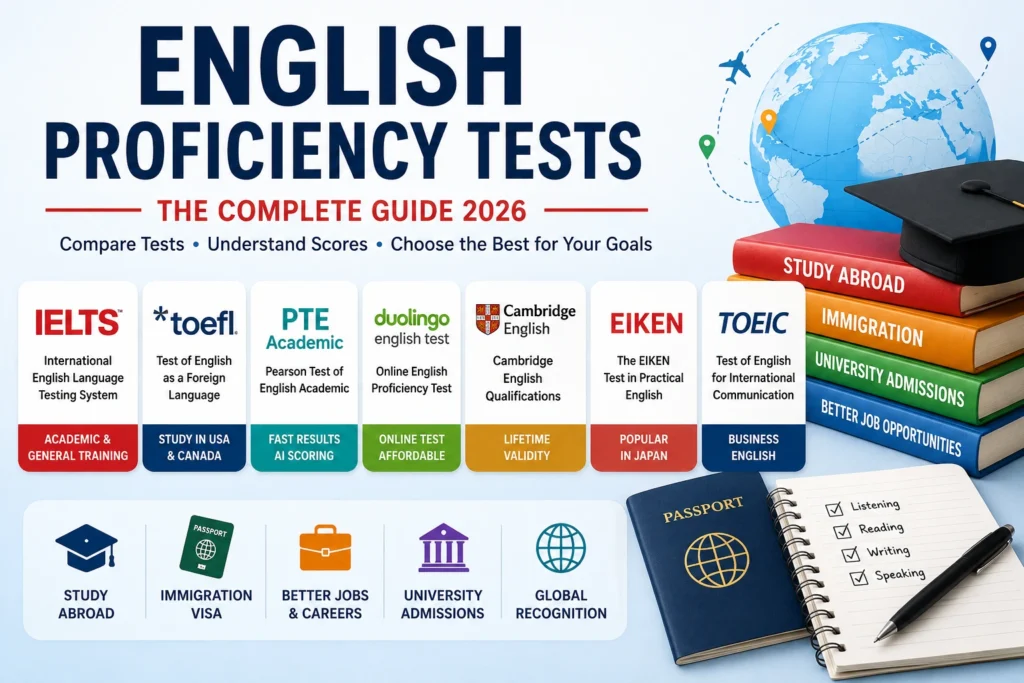
IELTS: Most common for immigration to Canada, Australia, and the UK.
TOEFL: Preferred by American universities.
PTE Academic: Gaining popularity for its fast results and computer-based format.
OET: Specifically for healthcare professionals.
How can I improve my English accent at home?
The best resource for accent reduction is ELSA Speak, which uses AI to compare your voice to native patterns. Additionally, the “Shadowing Technique” where you listen to a native speaker and repeat exactly what they say with a 1 second delay, is a highly effective, free method.
How many hours a day should I study English?
Research suggests that 30 to 60 minutes of “Active Study” (focused effort) combined with 1–2 hours of “Passive Immersion” (listening to music or podcasts while doing other things) is the most sustainable path to fluency. Over studying can lead to burnout, so it’s better to do a little every day than a long session once a week.
Are AI English tutors better than human teachers?
AI tutors are better for on-demand practice, grammar drilling, and low-cost repetition. However, human teachers are still superior for understanding cultural nuances, providing emotional encouragement, and preparing you for the unpredictability of real life social interactions. A mix of both is the ideal 2026 strategy.