Mastering punctuation is like learning the traffic signals of a language. Without them, your writing is a high-speed collision of ideas, leaving your reader confused and exhausted. Correct punctuation ensures that your message is delivered with the exact rhythm, emphasis, and clarity you intended.
This Punctuation Worksheet and Guide is designed to take you from basic understanding to total mastery. Whether you are preparing for the IELTS, managing a professional blog like englishlanguagestudies.com, or tutoring students, this comprehensive resource will help you master the “fine art” of the marks.
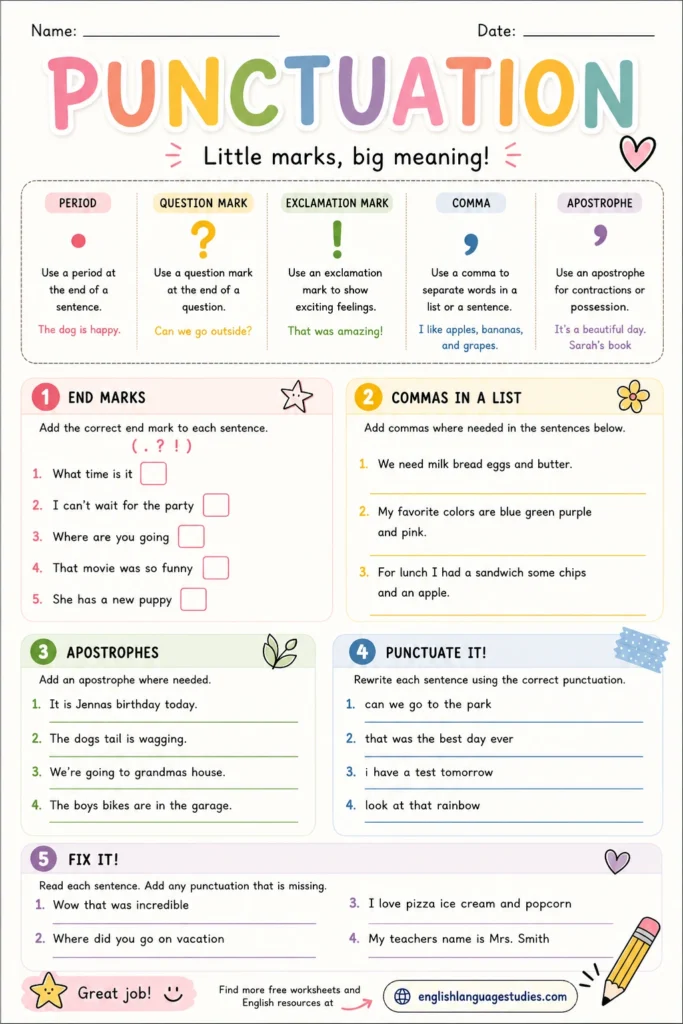
1. The Terminal Marks: Defining the Boundary
Terminal marks are the “stop signs” of the English language. They tell the reader that one complete thought has ended.
- The Period (.): Used to end a declarative sentence.
- Example: The student completed his ICT lab.
- The Question Mark (?): Used to end a direct inquiry.
- Example: Have you applied the thermal paste to the CPU yet?
- The Exclamation Point (!): Used to express strong emotion or urgency.
- Pro Tip: In academic writing (like the IELTS), use these very sparingly. They can make your work look unprofessional if overused.
2. The Comma (,): The Art of the Pause
The comma is the most used—and most misused—punctuation mark. It isn’t just a “breath”; it is a structural tool used to separate ideas within a sentence.
Key Comma Rules:
- The List Rule: Use commas to separate three or more items in a series.
- Example: I need to study Physics, C++, and Economics.
- The FANBOYS Rule: Use a comma before a coordinating conjunction (for, and, nor, but, or, yet, so) when joining two independent clauses.
- Example: I wanted to go for a walk, but it was raining.
- The Introductory Rule: Use a comma after an introductory phrase or dependent clause.
- Example: Although he was tired, Mudassir kept coding.
3. Semicolons (;) and Colons (:): The Sophisticated Links
These marks are the hallmark of advanced writing. Mastery of these will instantly boost your score in Grammatical Range and Accuracy.
The Semicolon (;)
The semicolon is stronger than a comma but weaker than a period. Use it to join two independent clauses that are closely related in meaning.
- Example: The laptop is overheating; the fan needs to be cleaned.
- Pro Tip: Use a semicolon before conjunctive adverbs like however, therefore, and nevertheless.
The Colon (:)
Think of the colon as a “ta-da!” mark. It signals that what follows is an explanation, a list, or a direct result of the first part of the sentence.
- Example: You need three things for SEO success: quality content, backlinks, and technical optimization.
4. Apostrophes (‘) and Quotation Marks (“)
These marks handle ownership and external voices.
- Apostrophes for Possession: * Singular: The student’s book (One student).
- Plural: The students’ books (Many students).
- Quotation Marks: Use these to enclose direct speech or titles of short works. In British English, single quotes (‘ ‘) are often used for the main quote, while American English prefers double quotes (” “).
5. Dashes (—) vs. Hyphens (-)
Even experienced writers confuse these two.
- The Hyphen (-): Used to join words together.
- Example: A well-known author; a long-term project.
- The Em Dash (—): A long dash used to signal a dramatic break or to add an emphasized parenthetical thought.
- Example: The result was clear—victory was ours.
6. Punctuation Worksheet: Test Your Skills
Copy these sentences and try to place the correct punctuation. The answers are provided in the FAQ section below!
- Ayan wants to play games however he must finish his math first
- The following subjects are required Physics Chemistry and Math
- Its a beautiful day to study isnt it
- If you want to pass the exam you must practice every day
- Wait the teacher shouted dont leave yet
7. Common Punctuation Mistakes to Avoid
- The Comma Splice: Joining two independent clauses with only a comma.
- Wrong: I am a student, I study C++.
- Right: I am a student; I study C++.
- The Greengrocer’s Apostrophe: Using apostrophes for plurals.
- Wrong: I bought three apple’s.
- Right: I bought three apples.
- Over-punctuation: Don’t put a comma everywhere you pause while speaking. Punctuation must follow grammatical rules, not your breathing patterns.
Check out: 5 Best AI Applications to Practice English Speaking (Updated Guide) | Top Apps for Fluency
Conclusion
Punctuation is the “silent grammar.” When done correctly, nobody notices it—the writing just flows. When done incorrectly, it’s all a reader can see. By mastering these marks, you ensure that your voice is heard exactly the way you intended.
Also read this: Top Grammar Checking Tools for Teachers (2025 Edition)
Frequently Asked Questions (FAQs)
1. Answers to the Punctuation Worksheet:
- Ayan wants to play games; however, he must finish his math first.
- The following subjects are required: Physics, Chemistry, and Math.
- It’s a beautiful day to study, isn’t it?
- If you want to pass the exam, you must practice every day.
- “Wait!” the teacher shouted. “Don’t leave yet!”
2. What is the Oxford Comma, and do I need it?
The Oxford Comma is the final comma in a list before “and” (e.g., Apples, oranges, and pears). In American English, it is standard. In British English, it is often optional unless it’s needed for clarity. For your blog and academic tests, we recommend using it to avoid any possible confusion.
3. Can I start a sentence with a conjunction like “But” or “And”?
In formal academic writing, it is generally discouraged. However, in blogging and creative writing, it can be used for emphasis. If you are writing for the IELTS, try to use transition words like “Moreover” or “However” instead.
4. How do I punctuate “inside” or “outside” quotation marks?
In American English, periods and commas almost always go inside the quotation marks (“like this.”). In British English, they often go outside unless the punctuation is part of the original quote.
5. Why is the semicolon called the most misunderstood mark?
Because many people use it where a colon or comma should go. Remember the golden rule: A semicolon must have a complete sentence on both sides of it. If the second part isn’t a complete thought, you can’t use a semicolon.
Would you like me to generate a specific set of practice exercises for semicolons and colons to help you master those advanced links?