Looking for a reliable PTE Academic Practice Test 2026 to prepare for your upcoming exam? Whether you are applying for a university in the USA or a professional visa in Europe, staying updated with the latest Pearson changes is essential.
As of early 2026, the exam has transitioned to a “Hybrid Scoring” model. This means that while AI still handles the speed of your results, human oversight now ensures that your responses—especially in the new Respond to a Situation and Summarize Group Discussion tasks—are natural and relevant. If you’ve been using outdated materials, your preparation might not align with these new standards. In this guide, we provide a complete PTE Academic Practice Test 2026 experience, along with the “79+ Secret” strategies used by high-scoring students to bypass common AI flags.
Key Takeaways: PTE Academic 2026
- Hybrid Scoring is Active: Scores are now determined by a mix of AI precision and human oversight to ensure your responses are relevant and natural.
- New Task: Summarize Group Discussion: You must now listen to 3 speakers and summarize their conflicting viewpoints—purely memorized templates will no longer work here.
- New Task: Respond to a Situation: You’ll have 20 seconds to prepare a spoken response to a real-world scenario (e.g., apologizing to a professor or asking for directions).
- Accuracy > Speed: In 2026, the AI penalizes “rhythmic monotony.” Avoid speaking like a robot; use natural intonation and pauses.
- The 79+ Priority: Focus your energy on Write from Dictation and Repeat Sentence, as these carry the highest weight for “Superior” level scores.
1. Prioritize Oral Fluency Over Perfection
Many test-takers from Europe and the USA lose marks because they try to sound too “perfect” or academic. In the Read Aloud and Repeat Sentence tasks, the PTE AI prioritizes Oral Fluency (the flow of your speech) over Pronunciation (your accent).
- The Golden Rule: If you stumble on a word, do not stop or correct yourself. A self-correction is a “fluency killer” that signals hesitation to the AI.
- 2026 Update: In the latest scoring updates, keeping a steady, moderate pace—like a newsreader—is more effective than speaking as fast as possible.
Check out our Free PTE Academic Practice Test | Read Aloud & Summarize
2. Master the “Keyword Mapping” Technique for Retell Lecture
You don’t need to understand every nuance of the lecture to get a high score. You need to capture the right keywords.
- The Strategy: During the audio, jot down 8–12 high-value nouns and adjectives (e.g., “climate change,” “socio-economic impact,” “mitigation”).
- The Template: Use a flexible framework like: “The lecture provided information about [Topic]. The speaker discussed [Keyword 1] and [Keyword 2]. Furthermore, the importance of [Keyword 3] was highlighted. In conclusion, the lecture suggests that [Keyword 4] is essential.” * Why it works: This ensures you hit the “Content” marks while maintaining a high “Fluency” score through a pre-memorized structure.
3. Beat the “Time Trap” in the Reading Section
The Reading section is uniquely challenging because the timer is shared across all question types. Many students spend 5 minutes on a difficult Reorder Paragraph and then have only 30 seconds left for the Fill in the Blanks, where the easy marks are hidden.
- The 2-Minute Rule: If you haven’t solved a Reorder Paragraph or Multiple Choice question within 2 minutes, make your best guess and move on.
- Focus Areas: Spend more time on Reading & Writing: Fill in the Blanks, as this task contributes significantly to both your Reading and Writing scores.
Check out our PTE Reading Practice | Fill in the Blanks (Drag & Drop)
4. Accuracy Over Complexity in Writing
The PTE AI is programmed to penalize grammatical errors and spelling mistakes heavily. A simple, perfectly written essay will always outscore a complex essay filled with “sophisticated” errors.
- Sentence Structure: Stick to a mix of simple and compound sentences. Avoid overly long, “run-on” sentences that increase the risk of subject-verb agreement errors.
- 2026 Tip: Use standard American Spelling (e.g., analyze instead of analyse) if you are targeting US traffic, as the engine is highly sensitive to consistency.
5. The “Final Two-Minute” Proofreading Ritual
In the Write Essay and Summarize Spoken Text tasks, typos are the most common reason students miss a 79+.
- The Ritual: Stop writing exactly 2 minutes before the timer ends. Use this time exclusively to check for:
- Capitalization: Proper nouns and the start of sentences.
- Punctuation: Ensure every sentence has a period.
- Plurals: Check if you missed an ‘s’ on plural nouns.
- Common Typos: Double letters (e.g., occurrence) and ‘i before e’ words.
Check out our PTE Writing Practice | 79+ Essay Template & Tips
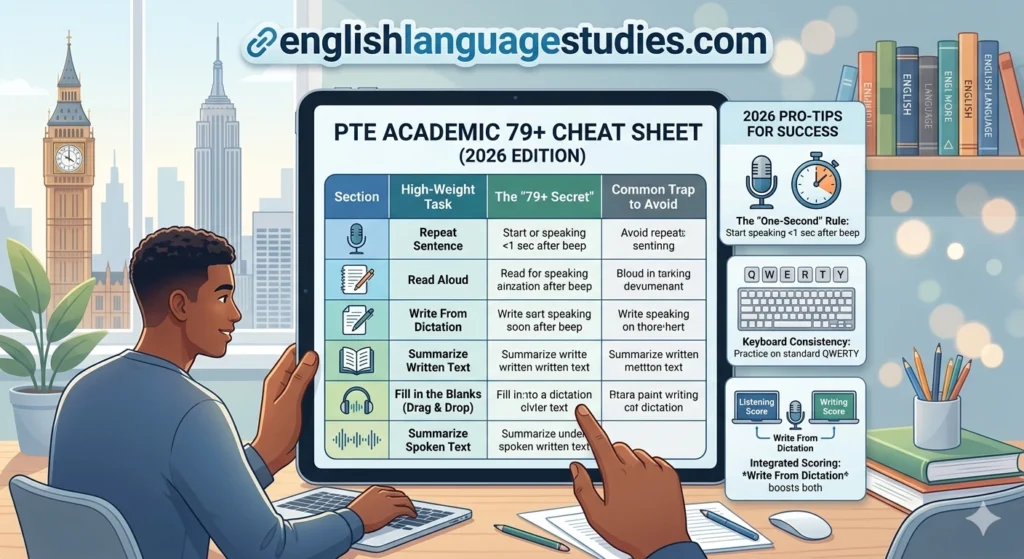
PTE Academic 79+ Cheat Sheet (2026 Edition)
| Section | High-Weight Task | The “79+ Secret” | Common Trap to Avoid |
| Speaking | Repeat Sentence | Focus on rhythm and intonation. Don’t stop if you miss a word; keep the flow. | Mimicking the accent. The AI wants clarity, not an impersonation. |
| Speaking | Read Aloud | Speak naturally. In 2026, Oral Fluency is king. Pause only at punctuation. | Over-pronouncing every syllable, which makes you sound robotic. |
| Writing | Write From Dictation | Every correct word is 1 point. You can add extra words if unsure of spelling! | Forgetting the period at the end of the sentence (zero marks for the item). |
| Writing | Summarize Written Text | Use a single, complex sentence (5–75 words). Connect ideas with “and” or “but.” | Writing multiple sentences or exceeding the word count. |
| Reading | Fill in the Blanks (Drag & Drop) | Use collocation knowledge (e.g., “provide an opportunity,” not “make an opportunity“). | Reading the entire text. Skim for context and focus on the surrounding words. |
| Listening | Summarize Spoken Text | Use a template. Focus on 9–12 high-value keywords from the audio. | Focusing so much on writing that you miss the next part of the lecture. |
Task 1: How to Master “Respond to a Situation”
In this task, you hear a real-world scenario (e.g., a late library book or a flight delay) and have 40 seconds to give a spoken response.
The Step-by-Step Strategy:
- Analyze the Tone (First 5 Seconds): Is it a boss (Formal), a friend (Informal), or a customer service agent (Semi-formal)?
- The “A-S-C” Framework (2026 Safe Template):
- Acknowledge: “I’m so sorry to hear about the delay with my assignment…”
- Solution/Action: “I will finish the remaining sections tonight and email them by 8 AM.”
- Close: “Thank you for your patience and understanding.”
- The “One-Second” Rule: Do not wait for the perfect sentence. Start speaking within 1 second of the beep to maintain your Oral Fluency score.
Pro-Tip for SEO: Add a section titled “Sample PTE Respond to a Situation Prompts 2026” to capture “Practice” intent traffic.
Task 2: How to Master “Summarize Group Discussion”
This is the most difficult new task. You listen to 3 people (2 males, 1 female or vice versa) and have 2 minutes to summarize their conversation.
The Step-by-Step Strategy:
- Note-Taking by Speaker: Draw three columns on your erasable scratchpad: S1, S2, S3.
- Identify the “Consensus”: Don’t just list what they said. Identify where they agree or disagree.
- The “Relationship Mapping” Template:
- “The discussion focused on [Topic]. While Speaker 1 argued that [Point], Speaker 2 disagreed, suggesting instead that [Point]. Speaker 3 mediated by proposing that [Point]. Ultimately, the group reached a consensus that [Final Outcome].”
- Avoid the “Robotic” Penalty: Use varied intonation. If you speak in a flat, monotone voice, the 2026 AI will flag it as a memorized script and lower your score.
2026 Scoring Warning: The Hybrid Model
In 2026, Pearson uses AI + Human Oversight.
- The AI checks your fluency and pronunciation.
- The Human checks if your content actually makes sense.
- Strategy: You can no longer say “The lecture was about birds, birds are good, I like birds” to cheat the fluency score. You must be relevant.
The 2026 Score Conversion Table
Use this data, which reflects the latest 2026 updates (where PTE 79+ is the gold standard for “Superior” English).
| Proficiency Level | PTE Academic | IELTS Band | TOEFL iBT (2026 Scale) |
| Expert | 86+ | 9.0 | 5.5 – 6.0 |
| Superior (Target) | 79 – 85 | 8.0 | 5.0 |
| Advanced | 73 – 78 | 7.5 | 4.5 |
| Good | 65 – 72 | 7.0 | 4.0 |
| Competent | 58 – 64 | 6.5 | 3.5 |
| Modest | 50 – 57 | 6.0 | 3.0 |
Common Mistakes to Avoid in the 2026 PTE
- Mistake #1: The “Silence Penalty.” Waiting more than 2 seconds to speak in the Respond to a Situation task.
- Mistake #2: Over-using generic connectors. AI now looks for “contextual” connectors like “Conversely” or “In light of this” rather than just “First, Second, Third.”
- Mistake #3: Ignoring Speaker Accents. In Summarize Group Discussion, listen for different accents (Australian, British, American) as the AI tracks if you’ve correctly identified which speaker said what.
Conclusion: Your Path to a 79+ PTE Score in 2026
The PTE Academic 2026 has evolved into a test that rewards authentic communication over mechanical memorization. By mastering the new Respond to a Situation and Summarize Group Discussion tasks and moving away from rigid, “robotic” templates, you are already ahead of 90% of test-takers.
Success in the 2026 format comes down to three things: Oral Fluency (staying smooth, not perfect), Content Relevance (answering the prompt, not just filling space), and Time Management. Whether your goal is a top-tier university in the USA or a professional career in Europe, the PTE remains the fastest, most reliable way to prove your English proficiency to the world.
Ready to Ace Your Exam?
Don’t leave your score to chance. Take the next step in your preparation today:
- Practice with Purpose: Use our [Link to Free 2026 PTE Mock Test] to see how the new hybrid scoring feels in real-time.
- Stay Updated: English requirements change fast. [Join our Newsletter] to receive weekly 2026 exam updates, PDF cheat sheets, and exclusive tips delivered straight to your inbox.
- Have a Question? Not sure how your current score converts or struggling with a specific task? Leave a comment below! I personally reply to every question to help you reach your target score.