Some people go to work simply to collect a paycheck. Others go because they have a calling. If you are the kind of person who naturally cheers for the underdog, who possesses a deep well of patience, and who believes that every single child deserves a chance to learn at their own pace, then entering the world of exceptional education isn’t just a career path, it is your purpose.
Choosing what to study in college is a massive, life-shaping decision. As you research paths in the education sector, you might be wondering: Is a special education bachelor’s degree too difficult? Will the emotional toll lead to early burnout? Is the investment of time and tuition actually worth it in today’s job market?
Let’s take an honest, in-depth look at what a special education bachelor degree is really about, what your college years will look like, and how you can choose the absolute best accredited university to launch your career.
What Exactly is a Special Education Bachelor’s Degree?
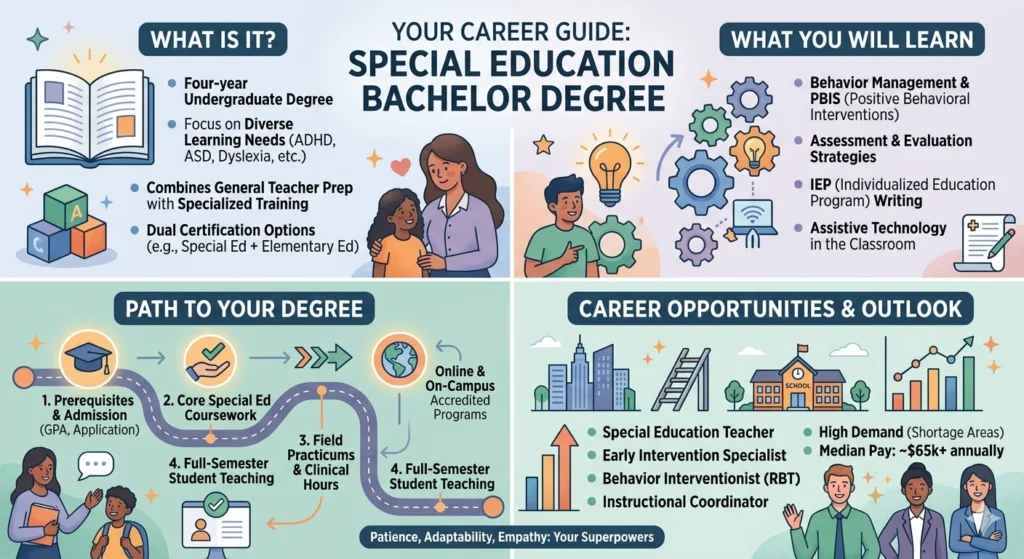
At its core, a special education bachelor degree is a four-year undergraduate program designed to equip you with the legal knowledge, behavioral strategies, and instructional tools needed to teach students with diverse learning needs. These needs span a wide spectrum, ranging from mild learning differences like dyslexia and ADHD to severe developmental delays, autism spectrum disorders (ASD), and physical disabilities.
This degree is much more focused than a general education track. While standard education majors learn what to teach to a standardized baseline, special education majors learn how to adapt the environment so every child can access that knowledge. It is less about rigid lesson planning and much more about creative problem-solving and systemic advocacy.
The “Dual Certification” Advantage
When shopping around for university programs, you will often find colleges offering a Dual Certification Major. This usually pairs a special education bachelor degree with a track in General Elementary Education (K-6) or Secondary Content Areas.
If you can find one of these programs, grab it. It essentially gives you two teaching credentials in a single undergraduate window, making you a highly versatile candidate. School principals actively hunt for dual-certified teachers because they understand how to seamlessly manage inclusion models where students with special needs study alongside neurotypical peers.
What Will You Actually Study?
Your university schedule will cover deeply practical, human-centered topics. Instead of just reading abstract academic theories, a modern special education bachelor degree requires you to take deep dives into:
- Introduction to Exceptionalities: Understanding the medical, psychological, and social aspects of different disabilities.
- Behavior Management & Positive Behavioral Interventions (PBIS): Learning how to decode a student’s behavior. You will learn that “acting out” is usually just a frustrated attempt to communicate, and you’ll discover how to guide them toward positive habits without relying on punishment.
- Assessment and Evaluation: Discovering how to accurately test and measure a child’s true cognitive and emotional potential, ensuring they aren’t left behind by rigid, standardized testing protocols.
- IEP (Individualized Education Program) Writing: The legal backbone of special education. You will learn how to draft custom educational roadmaps for students, which is a highly valued, specialized legal and pedagogical skill.
- Assistive Technology in the Classroom: Exploring everything from text-to-speech software and specialized communication apps to physical sensory tools that help neurodivergent kids focus and participate.
The Roadmap: How to Get Your Degree
Earning your special education bachelor degree is an intentional, step-by-step journey. While every university has its own unique layout, the general path looks remarkably consistent across accredited institutions.
[Prerequisites & General Ed] ---> [Core Special Ed Coursework] ---> [Field Practicums] ---> [Full-Semester Student Teaching]
1. Admission Prerequisites
To get accepted into a university’s school of education, you generally need a high school diploma or GED with a baseline GPA (typically between 2.5 and 3.0). Many competitive programs also require you to pass a basic academic skills test, such as the Praxis Core exam, during your sophomore year before you can officially enter upper-level teaching clinics.
2. The Clinical Component (Real-World Practice)
You won’t just be sitting in lecture halls copying down notes. A huge percentage of a special education bachelor degree takes place inside real classrooms.
- Field Practicums: Starting as early as your sophomore or junior year, you will spend a few hours a week observing local special education classrooms, helping with small groups, and getting comfortable with diverse learning dynamics.
- Student Teaching: This is the grand finale of your degree. During your senior year, you will spend an entire semester embedded full-time in a local school under the watchful eye of a master mentor teacher. This is where the magic happens where theory turns into practice, and where you build the confidence to run a room of your own.
Top Accredited Online Universities for This Degree
If you need a program that adapts to your life, pursuing your degree online is a fantastic option. However, not all online programs are created equal. The top-ranked, accredited online universities offering a special education bachelor degree vary by cost, structure, and entrance requirements:
1. Western Governors University (WGU)
WGU is widely recognized as one of the top producers of online special education graduates. It operates on a unique competency-based model, meaning you pay a flat rate per six-month term rather than paying per credit hour. If you work quickly and master the material fast, you can accelerate through classes, graduate early, and save massive amounts of tuition money.
- Accreditation: Northwest Commission on Colleges and Universities (NWCCU); AAQEP.
- Tuition Cost: Approximately $4,025 per 6-month term (which includes a $200 resources fee). Because there is no cost per class, you can finish as many courses as you can handle in that window.
- Enrollment Requirements: High school diploma or GED, official transcript submission, passage of a mandatory background check, and an interview with an admissions counselor.
2. Liberty University
Liberty University offers a highly structured, online Bachelor of Education (B.Ed.) in Special Education that leads directly to licensure eligibility. It provides a more traditional, semester-based timeline but with 100% online coursework flexibility.
- Accreditation: Southern Association of Colleges and Schools Commission on Colleges (SACSCOC); CAEP.
- Tuition Cost: $390 per credit hour for full-time enrolment (~$11,700 per year). E-books and online content are provided at no additional cost. They also offer a steep military discount dropping rates to $250 per credit hour.
- Enrollment Requirements: Online application, official high school or prior college transcripts showing a competitive GPA, and a formal background check clearance to allow for local field experience placement.
3. Florida International University (FIU Online)
For students seeking the prestige of a major public research institution, FIU Online offers a highly competitive Bachelor of Science in Exceptional Student Education. It features a robust curriculum focusing heavily on urban education challenges and diverse student backgrounds.
- Accreditation: SACSCOC; CAEP.
- Tuition Cost: Out-of-state tuition hovers around $660 per credit hour (~$18,500 annually). In-state Florida residents receive a heavily subsidized rate of roughly $205 per credit hour (~$6,500 annually).
- Enrollment Requirements: Online undergraduate application, official high school transcripts, SAT/ACT scores (for first-year applicants), or a minimum of 24 transferable college credits with a cumulative GPA of 2.5 or above.
Direct Comparison Metrics
| University | Best For | Pricing Structure | Licensure Track? |
| WGU | Fast-paced self-starters | Flat rate per 6-month term | Yes (Single or Dual Options) |
| Liberty University | Structured semester timelines | Per-credit hour pricing | Yes (Direct Licensure) |
| FIU Online | Public university prestige | Traditional per-credit rates | Yes (Includes ESOL endorsement) |
Critical Note on Online Certifications: While your academic classes for a special education bachelor degree can be completed 100% online, every accredited licensure track requires in-person field hours. You will work alongside your university’s clinical coordinator to fulfill your face-to-face observations and student teaching hours within a local public or private school in your immediate geographical area.
You may be interested in Fully Funded PhD Scholarships Around the World.
Career Opportunities Beyond the Classroom
A common misconception is that earning a special education bachelor degree means you are locked into a single job: teaching in a self-contained public school classroom forever. That couldn’t be further from the truth! This degree develops highly specialized, transferable skills that are desperately needed across multiple sectors.
- Special Education Teacher: Modifying curriculum, leading IEP meetings, and teaching core subjects in standard public or private school classrooms.
- Early Intervention Specialist: Working with infants and toddlers within state agencies or private clinics to catch and treat developmental delays early.
- Behavior Interventionist / Registered Behavior Technician (RBT): Implementing custom behavioral therapy plans for neurodivergent children in dedicated clinical or private practice spaces.
- Instructional Coordinator: Developing specialized curriculum frameworks and training general education teachers on how to handle accommodation requirements.
Salary Outlook and Market Security
The demand for qualified professionals holding a special education bachelor degree is historically high. School districts across the country experience chronic shortages in this field year after year.
According to the Bureau of Labor Statistics, tens of thousands of openings for special education teachers are projected each year on average over the coming decade due to programmatic expansions and retirements. The median annual pay hovers around $64,270, with senior-level educators, specialists, and coordinators in high-paying or high-demand regions clearing well over $100,000 per year.
Because it is a high-demand specialty area, many school districts offer attractive signing bonuses, student loan forgiveness incentives, or slightly accelerated salary steps for special education staff compared to general education tracks.
Is This Degree Right For You? The Soft Skills Checklist
Before you enroll and submit your application, it helps to do a quick heart-check. The best professionals who hold a special education bachelor degree share a specific set of core traits that can’t easily be taught in a university lecture:
- High Emotional Intelligence: Can you celebrate the tiny victories? In this field, progress isn’t always measured in giant leaps. Sometimes, a student finally making eye contact, regulating an emotional spike, or writing their own name for the first time is your biggest win of the month.
- Deep Patience & Empathy: When a student is having an intense sensory breakdown, can you remain the calm anchor in their storm rather than matching their frustration?
- Radical Adaptability: If a lesson plan fails beautifully ten minutes into class, can you smile, pivot, and invent a completely new approach on the fly?
- Collaborative Spirit: You aren’t an island. You will constantly work alongside anxious parents, speech-language pathologists, occupational therapists, school psychologists, and administration. Being an elite team player is non-negotiable.
Frequently Asked Questions (FAQs)
Can I earn a special education bachelor degree completely online?
Yes, the academic portion can be completed 100% online through many accredited universities. However, keep in mind that the mandatory student teaching and field practicum hours must be completed in person at an approved school or clinical setting in your local area.
What is the difference between a general education degree and a special education degree?
A general education degree focuses on teaching standard curricula to large groups within a specific grade level or subject area. A special education bachelor degree focuses on instructional modification, behavior analysis, legal accommodations, and individualizing lessons for students with varied cognitive, emotional, or physical needs.
Are there student loan forgiveness programs for special education teachers?
Yes! Because special education is classified as a high-need field in almost every state, graduates often qualify for substantial federal loan forgiveness programs (such as the Public Service Loan Forgiveness program or the Teacher Loan Forgiveness program) after teaching full-time in a low-income school for a set number of years.
The Verdict: Taking Your Next Step
Earning a special education bachelor degree requires genuine dedication, emotional investment, and resilience. It is a path that challenges you to grow as a person just as much as an educator. But if you have a passion for advocacy and a desire to build a career that leaves a legacy, the rewards are completely unmatched. You get to be the person who helps a child discover their hidden voice, decode a world that feels overwhelming, and build the confidence to succeed against all odds.
If your heart is pulling you toward this field, look into local or accredited online universities today, check out their dual-licensure tracks, and take that first step toward a deeply meaningful career.