For thousands of students worldwide, the International English Language Testing System (IELTS) is the gateway to prestigious universities and global career opportunities. However, the path to a Band 7.5 or 8.0 is rarely a straight line. Many candidates spend months memorizing vocabulary only to find themselves overwhelmed by the pressure of the actual exam. This is where IELTS mock tests become your most powerful weapon.
A mock test is more than just a practice session; it is a full-scale simulation of the psychological and intellectual demands of the test day. In this comprehensive guide, we will explore how to leverage mock tests to master the Academic Reading and Writing modules, ensuring you walk into the test center with total confidence.
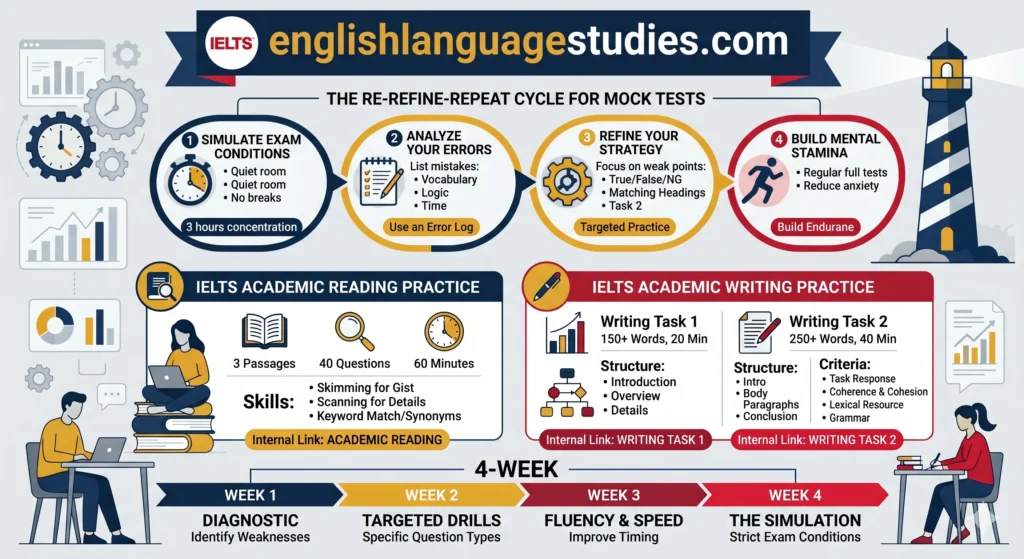
The Importance of Simulating the Exam Environment
The most common reason for underperformance in the IELTS is not a lack of English knowledge, but a lack of time management. The Academic module, in particular, is designed to be a “race against the clock.” By taking a full-length IELTS mock test, you learn exactly how your brain reacts when you have only ten minutes left and a full page of text to analyze.
The Psychology of the Mock Test
When you sit for a practice test, you are building “mental stamina.” Most students are not used to concentrating for three hours without a break. Regular practice helps reduce “test anxiety,” as the format, the question types, and the ticking clock become familiar friends rather than sources of stress.
Mastering Academic Reading via Mock Tests
The IELTS Academic Reading section consists of three long passages with a total of 40 questions. These texts are often taken from journals, magazines, and newspapers, covering topics ranging from space exploration to psychological theories.
Strategies for the Reading Module
When engaging with IELTS mock tests, you should focus on three core techniques:
- Skimming: Reading the passage quickly to get the “gist” or the main idea of each paragraph. This should take no more than 2 to 3 minutes per passage.
- Scanning: Looking for specific information—names, dates, numbers, or keywords—without reading every word.
- The “Keyword” Match: The IELTS is a test of synonyms. If the question uses the word “significant,” the text might use the word “substantial.” Mock tests help you build this “synonym radar.”
Breaking Down Academic Writing Task 1
In Academic Writing Task 1, you are required to describe visual information in at least 150 words. This could be a bar chart, line graph, pie chart, table, or a process diagram.
The Three-Step Structure
To score a Band 7.0 or higher, you must follow a logical structure:
- Introduction: Paraphrase the prompt.
- Overview: Describe the main trends or the most striking features of the data without mentioning specific numbers.
- Details Paragraphs: Group the data logically and provide specific figures to support your observations.
Using IELTS mock tests to practice Task 1 allows you to develop “speed-writing” skills. You should never spend more than 20 minutes on this task, as Task 2 is worth double the points.
The Art of the Argument: Academic Writing Task 2
Academic Writing Task 2 is a formal essay of at least 250 words. You will be asked to discuss an opinion, argue for or against a statement, or analyze a problem and its solutions.
The Secret to Task 2 Success
The examiner marks you on four criteria:
- Task Response: Did you answer every part of the question?
- Coherence and Cohesion: Do your ideas flow logically? Are you using transition words like Furthermore, In contrast, and Consequently?
- Lexical Resource: Are you using a wide range of academic vocabulary?
- Grammatical Range and Accuracy: Are you using complex sentences and avoiding simple spelling errors?
During your IELTS mock tests, practice planning your essay for 5 minutes before you start writing. A well-planned essay is always more coherent than one written in a rush.
How to Analyze Your Mock Test Results
Taking the test is only half the battle; the real growth happens during the Review Phase.
The Error Log
Keep a dedicated notebook for your mock test errors. For the Reading section, don’t just see that you got a “True/False/Not Given” question wrong. Ask yourself:
- Did I misunderstand a vocabulary word?
- Did I miss a “distractor” word like always, sometimes, or only?
- Did I misread the question instructions?
Using a Band Score Calculator
Because the Listening and Reading modules are objective, you can use a raw score table to estimate your band. If you consistently score 30 out of 40 in your IELTS mock tests, you are hovering around a Band 7.0. Aiming for 35 or more will push you into the elite Band 8.0 category.
Building Vocabulary through Mock Papers
One of the best ways to expand your academic vocabulary is to harvest words from the reading passages you have just practiced. Words like ubiquitous, mitigate, detrimental, and unprecedented appear frequently in Academic IELTS. Instead of memorizing long lists of random words, learning them in the context of a story or an article makes them much easier to remember and use in your own Writing tasks.
The Final Countdown: 4 Weeks to Test Day
To maximize the effectiveness of IELTS mock tests, we recommend a structured 4-week countdown:
- Week 1 (Diagnostic): Take two full-length tests to identify your weakest module. Is it the pressure of Task 2 or the complexity of the third Reading passage?
- Week 2 (Targeted Practice): Spend the week doing specific drills. If you struggle with Reading, do five “Matching Headings” tasks in a row.
- Week 3 (Fluency and Speed): Take three mock tests this week. Focus on finishing each module with 5 minutes to spare.
- Week 4 (The Simulation): Take one test every two days under strict exam conditions. No phone, no snacks, and no breaks.
Conclusion: Why Your Journey Starts with a Mock Test
The IELTS is not just a test of your English; it is a test of your ability to perform under pressure. By integrating IELTS mock tests into your weekly study routine, you transform the exam from a terrifying obstacle into a predictable set of tasks.
Whether you are aiming for a Band 6.5 for immigration or a Band 8.5 for a medical license, the secret remains the same: practice, analyze, and refine. At englishlanguagestudies.com, we provide the tools, the templates, and the interactive support you need to reach your target. Start your first mock test today, and take the first step toward your global future.
For more practice, check out 10 Best Websites for Free IELTS Mock Tests (Updated Edition)
FAQs
How many mock tests should I take?
Ideally, you should take at least 8 to 10 full-length tests before your actual exam date to ensure your speed and accuracy are consistent.
Can I use a pen for the IELTS Reading and Listening?
If you are taking the Paper-Based test, you must use a pencil for the Reading and Listening sections. However, for the Computer-Based test, you will type your answers.
Is Writing Task 2 more important than Task 1?
Yes. Task 2 carries double the weight toward your final Writing band score. However, you must perform well in both to reach a high band.
What is the difference between an online IELTS mock test and the official Computer-Delivered IELTS?
While many IELTS mock tests online mimic the general feel of the exam, the official Computer-Delivered IELTS has specific features like a built-in “Highlight” tool and a “Notes” function. Additionally, the official test interface includes a clock that turns red when you have five minutes remaining in the Writing section. Practicing with digital mock tests is excellent for building typing speed and getting used to reading on a screen, which is essential if you plan to skip the paper-based version.
If I take a mock test, how accurate is the score for the Writing section?
Scoring your own Reading and Listening modules is easy because they have fixed answers. However, scoring Writing is more complex. Most students use an IELTS mock test to practice their timing and structure, but for an accurate band score, you should compare your essay against the official “IELTS Band Descriptors.” These focus on four areas: Task Response, Coherence, Lexical Resource, and Grammar. If your mock essay follows a proven template and addresses all parts of the prompt, you are likely on track for a high score.