This worksheet includes 50 MCQs covering all major types of conditional sentences. Each section has ten questions, making it ideal for classroom practice, homework, ESL teaching, online quizzes, and exam preparation. Students will strengthen their understanding of verb forms, sentence structure, and meaning interpretation.
The questions are designed to promote careful thinking and recognition of patterns. Options are written with dark backgrounds (as you prefer) for better readability when published on your website or embedded in LiveWorksheet format.
Whether you are a teacher looking for ready-made practice materials or a learner preparing for tests like IELTS, O-Level, or entry exams, this interactive Conditional Sentences Live Worksheet will improve your grammar skills and confidence.
Conditional Sentences Live Worksheet 1
Test your knowledge of Zero, 1st, 2nd, and 3rd Conditionals.
Conditional Sentences Live Worksheet 2
Mix of Zero, 1st, 2nd, and 3rd Conditionals.
- If you heat ice, it (melt).
- If it rains tomorrow, I (stay) at home.
- If she (study) hard, she will pass the exam.
- If I (win) the lottery, I would travel the world.
- If I (be) you, I would tell the truth.
- What would you do if you (see) a ghost?
- If they (leave) earlier, they wouldn’t have missed the bus.
- If I (know) it was your birthday, I would have bought a gift.
- She (pass) if she had studied more.
- If you don’t water plants, they (die).
- If we (not go) to the party, we wouldn’t have met him.
- If I (have) more time, I would help you.
Check out our more Live Worksheets
INTRODUCTION
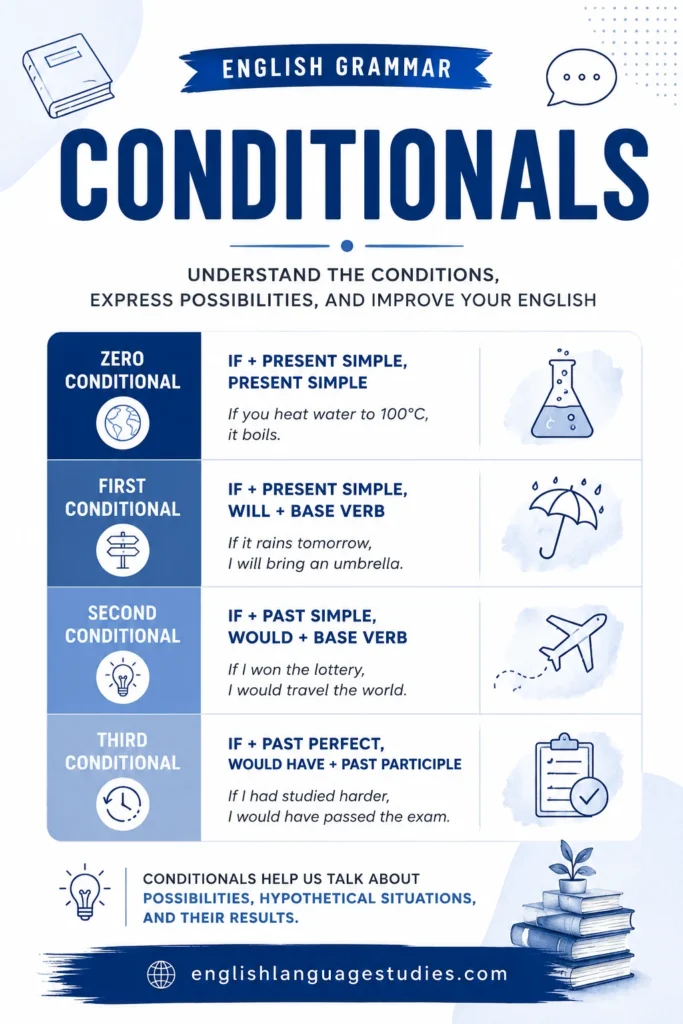
Conditional Sentences are an essential part of English grammar because they help us talk about possibilities, situations, consequences, and imaginary scenarios. Whether you are making predictions, giving advice, imagining unreal situations, or talking about past regrets, conditional sentences allow you to express complex ideas with clarity. This “Conditional Sentences Live Worksheet” gives learners the chance to practice all four main types: Zero Conditional, First Conditional, Second Conditional, and Third Conditional, along with a Mixed Conditional section for advanced understanding.
In English, conditional sentences follow specific patterns that help show whether something is always true, likely, unlikely, or impossible. Students often confuse the verb tenses used in the “if-clause” and “main clause,” which is why structured practice is necessary. This worksheet makes the learning process simple, interactive, and learner-friendly.
Zero Conditional is used to express facts, routines, and situations that are always true. The structure is straightforward: If + present simple, present simple. For example: “If you heat ice, it melts.” These sentences reflect scientific truths or general behaviours.
First Conditional expresses real and possible situations in the future. It uses: If + present simple, will + base verb. An example is: “If it rains, we will stay home.” These sentences talk about realistic possibilities.
Second Conditional describes unreal, imaginary, or unlikely situations in the present or future. The pattern is: If + past simple, would + base verb. For example: “If I had wings, I would fly.” These sentences show imagination or hypothetical conditions.
Third Conditional talks about imaginary situations in the past—things that did not happen but we imagine different outcomes. Its structure is: If + past perfect, would have + past participle. Example: “If she had studied, she would have passed.”
Mixed Conditionals combine different time references—often imagining a different past affecting the present, or an unreal present affecting an imagined past. For example: “If I had slept earlier, I wouldn’t be tired now.”