Choosing between the two giants of English proficiency is the first major hurdle for any international healthcare professional. When asking “IELTS vs. TOEFL: Which Exam is Best for a US Nursing License?”, the answer depends less on which test is “easier” and more on which one aligns with your specific state board and visa requirements in 2026. For an international registered nurse (RN), this decision is a strategic career move that impacts your CGFNS certification, your VisaScreen® application, and your ultimate ability to practice in the United States.
The United States has some of the most rigorous English standards in the world for healthcare workers. To ensure patient safety and effective communication within the US healthcare system, organizations like the Commission on Graduates of Foreign Nursing Schools (CGFNS) and various State Boards of Nursing (BON) set strict “cut-off” scores. While both exams are widely accepted, they offer vastly different testing experiences. The IELTS (International English Language Testing System) is known for its face-to-face speaking component, while the TOEFL (Test of English as a Foreign Language) is a fully computer-based experience that many find more academically challenging.
In this comprehensive guide, we will analyze the latest 2026 requirements for both exams. We will break down the minimum score requirements for the most popular US states, compare the costs of each test, and evaluate which exam format favors the typical nursing background. Whether you are aiming for a position in a high-paying California hospital or a specialized clinic in New York, understanding the nuances of the IELTS vs. TOEFL for a US nursing license will save you months of redirected effort and hundreds of dollars in unnecessary retake fees. Let’s dive into the data to see which pathway is right for your American nursing dream.
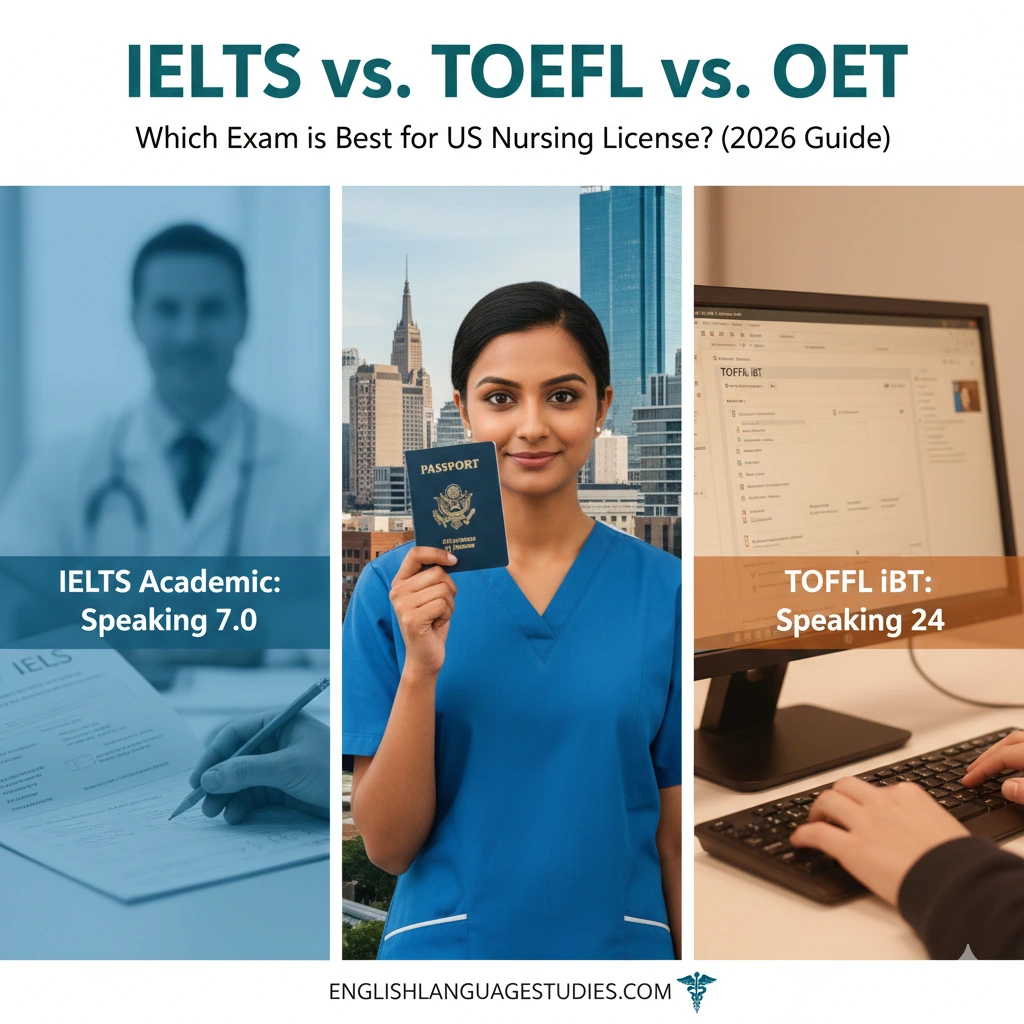
Table of Contents
Essential Comparison Table
| Feature | IELTS Academic | TOEFL iBT |
| CGFNS/VisaScreen Goal | Overall 6.5 (Speaking: 7.0) | Overall 81 (Speaking: 24) |
| Test Format | Paper or Computer + Human Interview | 100% Computer-based |
| Speaking Section | One-on-one with an examiner | Speaking into a microphone |
| Writing Style | Data analysis & Opinion essay | Integrated academic tasks |
| Best For | Nurses who prefer human interaction | Nurses comfortable with fast typing |
The “Wildcard” Option: Is OET Better Than IELTS or TOEFL?
While IELTS and TOEFL are the traditional giants, many international nurses are switching to the OET (Occupational English Test). Unlike general exams, the OET uses real-world medical scenarios—like writing a patient referral letter or role-playing a consultation with a patient.
As of 2026, OET is widely accepted by CGFNS for VisaScreen® and an increasing number of US State Boards (including Florida, Oregon, Washington, Michigan, and Massachusetts).
Pros of Choosing OET
- Medical Context: You won’t have to write essays about “space exploration” or “global warming.” All tasks are based on nursing work, which often feels more natural for healthcare professionals.
- Higher Pass Rates for Nurses: Many nurses who struggle to get a 7.0 in IELTS Writing find the OET Writing section (writing a discharge/referral letter) much easier to pass.
- Section Banking: In some jurisdictions, if you fail one sub-test, you may be able to “bank” your passing scores and only retake the section you missed (though you must verify if your specific US state board allows this in 2026).
Cons of Choosing OET
- Higher Cost: The OET is significantly more expensive. Expect to pay approximately $455 USD, compared to roughly $250 USD for IELTS or TOEFL.
- Limited Acceptance: While growing, OET is not yet accepted by all 50 US State Boards. If you haven’t decided which state you want to work in yet, IELTS or TOEFL are “safer” because they are accepted everywhere.
- Immigration Restrictions: While CGFNS accepts OET for your visa credentials, some other countries (like Canada) still primarily require IELTS for permanent residency pathways. If you are considering multiple countries, OET might limit your options.
The 2026 CGFNS English Verification Checklist
Follow these 6 steps to ensure your English scores are accepted for your VisaScreen® or State Board evaluation.
☐ Step 1: Confirm Your “State-Specific” Requirements
Before booking an exam, check your target State Board of Nursing (BON). While the federal VisaScreen requires an IELTS Speaking score of 7.0 or a TOEFL Speaking score of 24, some states (like New Jersey or Virginia) have slightly different thresholds for initial licensure.
☐ Step 2: Choose an “In-Person” Test Center
Critical Warning: As of 2026, CGFNS does not accept “At-Home” or “Online” versions of the IELTS or TOEFL. You must physically go to an authorized testing center. Taking the home version will result in an automatic rejection of your English requirement.
☐ Step 3: Register Using Your Exact Passport Name
Ensure the name on your exam registration matches your CGFNS Connect profile and your passport exactly. Even a minor typo or a missing middle name can cause months of delays in “matching” your scores to your file.
☐ Step 4: Add CGFNS as a Score Recipient
Do not wait until you get your results. When you register for your exam, use the following institution codes to have your official Electronic Score Report sent directly to CGFNS:
- TOEFL Code: 5907
- IELTS: Search for “CGFNS International” in the list of recognized organizations.
☐ Step 5: Verify the “Single Sitting” Rule
CGFNS requires you to achieve all minimum scores in a single test sitting. Unlike some UK or Australian boards, CGFNS generally does not allow “score clubbing” (combining results from two different dates).
☐ Step 6: Monitor Your “CGFNS Connect” Portal
After your exam, it typically takes 7 to 14 business days for scores to appear in your CGFNS dashboard. If they do not appear after 21 days, use the “Contact Us” feature in your portal to request a manual match using your TRF number (IELTS) or Appointment Number (TOEFL).
Conclusion: Your Pathway to the US Healthcare System
Deciding between IELTS vs. TOEFL for your US nursing license is more than just a language choice; it is a logistical decision that sets the pace for your entire immigration journey. In 2026, both exams remain gold-standard options recognized by CGFNS and State Boards across the country. If you thrive in one-on-one conversational settings and prefer a mix of question types, the IELTS Academic remains your strongest ally. However, if you are a fast typist who prefers a streamlined, 100% computer-based academic environment, the newly shortened TOEFL iBT may be your fastest route to success.
Ultimately, your goal is not just to “pass” a test, but to ensure your communication skills are robust enough to provide safe, effective patient care in a high-pressure American hospital. Before booking your seat, verify your specific state’s “Speaking” requirements one last time, as these are the most common points of failure for international RNs. With the right preparation and a clear understanding of the 2026 CGFNS standards, you are well on your way to achieving your dream of practicing nursing in the United States.
Final 2026 Nursing License Action Plan
- Select Your State: Check if your target State Board of Nursing (e.g., Texas, California, Florida) accepts your chosen exam.
- Verify the Version: Ensure you are booking IELTS Academic (not General) or TOEFL iBT (at a test center).
- Download the 2026 Syllabus: Get the latest official prep materials to avoid practicing with outdated 2024/2025 formats.
- Schedule for “Buffer Time”: Book your exam at least 6 months before you intend to submit your VisaScreen® application to allow for potential retakes.
More Insights
The OET Test for Healthcare Professionals: A Complete Guide
FAQs
Can I use the IELTS General Training for my US nursing license?
No. You must take the IELTS Academic version. The General Training version is not accepted by CGFNS or most state boards for professional licensure.
Does every US state accept the TOEFL iBT?
Yes, the TOEFL iBT is universally accepted across all 50 US State Boards of Nursing. However, some states (like Florida or Michigan) may have slightly different “speaking” score requirements than the federal VisaScreen standard.
Is the OET (Occupational English Test) better than IELTS or TOEFL?
The OET is healthcare-specific and often feels “easier” for nurses because the vocabulary is medical. However, it is more expensive (approx. $455 USD) compared to IELTS or TOEFL (approx. $250 USD). Always check if your specific state board accepts OET before booking.