Expanding your understanding of the English language requires moving beyond the alphabet. While we learn five vowel letters (A, E, I, O, U) in primary school, the reality of spoken English is far more complex. To achieve true fluency, one must master the 20 distinct vowel phonemes.
This guide is designed to help you with Understanding Vowel Sounds in the English Language, providing a deep dive into the mechanics of pronunciation, the mystery of the Schwa, and the “gliding” nature of diphthongs.
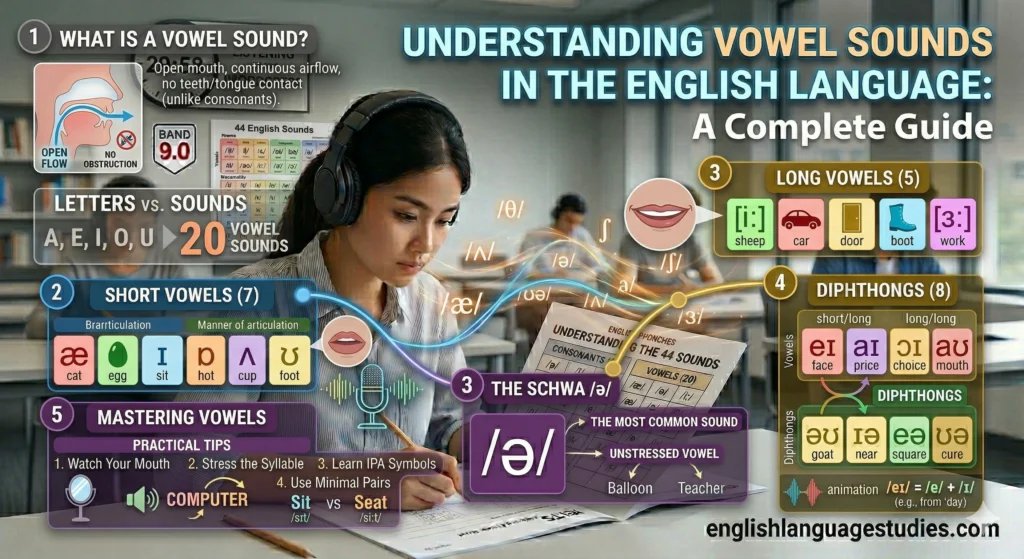
1. The Core Concept: Phonemes vs. Graphemes
The first step in Understanding Vowel Sounds in the English Language is separating the letter from the sound.
- Graphemes: These are the written letters (A, E, I, O, U).
- Phonemes: These are the actual sounds produced by the vocal cords.
In English, a single vowel letter can represent multiple sounds. For example, consider the letter ‘A’ in these three words:
- Cat (/æ/) – A short, sharp sound.
- Father (/ɑ:/) – A deep, open sound.
- Any (/e/) – A sound usually associated with the letter ‘E’.
By focusing on the sound rather than the spelling, you unlock the “source code” of English pronunciation.
2. The Mechanics of the Vowel Sound
Unlike consonant sounds, which are created by creating friction or stopping air with your teeth, tongue, or lips, vowel sounds are produced with an unobstructed vocal tract.
When you practice Understanding Vowel Sounds in the English Language, you are essentially learning how to manipulate three things:
- Tongue Position: Is the tongue at the front, middle, or back of the mouth? Is it high or low?
- Lip Shape: Are your lips rounded (like for “boot”) or unrounded/spread (like for “sheep”)?
- Jaw Tension: Is your mouth wide open (low) or nearly closed (high)?
3. Short Vowels: The Building Blocks
Short vowels are often the most frequent sounds in English. They are “lax,” meaning the muscles in your mouth are relatively relaxed when you produce them.
- /æ/ (The ‘Short A’): Found in apple, cat, trap. Your mouth should be open wide.
- /e/ (The ‘Short E’): Found in bed, men, dress.
- /ɪ/ (The ‘Short I’): Found in sit, pin, kit. This is a very quick sound.
- /ɒ/ (The ‘Short O’): Found in hot, rock, lot. (Note: This sound varies significantly between British and American English).
- /ʌ/ (The ‘Short U’): Found in cup, luck, strut.
- /ʊ/ (The ‘Short OO’): Found in foot, put, book.
- /ə/ (The Schwa): The most common sound in English. It is the neutral “uh” found in about and mother.
4. Long Vowels: The Tense Sounds
Long vowels are “tense,” meaning the vocal muscles are more engaged. In the International Phonetic Alphabet (IPA), these are marked with a colon (:) to indicate duration.
- /i:/ (Long E): Found in sheep, dream, keep. Your mouth should form a slight “smile.”
- /ɑ:/ (Long A): Found in car, bath, father. A deep sound from the back of the throat.
- /ɔ:/ (Long O): Found in door, saw, walk.
- /u:/ (Long U): Found in blue, food, goose. This requires strong lip rounding.
- /ɜ:/ (The ‘ER’ sound): Found in bird, nurse, work.
5. Diphthongs: The Vowel Glides
A diphthong is a single syllable that contains two vowel sounds. The sound starts as one vowel and glides into another. If you want to score high in English fluency, mastering these glides is essential.
- /eɪ/: Starts at /e/ and moves toward /ɪ/. (e.g., Face, Day, Break)
- /aɪ/: Starts at /a/ and moves toward /ɪ/. (e.g., Price, High, My)
- /ɔɪ/: Starts at /ɔ/ and moves toward /ɪ/. (e.g., Choice, Boy, Oil)
- /aʊ/: Starts at /a/ and moves toward /ʊ/. (e.g., Mouth, Now, Cloud)
- /əʊ/: Starts at /ə/ and moves toward /ʊ/. (e.g., Goat, Show, No)
- /ɪə/: Moves from /ɪ/ to the Schwa /ə/. (e.g., Near, Here, Ear)
- /eə/: Moves from /e/ to the Schwa /ə/. (e.g., Square, Fair, There)
- /ʊə/: Moves from /ʊ/ to the Schwa /ə/. (e.g., Cure, Tourist, Pure)
6. The “Invisible” Vowel: Mastering the Schwa /ə/
You cannot truly succeed in Understanding Vowel Sounds in the English Language without obsessing over the Schwa. Because English is a stress-timed language, we do not give every syllable equal weight.
In any multi-syllable word, the unstressed vowel usually collapses into a Schwa.
- Photograph (The first ‘o’ is stressed: /fəʊ/)
- Photography (The first ‘o’ becomes a Schwa: /fə/)
Learning to “weaken” your vowels in unstressed positions is the fastest way to stop sounding like a robot and start sounding like a native speaker.
7. Minimal Pairs Practice
To sharpen your ear, compare words that differ by only one vowel sound. This is a classic exercise for Understanding Vowel Sounds in the English Language.
| Word A (Short) | Word B (Long) |
| Ship (/ɪ/) | Sheep (/i:/) |
| Pull (/ʊ/) | Pool (/u:/) |
| Cot (/ɒ/) | Caught (/ɔ:/) |
| Fill (/ɪ/) | Feel (/i:/) |
8. Practical Tips for Self-Improvement
- Record and Compare: Record yourself reading a list of vowel-heavy sentences. Listen to a native speaker (using tools like YouGlish) and identify where your vowel mouth-shape differs.
- The “Finger” Test: For sounds like /æ/ (cat), you should be able to fit two fingers vertically between your teeth. For /ɪ/ (sit), only one.
- Physical Awareness: Notice where your tongue is. Is it touching your bottom teeth? Is it pulled back?
- Use the IPA: Don’t guess. When you look up a word in the dictionary, look at the phonetic spelling. It tells you exactly which of the 20 sounds to use.
Check out 5 Best AI Applications to Practice English Speaking (Updated Guide) | Top Apps for Fluency
Conclusion
Understanding Vowel Sounds in the English Language is the difference between being understood and being clear. By breaking vowels down into short, long, and diphthongs, and by giving the Schwa the respect it deserves, you will transform your pronunciation.
Remember: English spelling is a suggestion; English sounds are the reality.
More Reads
The Best Applications to Practice English Listening: A Complete Guide for USA & European Learners
10 AI-Powered Tools That Can Transform English Language Learning in 2025
Frequently Asked Questions
Why are there so many vowel sounds but only 5 letters?
English uses combinations of letters (digraphs) to create additional sounds. For instance, ‘o’ and ‘i’ together create the dynamic sound /ɔɪ/ found in “boy,” which is distinct from ‘o’ alone. This is why understanding vowel sounds is about phonetics, not just spelling.
What is the difference between a simple vowel and a diphthong?
A simple vowel (both short and long) uses a single tongue position that does not change (e.g., /i:/ in sheep). A diphthong, like /aʊ/ in cow, requires your tongue to move smoothly from one position to a second position within the same syllable.
Can I use the alphabet letter names to remember vowel sounds?
No. Alphabet letter names (A= /eɪ/, E= /i:/) are useful for spelling, but understanding vowel sounds requires recognizing that the letter ‘a’ can also make the sound /æ/ (cat), /ɔ:/ (ball), or /ə/ (sofa).
How can I learn the Schwa sound effectively?
To learn the Schwa, you must first learn word stress. Identify the unstressed syllables in a word. If a vowel falls in that unstressed spot, it is almost certainly a Schwa. Focus on making it a neutral, quiet “uh” sound.
Does my accent change the number of vowel sounds I use?
Almost all dialects of English use the same categories of vowel phonemes (20 sounds), but the precise way they sound or are realized varies enormously. (Example: the word “bath” uses /æ/ in US English but /ɑ:/ in British RP). Understanding vowel sounds globally means recognizing these phoneme shifts.