
Basic Email Writing in Business English
In today’s globalized workplace, digital correspondence has become the primary bridge between professionals across the globe. Mastering Basic Email Writing in Business English: Greetings & Closings is no longer just a helpful skill; it is a fundamental requirement for anyone looking to build professional credibility. Whether you are applying for a high-stakes job, pitching a service to a new client, or providing a critical update to your manager, every email you send acts as a digital handshake. A well-structured message reflects your attention to detail, your respect for the recipient, and your overall mastery of professional communication.
Despite its importance, many English learners struggle with the nuances of digital etiquette. The difficulty often lies in choosing the correct “register”—knowing when a situation requires a formal, traditional approach and when a more modern, conversational tone is appropriate. Using a greeting that is too casual can appear disrespectful, while an overly stiff closing can make a routine message feel unnecessarily cold. These small linguistic choices significantly impact how your message is received and how your professional brand is perceived by colleagues and leadership alike.
In this comprehensive guide, we will walk you through the essential building blocks of effective professional correspondence. We will explore the various categories of Basic Email Writing in Business English: Greetings & Closings, providing you with a library of practical phrases for every scenario. From the “Gold Standard” greetings used in international trade to the most effective sign-offs for follow-up messages, this guide offers clear, actionable examples. By the end of this article, you will have the confidence to hit “send,” knowing that your email is polite, professional, and perfectly tuned to the modern business environment. Let’s begin by looking at how to select the right opening for your specific audience.
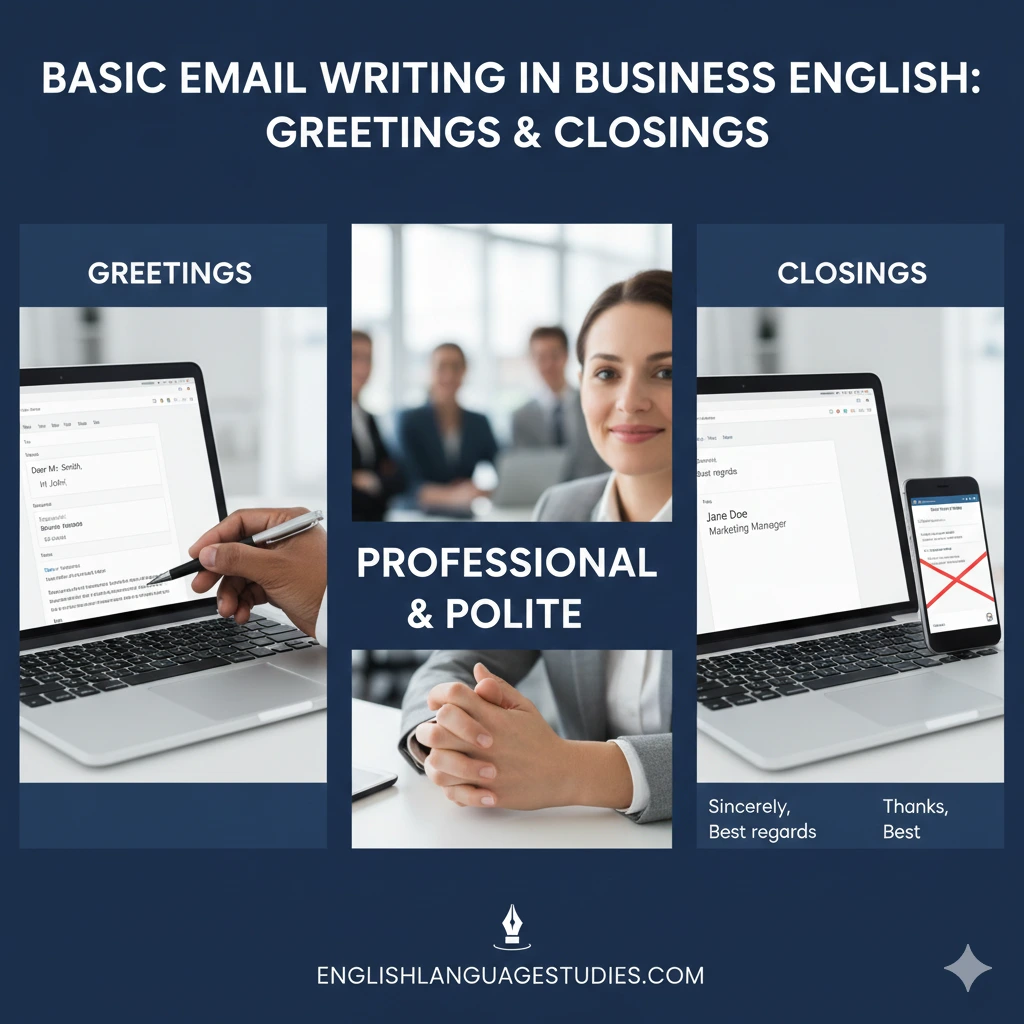
Why Email Writing Matters in Business English
A professional email can:
- Build a positive image of you and your company.
- Ensure your message is clear and polite.
- Help avoid misunderstandings.
- Strengthen business relationships across cultures.
Unlike text messages or casual chats, emails require clarity, politeness, and correct format.
1. Greetings in Business Emails
The greeting (salutation) sets the tone of your email. The choice depends on the level of formality and your relationship with the recipient.
Formal Greetings
Use when writing to clients, managers, professors, or someone you don’t know well.
- Dear Mr. Ahmed,
- Dear Ms. Khan,
- Dear Dr. Smith,
- Dear Sir/Madam, (when you don’t know the name)
- To Whom It May Concern, (very formal, often in cover letters)
Semi-Formal Greetings
Use with colleagues or business partners you know well.
- Dear John,
- Hello Sarah,
- Hi David,
Informal Greetings (Caution in Business!)
Use only if you have a very friendly relationship.
- Hi there,
- Hello everyone,
- Good morning team,
Tip: Always use the recipient’s last name + title unless you know them personally.
2. Structure of a Professional Email
A good email has a clear structure. Here’s a simple five-part formula:
Subject Line
- Short, clear, and specific.
Examples:
- “Meeting Request: Marketing Strategy Discussion”
- “Follow-up on Invoice #2024”
- “Job Application: Sales Manager Position”
Greeting
- Choose the right salutation (formal, semi-formal, informal).
Opening Line
- Show politeness before jumping into the purpose.
Examples:
- “I hope this email finds you well.”
- “Thank you for your email regarding…”
- “I am writing to request information about…”
Body Paragraphs
- Keep it short and clear (2–3 short paragraphs).
- Use bullet points for clarity.
Example:
- Purpose: “I am contacting you regarding the project deadline.”
- Details: “We would like to confirm if the report will be finalized by Friday.”
- Request: “Please let me know if an extension is possible.”
Closing Line + Formal Closing
- Thank the reader or signal next steps.
Examples:
- “I look forward to your response.”
- “Thank you for your time and assistance.”
- “Please do not hesitate to contact me if you need more details.”
3. Formal Closings in Business Emails
Closings are as important as greetings—they leave a final impression.
Common Formal Closings
- Best regards,
- Kind regards,
- Yours sincerely, (if you used the recipient’s name)
- Yours faithfully, (if you did NOT use their name, e.g., “Dear Sir/Madam”)
- Sincerely,
Semi-Formal Closings
- Regards,
- Warm regards,
- Many thanks,
Informal Closings (Use only with colleagues/friends)
- Best,
- Thanks,
- Cheers,
Rule: Match the tone of your closing with the formality of the greeting.
4. Sample Business Email (Formal)
Subject: Request for Project Update
Dear Mr. Khan,
I hope this email finds you well. I am writing to request an update on the progress of the client report scheduled for next week.
Could you kindly confirm if the draft will be ready by Thursday? If additional time is needed, please let me know so that we can inform the client accordingly.
Thank you for your support and cooperation.
Best regards,
Sarah Ahmed
Project Coordinator
5. Sample Business Email (Semi-Formal)
Subject: Team Lunch Invitation
Hi David,
Hope you’re doing well! We’re planning a team lunch this Friday at 1:00 PM at Café Roma. It would be great if you could join us.
Please let me know if you’ll be able to make it.
Kind regards,
John
6. Common Mistakes in Business Emails
- Using “Hey” or “Hi guys” in a formal email.
- Writing long, unstructured paragraphs.
- Forgetting to include a subject line.
- Overusing abbreviations like “BTW” or “ASAP” in professional contexts.
- Missing a closing or signature.
Always keep your emails clear, polite, and professional.
7. Quick Practice Exercises
Rewrite these email openings in a more professional way:
- “Hey, send me the report asap.”
- “I need info about your services.”
Fill in the blanks with the correct closing:
- Yours _______, (formal, when you don’t know the name)
- Best ______, (neutral formal closing)
Choose the best greeting for the situation:
- Writing to a client → _______
- Writing to your manager → _______
- Writing to a close colleague → _______
8. Extra Tips for Professional Email Writing
- Always proofread before sending.
- Avoid using slang or emojis.
- Keep attachments small and mention them in the email.
- Use professional fonts (e.g., Arial, Calibri).
- Reply promptly within 24 hours if possible.
FAQs
Is “Dear [Name]” too formal for modern business emails?
In 2026, “Dear” is still the safest choice for first-time contact or high-level professional correspondence (such as with clients or executives). However, for daily communication with colleagues, “Hi [Name]” or even just the name is increasingly common. If you aren’t sure, let the other person lead—if they reply with “Hi,” it is safe for you to do the same in your next email.
What is the difference between “Sincerely” and “Best regards”?
“Sincerely” is a traditional closing used for very formal letters or job applications, especially when you have addressed the person as “Dear Mr./Ms. [Surname].” “Best regards” (or simply “Regards”) is the “gold standard” for professional business emails; it is polite, neutral, and appropriate for almost any situation.
Can I use “To Whom It May Concern” if I don’t know the recipient’s name?
While it is grammatically correct, it can feel cold and outdated. In 2026, it is better to use a more specific group greeting like “Dear Hiring Team,” “Dear Admissions Committee,” or “Dear Customer Support Team.” This shows you have tailored your email to the specific department you are contacting.
Is “Sent from my iPhone” an acceptable professional closing?
While most people understand that professionals are often on the move, it is best to remove this default setting. It can look slightly unprofessional or lazy in a high-stakes business context. Instead, create a mobile signature that says: “Please excuse any brevity or typos as this was sent from a mobile device.”
When should I use “Yours faithfully” vs. “Yours sincerely”?
This is a classic British English rule. Use “Yours faithfully” if you started the email with “Dear Sir/Madam” (you don’t know their name). Use “Yours sincerely” if you started with their name (e.g., “Dear Mr. Smith”). In American Business English, this distinction is less common, and “Sincerely” is used for both.
Final Thoughts
Mastering basic email writing in Business English is an essential skill. By focusing on the right greetings, structure, and formal closings, you can write clear, professional emails that leave a strong impression.
Remember:
- Be polite and professional in every email.
- Match your greeting and closing to the level of formality.
- Keep your message clear and concise.
With practice, email writing will become second nature, helping you succeed in both workplace communication and international business.
For More Insights
Spoken English Course for Job Interviews (Complete Guide + Practice Tips)
Basic Email Writing in Business English: Greetings & Closings
10 Advanced Phrases for Executive Business Negotiations: The Master Guide to High-Stakes Fluency