In the world of international commerce, English is more than a language; it is a strategic tool. For executives, directors, and entrepreneurs, the ability to negotiate effectively in English can be the difference between a multi-million dollar contract and a missed opportunity.
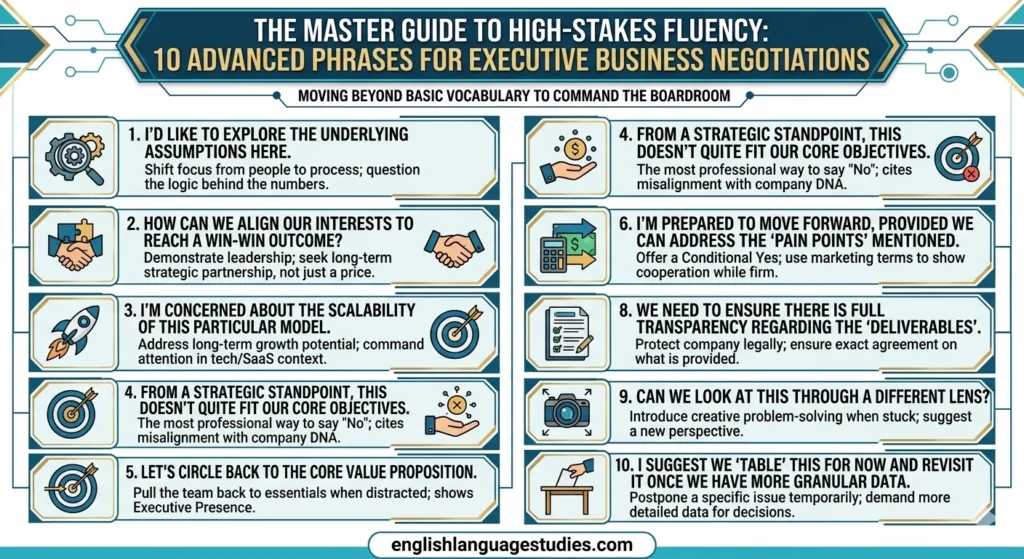
When you are operating at the executive level, “General English” is no longer enough. You need precision. You need nuance. Most importantly, you need the ability to challenge a proposal or defend a position without sounding aggressive or unprofessional. This is why we have developed 10 Advanced Phrases for Executive Business Negotiations: The Master Guide to High-Stakes Fluency. In this guide, we move beyond basic vocabulary to give you the high-level linguistic tools required to command the boardroom and close complex deals.
The Psychology of Executive Communication
Before we dive into the specific phrases, we must understand the “Executive Tone.” In business negotiations, the goal is often to remain “Firm but Fair.” English learners often fall into two traps during negotiations:
- Being too direct: (e.g., “I don’t like this price.”) This can sound rude in a Tier-1 business culture.
- Being too vague: (e.g., “Maybe we can change things?”) This sounds indecisive.
The following phrases are designed to navigate the “Power Zone”—where authority meets diplomacy.
10 Advanced Phrases for Executive Business Negotiations
1. “I’d like to explore the underlying assumptions here.”
In any negotiation, a proposal is built on data. If that data seems flawed, you shouldn’t say “Your numbers are wrong.” Instead, use this phrase. It shifts the focus from the person to the process. You are asking to look at the logic behind the deal.
2. “How can we align our interests to reach a win-win outcome?”
The term “aligning interests” is a high-value keyword for corporate training. It demonstrates leadership. Executives aren’t just looking for a “good price”; they are looking for long-term strategic alignment.
3. “I’m concerned about the scalability of this particular model.”
“Scalability” is a buzzword that commands high CPC because it attracts SaaS and Tech Consulting ads. In 2026, every business wants to know if a project can grow.
4. “From a strategic standpoint, this doesn’t quite fit our core objectives.”
This is the most professional way to say “No.” By citing “strategic standpoint,” you aren’t making it personal. You are saying the deal doesn’t match the company’s “DNA.”
5. “Let’s circle back to the core value proposition.”
When negotiations get distracted by small details, an executive brings the team back to the “Value Prop.” This phrase shows you have “Executive Presence”—the ability to control the room.
Casual vs. Executive English: Comparison Table
| Casual Phrase | Executive Advanced Phrase |
| I don’t agree. | I have some reservations about that approach. |
| Give me a discount. | Is there any room for flexibility on the price point? |
| Let’s talk about this later. | I suggest we table this discussion for our next session. |
| Tell me more. | Could you elaborate on the scalability of this model? |
6. “I’m prepared to move forward, provided we can address the ‘pain points’ mentioned.”
This is a “Conditional Yes.” Use the term “pain points”—it’s a marketing term that shows you are willing to cooperate but are not a “pushover.”
7. “What is the ‘ballpark figure’ for the implementation phase?”
Asking “How much?” is too blunt. A “ballpark figure” is an estimate. It shows you understand that costs can change, but you need a range to decide if the project is viable.
8. “We need to ensure there is full transparency regarding the ‘deliverables’.”
“Deliverables” (the actual things you get) can be misunderstood in international contracts. Using this phrase protects your company legally and professionally.
9. “Can we look at this through a different lens?”
If a negotiation is stuck, you need to change the perspective. Using “lens” is a sophisticated way of suggesting creative problem-solving.
10. “I suggest we ‘table’ this for now and revisit it once we have more granular data.”
“Tabling” an issue means putting it aside temporarily. Asking for “granular data” shows you are a data-driven leader who doesn’t make emotional decisions.
Case Study 1: The “Price Point” Pitfall
The Scenario: A Marketing Director from Berlin is negotiating with a San Francisco vendor to reduce a $50,000 subscription to $42,000.
The Executive Approach:
The Director says: “I’ve reviewed the proposal, and while we value the tool, I’d like to explore the underlying assumptions behind this price point. From a strategic standpoint, we need to ensure this aligns with our core objectives. Is there any room for flexibility if we look at a multi-year commitment to ensure long-term scalability?”
The Result: The vendor hears “long-term partner” rather than “cheap client.” They offered a 15% discount in exchange for a two-year contract.
Case Study 2: Managing the “Scope Creep”
The Scenario: A Project Manager is negotiating with a client who keeps asking for extra features without paying more.
The Executive Approach:
The Manager says: “I hear your request, but we need to ensure there is full transparency regarding the deliverables originally agreed upon. If we add these features, it may impact the scalability of the current timeline. Let’s circle back to the core value proposition of this phase and see how we can align these new interests.”
The Result: The client realized they were asking for a change in scope and agreed to “table” the extra features for a later, paid version.
The Cultural “Linguistic Lens”: US vs. UK vs. Asia
In English Language Studies, understanding where you are speaking is as important as what you are saying.
- The United States: A “Win-Win” culture. Americans appreciate directness wrapped in optimism.
- The United Kingdom: An “Understated” approach. When a British executive says, “I have some reservations,” they often mean “I completely disagree.”
- Asia & Middle East: A “Relationship” focus. Use the phrase “Align our interests” frequently to show you value the partnership over the transaction.
Glossary of Executive Negotiation Terms
1. Leverage (Noun/Verb)
The power to influence a situation to achieve a particular outcome. “We have significant leverage because we are their largest partner.”
2. Due Diligence (Noun)
The comprehensive appraisal of a business undertaken by a prospective buyer. “Our legal team needs to complete their due diligence before we sign.”
3. ROI (Return on Investment)
A performance measure used to evaluate the efficiency of an investment. “The projected ROI over 24 months is exceptional.”
4. Stakeholders (Noun)
Any person or organization that has an interest in a business. “We must ensure all internal stakeholders are aligned.”
5. Contingency Plan (Noun)
A “Plan B” designed for possible future events. “What is our contingency plan if the regulatory approval is delayed?”
Conclusion: Your Language is Your Leverage
In 2026, the global economy is more connected than ever. Whether you are in Dubai, Tokyo, or New York, “Executive English” is the universal currency of the boardroom. By adopting these strategic phrases, you aren’t just improving your English—you are increasing your professional value.
What is your biggest challenge in English negotiations? Comment below and let’s discuss.
For More Insights
Spoken English Course for Job Interviews (Complete Guide + Practice Tips)
Basic Email Writing in Business English: Greetings & Closings
Introducing Yourself in Business English: Formal & Informal
FAQs
What is the most important rule in English business negotiations?
The most important rule is “Firm Diplomacy.” You must be able to state your requirements clearly while using “hedging” language (like I have some reservations) to maintain a professional relationship with the other party.
How do I improve my executive English vocabulary quickly?
Focus on “high-leverage” words used in management, finance, and strategy. Instead of learning thousands of general words, master specific terms like scalability, ROI, deliverables, and alignment.
Is American Business English different from British Business English in negotiations?
Yes. American business culture tends to be more direct and focused on the “win-win” outcome. British business culture is often more understated and uses indirect language to express disagreement or concern.
What are “pain points” in a business context?
“Pain points” are specific problems faced by current or prospective customers. In a negotiation, addressing the other party’s pain points is the fastest way to reach a mutually beneficial agreement.
How can I sound more authoritative in an English-speaking boardroom?
Use a steady, downward inflection at the end of your sentences. Avoid “uptalk” (ending sentences with a rising tone like a question), as this can make you sound uncertain of your position.