In the modern classroom, teaching students how to decipher a text involves much more than just handing out a passage and a set of questions. While traditional methods have their place, the real magic happens when students move beyond passive reading and begin to “interact” with the story or article. To truly master comprehension, learners need to visualize, debate, and reconstruct the information they consume.
However, keeping a diverse group of students engaged with a single piece of text can be a challenge. Educators often find that the usual routine of “read and respond” can lead to waning interest and a surface-level understanding of the material. To combat this, teachers are increasingly turning to creative, kinesthetic, and collaborative activities that turn reading into an immersive experience. These methods not only improve retention but also help students build the critical thinking skills necessary for high-stakes exams and real-world literacy.
In this post, we will explore 10 Creative Reading Comprehension Activities for the Classroom that are designed to spark curiosity and deepen understanding. Whether you are looking to shake up your morning literacy block or find a new way to prepare for standardized testing, these strategies will help your students bridge the gap between simply seeing words and truly grasping their meaning.
Here are 10 Creative Reading Comprehension Activities designed to move beyond the standard worksheet and get your students truly excited about analyzing text:
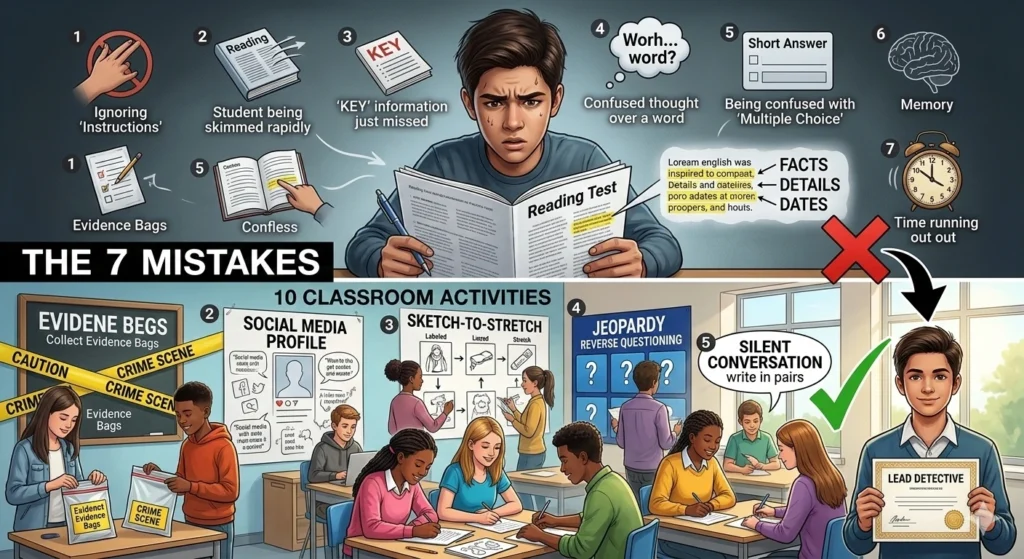
1. The “Crime Scene” Investigation
Turn a complex text into a “case file.” Students act as detectives, using highlighters to find “evidence” (quotes) that proves a specific “theory” (the author’s thesis or a character’s motive). They can even create a “suspect board” connecting different pieces of textual evidence with string.
2. Character Social Media Profiles
Have students create a mock Instagram feed or LinkedIn profile for a character or historical figure from the text. They must choose profile pictures, write a bio, and create posts that reflect the character’s personality, goals, and recent “status updates” based on plot events.
3. “Sketch-to-Stretch”
After reading a descriptive passage, students draw what they visualized. The catch? They must label their drawing with specific phrases from the text that informed their artistic choices. This bridges the gap between literal reading and mental imagery.
4. Reverse Questioning (Jeopardy Style)
Instead of giving students questions, give them the answers found in the text. Their task is to write the most complex question possible that leads to that specific answer. This forces them to think about how information is structured.
5. The “Silent Conversation”
Tape large pieces of paper with different quotes from the text around the room. Students walk around in total silence, writing their interpretations, questions, or connections directly on the paper. They can also “reply” to what another student wrote, creating a written dialogue.
6. Storyboard Comic Strips
Ask students to condense a long chapter or article into an 8-frame comic strip. To do this successfully, they must identify the most critical plot points or arguments, helping them practice the art of summarizing and identifying main ideas.
7. Podcast Interviews
Pair students up: one plays a “journalist” and the other plays a “character” or “expert” from the text. They record a 3-minute podcast interview. The journalist must ask “Why” and “How” questions that require the interviewee to cite information from the reading.
8. Text-to-Movie Casting Director
Students act as casting directors for a movie version of the text. They must choose famous actors for the roles and—most importantly—write a “casting report” justifying their choices using specific physical descriptions or personality traits mentioned in the text.
9. The “Word Wall” Graveyard
Identify “dead” or overused words in a passage (like said, happy, or went). Students must hunt for more descriptive synonyms within the text or use context clues to propose “vibrant” replacements that maintain the author’s original meaning.
10. Fortune Teller Predictions
At a climactic point in the reading, stop the class. Have students fold “paper fortune tellers” (cootie catchers). Inside, they write four different “future paths” the story could take, citing one piece of foreshadowing from the text for each prediction.
The Textual Detective: Evidence Rubric
Objective: To evaluate how well a student “investigates” a text to find proof for their claims.
| Skill Category | Rookie (1 pt) | Investigator (3 pts) | Lead Detective (5 pts) |
| Evidence Collection | Found 1 or 0 pieces of evidence. The “clues” don’t match the case. | Found 2-3 pieces of evidence. Most clues directly support the claim. | Found 4+ high-quality clues. Evidence is pinpoint accurate and undeniable. |
| Case Analysis | Only stated what happened. No “detective work” or deeper meaning. | Explained how the evidence proves the point. Making solid connections. | Expertly “connected the dots.” Showed how subtle clues reveal a bigger picture. |
| Source Integrity | Clues are misquoted or “tampered with” (out of context). | Clues are cited correctly from the text with page/line numbers. | Perfect citations. Used specific “exhibit” labels to organize findings. |
| The Verdict | The final conclusion is weak or unrelated to the evidence found. | The conclusion is logical and based on the clues provided. | The conclusion is a “slam dunk”—persuasive and fully backed by the file. |
CASE FILE: [Insert Book or Article Title]
This “Top Secret” Case File is designed to be printed as a single-page handout. It transforms a standard reading comprehension worksheet into an immersive role-playing experience.
OFFICIAL INVESTIGATION REPORT ASSIGNED DETECTIVE: ___________________________
DATE OF INVESTIGATION: ________________________
🕵️♂️ THE INVESTIGATION SUMMARY
Briefly describe the “incident” or the main topic you are investigating.
REPORT: ___________________________________________________________
🔍 EXHIBIT A: THE “SMOKING GUN” EVIDENCE
Find the most important quote from the text that proves your theory.
DIRECT QUOTE: “____________________________________________________” LOCATION (Page/Line): ___________ WHY THIS IS CRITICAL: This clue proves that ___________________________
👣 EXHIBIT B: CHARACTER/SUBJECT MOTIVES
Why did the person in the text act this way? List two clues found in their behavior.
- CLUE #1: ________________________________________________________
- CLUE #2: ________________________________________________________
📋 THE “WITNESS” STATEMENTS (Context Clues)
Identify an unfamiliar word or phrase (The “Witness”). Use the surrounding text to translate their “testimony.”
- THE UNKNOWN WORD: ____________________
- SURROUNDING CLUES: ______________________________________________
- THE TRANSLATED MEANING: __________________________________________
⚖️ FINAL VERDICT
Based on all the evidence collected above, what is your final conclusion?
[ ] CASE CLOSED: The evidence is undeniable. My conclusion is: __________
[ ] NEED MORE INTEL: The text leaves this mystery open because: __________
🛑 OFFICIAL SEAL (Teacher’s Use Only)
- [ ] LEAD DETECTIVE (Exceeded Expectations)
- [ ] FIELD AGENT (Met Expectations)
- [ ] IN TRAINING (Needs Revision)
LETTER OF COMMENDATION 📜
Department of Academic Investigations
THIS CERTIFIES THAT
________________________________________________
(Name of Student)
HAS OFFICIALLY ATTAINED THE RANK OF
⭐ LEAD DETECTIVE ⭐
In recognition of their exceptional performance in the case of [Insert Book/Text Title]. This student has demonstrated superior skills in evidence collection, textual analysis, and the uncovering of hidden truths within the written word.
By order of the High Council of Literacy, they are hereby authorized to investigate any complex text, decipher difficult vocabulary, and challenge weak arguments wherever they may be found.
DATED THIS DAY: ____________________ SIGNED: __________________________________ (Chief Investigator / Teacher)
Conclusion: Turning Readers into Researchers
At the end of the day, the goal of these activities isn’t just to make the classroom “fun”—it’s to shift the student’s mindset from a passive observer to an active participant. When students view a text as a puzzle to be solved or a crime scene to be investigated, the “Top 7 Mistakes” we discussed earlier—like skimming or relying on memory—naturally begin to fade. They stop reading because they have to and start reading because they are looking for something specific. By integrating these creative strategies, you aren’t just helping them pass a test; you are giving them the tools to navigate a world full of complex information with a critical and discerning eye.
Happy investigating!
More Insights
Best AI Applications to Practice English Speaking (Updated Guide) | Top Apps for Fluency
10 AI-Powered Tools That Can Transform English Language Learning in 2025
10 Easy and Practical Ways to Learn English as a Second Language | ESL Tips